If you want one name for who discovered the structure of the atom, history will not give you one. The answer is a relay of five people across about 130 years: John Dalton, J. J. Thomson, Ernest Rutherford, Niels Bohr and James Chadwick, with lab workers such as Hans Geiger and Ernest Marsden doing key measurements along the way. Each person found one piece, and each piece broke the model that came before it.
Who discovered the structure of the atom, in short
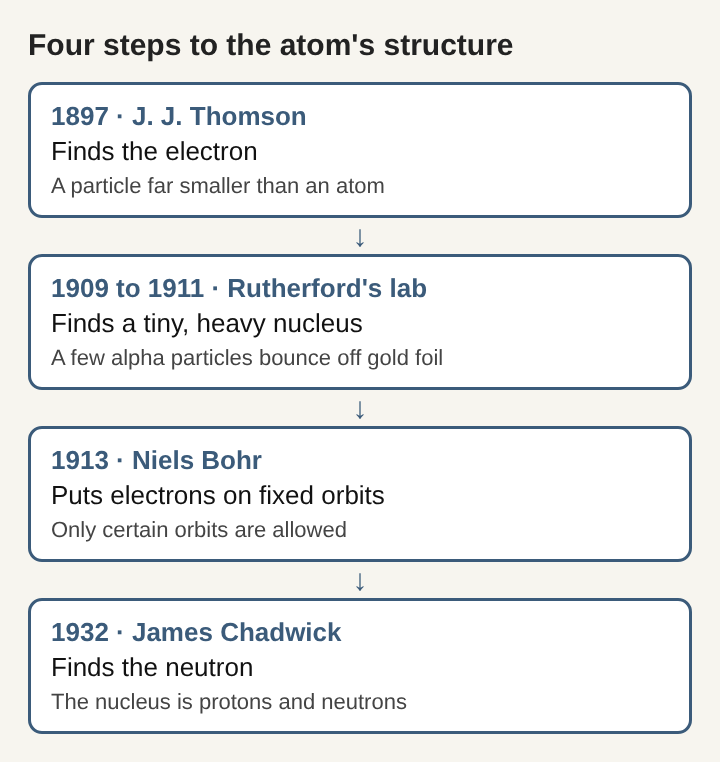
The short version runs in five steps. Dalton gave chemistry atoms with weights in 1803. Thomson identified the electron in 1897. Rutherford's lab located the nucleus between 1909 and 1911. Bohr put the electrons on fixed orbits in 1913. Chadwick identified the neutron in 1932, which completed the basic picture of protons and neutrons in a nucleus with electrons around it.
According to the Wikipedia article on the atom, an atom is a nucleus of protons and usually neutrons, surrounded by electrons, and the number of protons decides which element it is. The modern physics side of this story sits in the course Fields, Relativity and the Atom on Learn 100 Influential People, next to relativity and the physics of fields.
Dalton's atoms had weight but no parts
Dalton built on older ideas that matter cannot be divided forever, but the measured, chemical version of the atom starts with him. The Wikipedia article on John Dalton says he developed his chemical atomic theory in 1803. His claims were simple: each element is made of identical atoms with a characteristic weight, and compounds form when atoms of different elements combine in fixed whole-number proportions.
His book A New System of Chemical Philosophy, published in 1808, gave relative atomic weights for the elements and a set of symbols for them. That made chemistry something you could count. What Dalton did not offer was any inside to the atom. For him, an atom was the smallest unit, with nothing smaller inside it.
Thomson and the first piece inside the atom
The first crack came in 1897. The Wikipedia article on J. J. Thomson says he showed that cathode rays were made of previously unknown particles with a negative charge, with bodies much smaller than atoms. He won the Nobel Prize in Physics in 1906.
Thomson called these particles corpuscles. Most people used the name electron instead, a word G. J. Stoney had already coined. Once atoms had smaller parts with a negative charge, a new question followed: atoms are neutral overall, so where is the positive charge?
Thomson's answer, in his 1904 paper On the Structure of the Atom, became known as the plum pudding model. The Wikipedia article on the plum pudding model describes it as positive charge spread through the whole atom, with electrons set inside it. It explained the two facts known at the time: atoms contain electrons, and atoms are neutral.
Gold foil and the discovery of the nucleus
The plum pudding model made a clear prediction. If positive charge is spread thinly across the atom, fast alpha particles fired at a thin sheet of metal should pass straight through with only small nudges.
That is not what happened. According to the Wikipedia article on the Rutherford model, Hans Geiger and Ernest Marsden, working in Rutherford's lab in 1908 and 1910, showed that alpha particles could occasionally bounce back from gold foil. Most of the beam went through, but a few were thrown off course.
In a paper of May 1911, Rutherford gave his reading of the result: a high charge concentrated in a very small central volume that holds most of the atom's mass. That centre later got the name nucleus. The same article notes that Rutherford did not say how the electrons were arranged around it. His paper settled the centre and left the outside open.
Bohr's orbits and why they were needed
A tiny nucleus with electrons around it raised a problem from older physics. The Wikipedia article on the Bohr model explains that, under classical electrodynamics, an accelerating charge gives off energy, so an electron kept in orbit should be unstable.
Niels Bohr had come to work in Rutherford's lab, and in 1913 he proposed a fix. Electrons could only move on certain fixed orbits, called stationary orbits, and could not sit anywhere between them. That rule was a clear break from classical physics.
Bohr kept working on the model. In 1922 he added the idea that certain numbers of electrons, such as 2, 8 and 18, form stable closed shells. In 1925 a new kind of mechanics, quantum mechanics, extended his quantized orbits into a more accurate model of electron motion.
Chadwick and the missing neutral particle
By 1920 the nucleus still did not add up. The Wikipedia article on the discovery of the neutron says that by then isotopes were known, atomic masses were close to whole multiples of the mass of hydrogen, and the atomic number was understood as the charge on the nucleus. Through the 1920s, physicists pictured the nucleus as a mix of protons and electrons, and that picture kept running into contradictions.
The fix came in 1932. James Chadwick, working at the Cavendish Laboratory, identified the neutron, a particle with no charge that is distinct from the proton. Irène Joliot-Curie and Frédéric Joliot had made measurements in Paris that same year that led toward it without knowing what they had seen. After Chadwick's result, physicists quickly accepted that the nucleus is made of protons and neutrons.
A worked example: one sodium atom through five models
You can follow the whole story by tracing one atom through each model. Take sodium, which the atom article uses as its example: any atom with 11 protons is sodium.
- Dalton, 1803. A sodium atom is a single solid unit with its own weight, the same for every sodium atom. Nothing is inside it.
- Thomson, 1904. The sodium atom now holds electrons, set inside a spread of positive charge that balances them.
- Rutherford, 1911. Almost all of the sodium atom's mass and its positive charge sit in a tiny centre. The electrons are somewhere outside it, arrangement unknown.
- Bohr, 1913 and 1922. The 11 electrons sit on allowed orbits. With his closed shells of 2 and 8, that leaves 1 electron on its own in the outer shell.
- Chadwick, 1932. The nucleus holds 11 protons plus neutrons. A sodium atom with a different number of neutrons is still sodium, just a different isotope.
Notice what changes at each step. The element never changes, because the proton count fixes it. What changes is how much of the inside you can describe, and each step answers a question the step before it could not.
Frequently asked questions
Who first discovered that atoms have smaller parts?
J. J. Thomson, in 1897. According to the Wikipedia article on Thomson, he showed that cathode rays were made of negatively charged particles much smaller than atoms, which are now called electrons.
What did the gold foil experiment show?
Most alpha particles went through the gold foil, but a few bounced back sharply. Rutherford read this in 1911 as proof that the atom's positive charge and most of its mass sit in a tiny central nucleus.
Why was Bohr's model replaced?
In 1925 quantum mechanics was proposed. It took Bohr's quantized orbits and extended them into a more accurate account of how electrons move.
When was the structure of the atom fully worked out?
The basic picture was complete in 1932, when James Chadwick identified the neutron. From then on the nucleus was understood as protons and neutrons, with electrons around it.
Why the structure of the atom needed many discoverers
The structure of the atom was never one discovery, because no single experiment could see all of it. Dalton's weights could not reveal parts. Thomson's electrons could not show where the positive charge was. Rutherford's foil found the centre but said nothing about the electrons. Bohr's orbits explained the electrons but not why the nucleus weighed more than its charge suggested. Each person stood on a question left by the last one, and the full answer only appeared when Chadwick's neutron closed the final gap in 1932.
Learn 100 Influential People
100 people who shaped history, from Moses to the web. Visit influentialpeople.vlvd.net