Negative visualization is the Stoic habit of picturing, on purpose and for a short time, something you value going wrong. If you have searched for what is negative visualization, the short answer is that it is a rehearsal: you meet a loss in your mind first, so that the real one finds you calmer, and so that you notice what you still have today. It sounds gloomy. In practice it tends to end in two plain things, a small action and a moment of thanks.
The exercise sits close to the daily practice that How to Find Your Meaning builds around Epictetus, Marcus Aurelius and Seneca, with a morning question, one thing to try during the day and Seneca's three questions in the evening. A few minutes of picturing what could go wrong fits easily into either end of that day.
What is negative visualization, and where does it come from?
The Latin name given to it is futurorum malorum praemeditatio, which means, word for word, studying future bad things in advance. According to Wikipedia's page on negative visualization, the method began with the Cyrenaic philosophers, was later taken up by the Stoics, and became widely known through Seneca's letters to his friend Lucilius, the Epistulae Morales ad Lucilium. It is thought to have been one of the common Stoic spiritual exercises, the regular mental training the school expected of its students.
One detail is worth knowing before you read more about it. The English phrase "negative visualization" and the short Latin tag "premeditatio malorum" are recent. The same page says English-speaking Stoics coined them in the 21st century, inspired by translations of Seneca, often without saying where in the ancient texts the idea appears. The practice is old; the label is new.
Picturing a loss is not the same as worrying
The obvious objection is that picturing losses on purpose could train you to be anxious. The difference lies in three things: the exercise is chosen, it is short, and it has an end.
Worry arrives uninvited and loops. It replays the same bad outcome without asking what you could do about it, and it rarely stops by itself. Negative visualization is a session you start at a time you pick, with a scene you pick, and you close it on purpose. Its aim, as the Wikipedia page puts it, is to prepare you for real losses and to bring gratitude for what you actually have. Worry has no such aim.
It also differs from the positive visualization of self-help books, where you dwell on a goal already won so as to feel the reward early. The Stoic version pictures the realistic setback instead. That links it to the Stoic split between what is up to you and what is not: once a loss is in front of you, the useful question is which part of it was ever up to you.
How strong should the picture be?
The exercise comes in different strengths. At the mild end you imagine giving up a small pleasure, such as your morning coffee or a quiet train seat. At the strong end you imagine your worst fear having already happened: the loss of money, standing or a life. The same page describes this whole range.
For a beginner, the mild end is the place to start. Picture losing something small and replaceable, notice your reaction, and see how much of the upset rests on a judgment about the thing rather than the thing itself. The stronger forms are for when the habit is steady. A picture so strong that it leaves you shaken for the rest of the day has gone past training into distress, and that is a signal to step back to a lighter scene.
A worked example: one evening, one laptop
Here is one session from start to finish. It takes about five minutes.
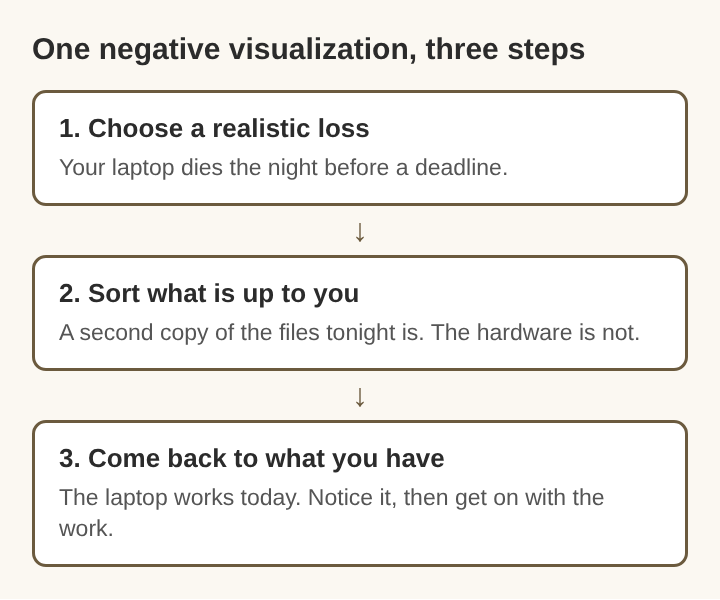
- Choose a realistic loss. You have a report due tomorrow morning. Imagine your laptop refusing to turn on tonight. Make it concrete: the black screen, the clock, the files you have not saved anywhere else. Stay with it for a minute and notice the jolt.
- Sort what is up to you. The hardware failing is not up to you. Whether a copy of the report sits somewhere else tonight is. So is knowing which friend or library has a computer you could use. Write down the one step you can take now.
- Come back to what you have. Open your eyes. The laptop works. The report is there. Take a moment to notice that, then copy the file to a second place and get on with the work.
Two results come out of that session. One is practical: the second copy. The other is quieter: a laptop that was invisible ten minutes ago now registers as something you are lucky to have. Both are what the exercise is for.
How Seneca and Marcus Aurelius used the practice
The best-known ancient source is Seneca's letters, the work that made the practice widely known. Marcus Aurelius used a morning form. In Meditations Book II.1, as the same page sets out, he tells himself at the start of the day that he will meet meddling, ungrateful and envious people. He then reminds himself that they act from not knowing what is truly good and bad, and that none of them can harm his own character. The scene is not a disaster. It is an ordinary difficult day, faced before it starts, which links naturally to what Seneca taught about anger: expecting people to err takes away much of the surprise that feeds a temper.
The Stoics also treated the thought of death as one form of the same exercise. Seneca's letters advise reflecting on death, and Epictetus, in the Discourses his students recorded, advised them to remind themselves that things and people do not last. That is the root of memento mori, the reminder of mortality, which is negative visualization at its strongest setting.
Modern Stoics usually advise doing the exercise daily at a set time, early in the morning or late at night. A morning session prepares you for the day ahead, while an evening one fits beside a look back at the day that has just passed.
What psychology says about planning for setbacks
A related idea exists in psychology under another name. Defensive pessimism, identified by Nancy Cantor and her students in the mid-1980s, describes people who set low expectations before a stressful event and then think through specific things that could go wrong, so as to prepare for them. Wikipedia's example is a nervous speaker who imagines forgetting the words or getting thirsty, and so brings note cards and a glass of water.
The shape is close to the Stoic one: picture the setback, then act on the part you control. Some modern Stoics also say that cognitive behavioral therapy took up negative visualization. The negative visualization page notes that some licensed psychologists support that claim, but that the idea has mostly been taken up by popular psychology writers. It is fair to treat the link to therapy as plausible but loose, not as a settled clinical finding.
Frequently asked questions
Is negative visualization the same as premeditatio malorum?
They name the same practice, as Wikipedia's page on it explains. The fuller Latin phrase is futurorum malorum praemeditatio; the shorter tag and the English name were both coined by modern writers.
How often should you practice negative visualization?
Modern Stoics usually suggest once a day at a fixed time, in the morning or at night. A few minutes is enough, and a light scene done often is more useful than a heavy one done rarely.
Can negative visualization make anxiety worse?
It can if it turns into an open loop of worry. Keep each session short, chosen and closed with an action or a moment of thanks, and step back to a milder scene if a picture leaves you shaken.
Is memento mori a kind of negative visualization?
Yes. The Stoics treated reflecting on death as one form of the exercise, its strongest setting, since it rehearses a loss nobody avoids.
Why negative visualization ends in gratitude
The odd thing about negative visualization is where it leaves you. You start by picturing something taken away and you finish by noticing that it is still here. The rehearsal does not make loss painless, and the Stoics never claimed it would. What it does is move the first shock to a quiet moment you chose, sort the part you can act on from the part you cannot, and turn ordinary things, a working laptop, a friend who answers, a normal morning, back into things you can see. Done for a few minutes a day, the exercise is less about the future going wrong than about the present being noticed while it lasts.
How to Find Your Meaning
Find what your life is for. Visit findyourmeaning.vlvd.net