Seneca's three questions for the end of the day are a short check on your own conduct, made once the day is over. The Roman Stoic philosopher Seneca tells his readers in On Anger that he examines himself every evening, and he credits the habit to an earlier teacher. The method is small, but it makes you look at what you did instead of what you meant to do. How to Find Your Meaning teaches Stoic philosophy, healthy habits and the story of who you are in short lessons, and the evening step of its daily practice is these same questions.
Where the questions come from
The practice is older than Seneca. In the third book of On Anger, which you can read in the Project Gutenberg edition of Seneca's Minor Dialogues, he says it was the custom of Sextius to question his own spirit when the day was over and he had gone to rest. Quintus Sextius was a Roman philosopher who mixed Pythagorean and Stoic ideas, and Seneca praised him often.
Seneca then describes doing the same thing himself. When the lamp has been taken out of the room and his wife has gone quiet, he goes back over the whole day, every word and every act. The Stanford Encyclopedia of Philosophy calls it a famous passage and places it in section 36 of book III.
So Seneca did not invent the questions. He passed them on and explained why they work.
Seneca's three questions for the end of the day
A line quoted from memory is easily wrong, so here the questions are in plain words, as a paraphrase of what Sextius asked:
- What bad habit did you cure today? Which fault did you work on, and did anything shift?
- What vice did you check? Where did a pull toward a bad reaction show up, and did you hold it back?
- In what way are you better? Looking at the whole day, where did you improve, even slightly?
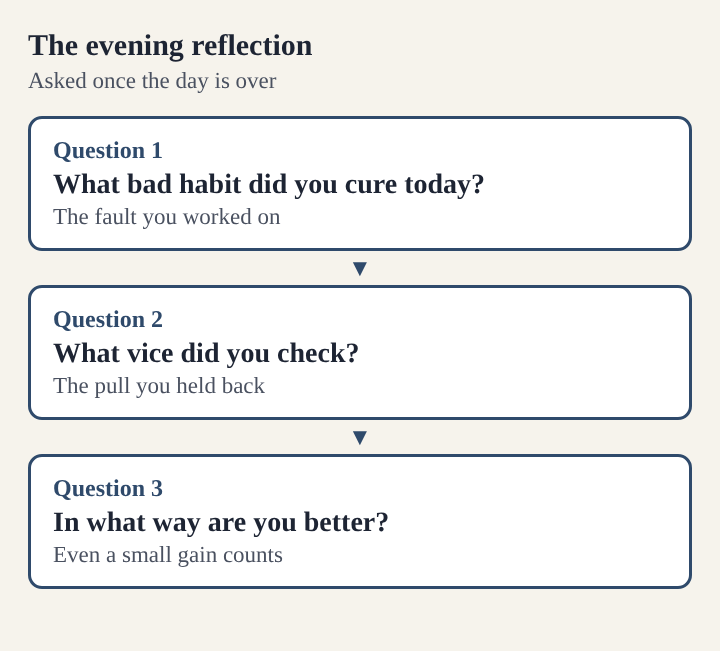
Notice what is missing. None of the questions asks whether you were productive, liked or successful. They ask about character: your faults, your resistance and your growth. That is the Stoic frame. Most outside events are not up to you, but your response to them is. The Stoics also name the qualities a good character is made of: prudence, justice, courage and moderation. The questions are a daily way to see how close you came.
Why Seneca keeps the practice honest and kind
Seneca says he hides nothing from himself and omits nothing. He adds that there is no reason to fear any of his faults when he can say to himself that he pardons this one, and that he must not do it again. He then gives himself a plain reminder of the mistake, such as arguing too sharply with a person who will not listen.
This shows the tone of the practice. It is honest, because you look at the real event. It is not a punishment, because the aim is to do better tomorrow. He also claims a practical result: anger grows gentler when it knows it must appear before a judge every day, and the sleep that follows it is calm.
A worked example, from meeting to answer
Suppose you ran a meeting today. A colleague interrupted you three times, and the third time you answered sharply. Nobody commented, but you noticed it.
Question one: what bad habit did you cure?
Name the fault exactly. "I was impatient" is vague. "I cut people off when I think I already know what they will say" is something you can watch for. Then ask whether you made any progress. Often the honest answer is that the habit ran as usual, and writing that down is still useful.
Question two: what vice did you check?
Look for the moment of choice. You felt irritation rise at the second interruption and held it back. At the third you did not. That is a real answer: you checked it once and failed once, and you now know where your limit sits.
Question three: in what way are you better?
This question asks for progress, so look for it. Perhaps you noticed the irritation sooner than last week. Perhaps you apologised after the meeting. A small gain counts, and so does the simple fact that you noticed.
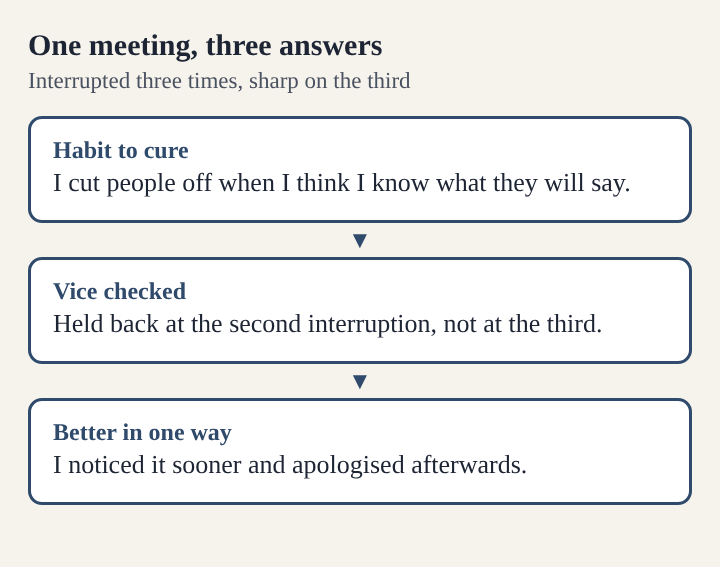
One to three sentences per question is plenty. The whole reflection should take a few minutes, not an hour.
Why the evening suits this kind of reflection
Character is hard to judge in the abstract. At the end of a day you have real material: a conversation, a decision, a moment of impatience. The day is also over, so you cannot fix it, and that makes it easier to look at without defending yourself. Nothing is at stake except what you learn.
The evening works best as the second half of a pair. In the morning you set up the day, and in the evening you check how it went. The daily practice in How to Find Your Meaning follows that shape: a morning question with one of the four Stoic virtues, a passage from Epictetus, Marcus Aurelius or Seneca with one thing to try that day, and then the evening reflection. What you tried in the morning becomes the material for the evening.
Turning the questions into a habit that lasts
A habit lasts when it is easy to repeat. A few choices help:
- Pick one fixed moment. Choose something that already happens every evening, such as putting your phone down or brushing your teeth, and do the questions right after it.
- Keep it short. A reflection you can finish in a few minutes is one you will still do on a tired night.
- Write something. A line or two on paper makes the answers harder to skip and lets you read them back later.
- Do it on bad days too. The days you want to skip often have the most to examine.
Over weeks, your notes show patterns: the same fault returning, the same situation that strains your patience, the same small improvement you keep making. Those patterns are a record of your character, and a record is more reliable than a guess when you face a larger decision.
Common mistakes in the evening reflection
- Turning it into a trial. If every evening ends in self-criticism, you will stop. Seneca's account is an honest look followed by a pardon, so aim for that.
- Listing only wins. A reflection that finds no faults is not an honest one. Look at what actually happened.
- Staying vague. "I could be better" gives you nothing to work on. Name the moment and the behaviour.
- Judging the outcome instead of the conduct. A meeting can go badly through no fault of yours. The questions are about how you acted, not how things turned out.
- Making it too long. If it takes thirty minutes, you will skip it. Cut it down until it fits.
- Quitting after a missed night. One missed evening is just a missed evening. Pick it up the next day.
How the questions connect to finding meaning
Meaning rarely arrives as one large insight. It builds from many ordinary days in which you acted in a way you can stand behind. The three questions give those days a shape, and they keep asking whether your actions matched what you say you care about.
That is why a small evening habit can matter more than a big resolution. You are no longer guessing at your character. You are reading a record of how you lived, and each evening gives you one more line in it.
Frequently asked questions
Did Seneca invent the evening reflection?
No. In On Anger he says it was the custom of Sextius, a Roman philosopher he admired. Seneca's contribution was to describe it clearly and to say why it helps.
How long should the three questions take each night?
A few minutes is enough. One to three sentences per question gives a real answer without turning the practice into a chore.
What if the honest answer to a question is nothing?
Write "nothing today" and move on. Some days no habit shifted and no vice needed checking, and an honest blank is more useful than an invented answer. Over time the blanks and the entries together show your real pattern.
Should the answers be written or only thought through?
Either works, but writing leaves a record you can read back later. That record shows which faults repeat and which have faded.