What is the dichotomy of control? It is the Stoic habit of sorting every worry into two groups: what is up to you and what is not. It comes from the teaching of Epictetus, which the Stanford Encyclopedia of Philosophy entry on Epictetus describes. You put your effort into the first group and stop spending energy on the second.
How to Find Your Meaning offers short lessons on Stoic philosophy, healthy habits and the story of who you are, with a daily Stoic practice to live what you learn.
What is the dichotomy of control?
A dichotomy is a split into two parts. Here the split is between things you control and things you do not. The Stoics did not mean control in the sense of getting what you want. They meant what is truly yours to decide, whatever happens around you.
Take a job interview. You cannot decide whether you get the offer. You can decide how well you prepare, how honestly you answer and how you treat the person across the table. The first group holds the outcome. The second holds your conduct. The dichotomy says to judge yourself by the second group and to hold the first one loosely.
Where the dichotomy of control comes from in Stoic philosophy
The idea comes from Epictetus, a Stoic teacher who spent part of his life as the slave of an administrator in Nero's court. His talks survive in the Discourses, which the essayist Arrian is said to have written down, and in the Encheiridion, a brief abridgment of them. The Stanford Encyclopedia of Philosophy entry on Epictetus gives the background on his life and teaching. It uses the words volition for what is in a person's power and externals for what is not.
Seneca, Epictetus and Marcus Aurelius are the Roman Stoics whose writings survive in full, and Epictetus was a strong influence on Marcus Aurelius, who was emperor from 161 to 180. The Stanford entry on Stoicism shows where the distinction sits in the school's wider view: only virtue is good.
What is up to you and what is not
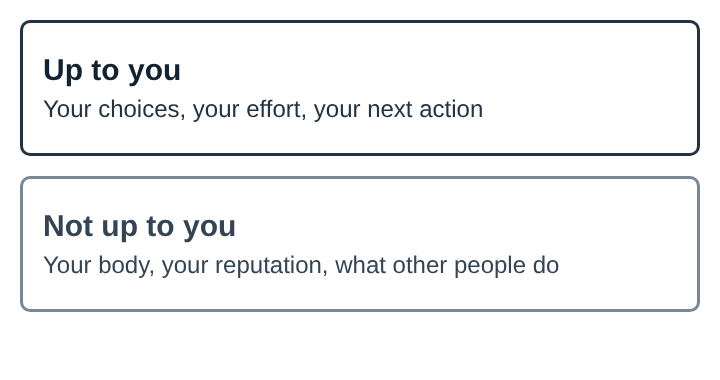
The Stanford entry puts in the first group a person's capacity to choose, which shapes convictions, attitudes, intentions and actions. In the second group it puts the body, possessions, relationships, success or failure in projects, and power or reputation, along with the choices of other people.
Some of that feels wrong at first. Your body is not fully yours to command? Your reputation is not yours? The point is that other people form their opinions of you, and you cannot always decide what happens to your body. You influence these things. You do not decide them.
A quick way to apply it is to ask one question about any worry: Could another person or an unlucky event change this, whatever you do? If yes, the outcome sits in the second group. What remains in the first group is your next action and your attitude toward it.
- Up to you: the effort you put in, the words you choose, whether you keep a promise, how you interpret an insult.
- Not up to you: whether someone likes you, the weather on the day of your trip, the result of a medical scan, the decisions of your employer.
The gray area: things only partly in your control
Most real situations sit between the two groups. Your health is the usual example. You decide what you eat, whether you move and when you sleep. You do not decide your genes, an infection or an accident.
The Stoics handled this with the idea of preferred indifferents. The Stanford entry on Stoicism says health, wealth and reputation are of a preferred type: the virtuous person usually pursues them over their opposites, yet having or lacking them does not decide whether life goes well. In practice it means you pursue a goal and accept the result without making your peace depend on it.
Epictetus also advised pursuing goals with reservation: you intend to do something, and you know it may not happen. A person who plans a long run on Saturday acts as if it will happen, and does not fall apart if rain or a sore knee gets in the way.
A useful way to handle a mixed case is to split it. Take a goal such as getting stronger over a year. The result (a certain weight on a bar or a certain number on a scale) is partly outside your control. The actions (turning up three times a week, going to bed on time) are inside it. Set your target on the actions.
How the dichotomy of control supports healthy habits
Habits are the clearest place to see the dichotomy working, because a habit is an action and an action is up to you.
People often drop a habit because the result did not show up fast enough. If you judge a walking routine by how much you lose in a month, you hand your motivation to something partly outside your control. If you judge it by whether you walked today, you can succeed every day, and the result can follow in its own time.
This also changes how you deal with a missed day. A slip is in the past, so it is outside your control. What you do next is inside it. The Stoic reply to a missed workout is to ask what the next action is and do it, without a long argument with yourself about the miss.
- Name the habit as an action you can do today.
- Separate it from the outcome you hope for.
- Check yourself against the action only.
- When you fail, name the next action and do it.
Using the dichotomy of control to find meaning in your own life
Meaning is easier to find when you stop waiting for outside events to supply it. If your sense of purpose depends on a promotion, a relationship or other people's approval, it can be taken away. If it rests on the kind of person you are choosing to be, it is yours in a way those things are not.
The Stoics held that only virtue is good, and they taught four virtues. Virtue lies in conduct, so it sits in the first group. You can ask on any day how you acted. That is a question about your own conduct, and you can answer it.
The daily practice in How to Find Your Meaning has three steps, about ten minutes in all. The morning gives a question for the day ahead and one of the four Stoic virtues to practise. During the day comes a short passage from Epictetus, Marcus Aurelius or Seneca with one thing to try. The evening closes with the three questions Seneca credits to Sextius. You can use the sorting on the day's one thing to try by asking which part of it is yours to do. You can read more about that evening habit in Seneca's three questions for the end of the day.
The Stoic reminder that life ends pairs with the sorting: if your days are limited, you choose what to spend them on. The article on the Stoic reminder that life ends goes into that side of the practice.
Common mistakes when applying the dichotomy of control
Treating it as a reason not to care
Letting go of outcomes does not mean you stop caring about them. A Stoic still prepares for the interview, still looks after a sick relative and still votes. You care about the effort and accept the result. Indifference to outcomes is not indifference to people.
Putting feelings in the wrong group
Epictetus placed volition, the way a person uses impressions to form convictions and act, in the first group. So the work is on the judgment you form about what happens, and on what you do next. A flash of feeling is not a failure. Deciding that someone meant to insult you, and acting on that, is a choice.
Sorting once and never again
A situation can change groups. A project is partly outside your control until you take on a task, and then that task belongs to you. Do the sorting each time something worries you, not once as a general exercise.
Using it to excuse passivity
Saying "that's out of my control" is sometimes true and sometimes a way to avoid effort. Before you use it, check whether there is a smaller piece you can act on. There usually is.
Frequently asked questions
What is the dichotomy of control in one sentence?
It is the Stoic practice of separating what is up to you, such as your judgments and actions, from what is not, such as other people's opinions and outside events, and directing your effort to the first group.
Who first taught the dichotomy of control?
It comes from the teaching of Epictetus, as the Stanford Encyclopedia of Philosophy entry on Epictetus describes it. Seneca and Marcus Aurelius are two other Roman Stoics whose writings survive.
Is your health in your control?
Only partly. Your habits are up to you, while illness and accidents are not. The Stoic approach is to work on the habits fully and accept the results calmly.
Does the dichotomy of control mean ignoring your emotions?
No. The practice is to look at the judgments you form about what happens and decide how to act, not to ignore what you feel.
How can a person start using the dichotomy of control day to day?
When something worries you, ask whether another person or chance could change it whatever you do. Then name one action that is yours and do it.