Expressive writing is a method of writing about your deepest thoughts and feelings on one issue, without editing, for about fifteen minutes a day over several days. If you have wondered what is expressive writing and how it differs from an ordinary diary, the difference is the instructions: one issue, no polish, a fixed time and a few days in a row.
The method is a research tool as much as a habit. The research is worth knowing, because it also shows where the claims run past the evidence. A site such as EnrichAI, which asks five questions a day about your own life, is built on a different idea, and that comes up further down.
What is expressive writing and where it began
Expressive writing is a form of writing therapy developed mainly by the psychologist James W. Pennebaker in the late 1980s. The Wikipedia page on expressive writing describes his first study and the work that followed it. Writing therapy as a whole is the wider family: it uses the act of writing, and the processing of what was written, in clinical settings for healing and personal growth, and the page on writing therapy covers its other forms.
Expressive writing is the narrow, self-guided version. It needs no therapist in the room. It needs a pen or a keyboard, a quiet place and the willingness to put an uncomfortable subject into words.
The original method, step by step
In the first study, people in the experimental group were asked to write about a past trauma and to put their very deepest thoughts and feelings about it on the page. The control group wrote as objectively and factually as they could about neutral subjects, such as a particular room or their plans for the day. Both groups wrote continuously for 15 minutes a day for 4 days in a row.
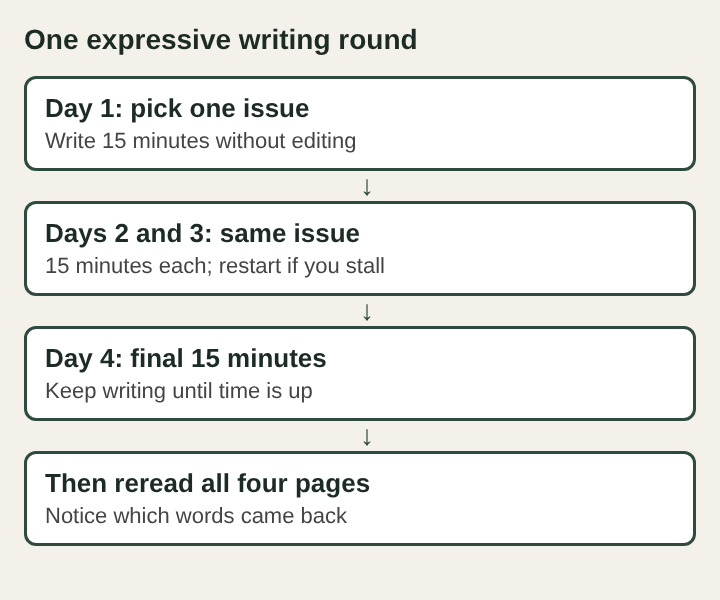
The instructions had a few firm parts:
- Write about an important emotional issue that has affected your life.
- Let go and explore your deepest emotions and thoughts. You may tie the issue to other people, to your past, present or future, or to who you have been and who you want to be.
- Do not worry about spelling, grammar or sentence structure.
- Once you start, keep writing until the time is up. If you run out of things to say, go back to the beginning and write it again, perhaps in a different way.
The same instructions can be used on any difficult subject, not only a trauma. What matters is that the writing is continuous and honest, and that nobody else is going to read it.
What the first studies found
Pennebaker and his team took several measurements before and after the writing. The finding that stood out was that, compared with the control group, the people who wrote about their deepest feelings made significantly fewer visits to a physician in the following months. Many of them said the writing upset them while they did it, and they also found it valuable and meaningful.
The same page notes that later studies looked at the immune system, at symptoms of depression in a small preliminary group of 40 people, and at other outcomes. Treat these as results from particular studies. They describe what happened in those groups under those instructions, not what will happen to you.
Why it might work, and the doubts
Pennebaker's explanation is about inhibition. Holding back thoughts and feelings about a painful event takes effort. The theory says this effort acts as a cumulative stressor on the body and goes with obsessive thinking about the event. Writing it out is meant to release that load.
The research record is not so tidy. The expressive writing page quotes two researchers, Baikie and Wilhelm, who say the theory has intuitive appeal but mixed empirical support. People who wrote about traumas they had never disclosed did no differently on health outcomes from people who wrote about ones they had already shared. And people who wrote about imaginary traumas, which they could not have been holding back, also showed improvements in physical health. So inhibition may play a part, but the benefit does not come only from reduced inhibition.
A 2013 study by Nazarian and Smyth compared five different sets of writing instructions. None of them significantly changed salivary cortisol compared with the control group, but the instructions did change mood in different ways. The wording of the prompt, in other words, shapes what the writing does.
A worked example: one fifteen-minute session
Suppose the issue is a conversation with a colleague that went badly and keeps coming back to you. Here is a first session, using the original instructions.
- Set a timer for fifteen minutes and put your phone out of reach.
- Write what happened, then what you felt at the time, then what you feel now. Do not fix sentences.
- When you stall, return to the first line and write the same events again, from a different side: what the other person may have felt, what you wish you had said.
- When the timer ends, stop in the middle of a sentence if you must. Do not reread the pages.
- Repeat the next day on the same issue or a close one, for four days in all.
On day four, reread all four pages in one sitting. Notice which words come back, which sentences changed from day one, and what you wrote on the last day that you could not have written on the first.
How expressive writing differs from a daily question practice
Expressive writing is intense and short. It goes deep on one issue for a few days, then it ends. A daily question practice is the opposite shape: light, wide and ongoing.
EnrichAI is the second kind. At the hour you choose it asks five questions about your own life, from the easiest to step into to the deepest. None can be answered yes or no. When the fifth answer is in, it writes a readout that catalogs your words, says plainly what you left unanswered, and sets the day beside your week and month. It does not tell you how you feel or grade what you said, and it keeps a plain record of your answers. Answers can be typed or spoken, and you can download everything you wrote.
The two can sit side by side. A heavy issue may call for four days of expressive writing, while the everyday record of what you noticed, valued and left unsaid builds up in small pieces.
Safety and limits
Because the method asks you to go toward something painful, writing can stir up strong feelings. The studies note that many people were upset while writing. If a subject feels too raw, write about a smaller one, shorten the session, or stop. Writing about a trauma is not a replacement for care from a professional.
The research does not promise a result. The writing therapy page says studies found the method mainly helpful for stress caused by adverse events a person had not disclosed to anyone, and for conditions linked to the immune system. That is a narrower claim than "writing makes you feel better".
Frequently asked questions
Who invented expressive writing?
The psychologist James W. Pennebaker developed it in the late 1980s. His first study had people write about a trauma for 15 minutes a day over 4 days.
How long should an expressive writing session last?
In the original protocol, 15 minutes a day for 4 consecutive days. The only rule is to keep writing until the time is up.
Is expressive writing the same as journaling?
Not quite. A journal can hold anything, on any schedule. Expressive writing has a set form: one emotional issue, continuous writing, no editing and a fixed number of days.
Does expressive writing have proven benefits?
Studies found fewer physician visits in one early group, but the explanation for it has mixed support, and later work found that some outcomes did not change. The results depend on the group and the instructions.
What expressive writing asks of the writer
The method asks for very little: a short time, an honest page and a willingness to stay with one hard question for a few days. Its research record is mixed, and it is still a clear example of how writing about your own experience in your own words can change how you hold it. What the writing does is shaped by the instructions, which is why the fixed form of the method matters more than any single page.