What makes a good set of daily self-reflection questions
Daily self-reflection questions are a short list you ask yourself at a fixed time, on purpose, so that you notice your own life instead of only getting through it. The practice is old and simple. Most of the work is in choosing questions that make you think and in keeping the list small enough to finish.
The habit sits close to what psychologists and philosophers call introspection: the examination of your own conscious thoughts and feelings. The same page notes that introspection is closely related to self-reflection and self-discovery, that it is set against watching the outside world, and that it has been discussed in philosophy for thousands of years. A daily list of questions is the plainest way to put that idea to use.
One project built around this is EnrichAI, which asks five questions a day about your own life, at the hour you choose. Its list is a useful model even if you never use it, because its shape answers the three problems that make most daily lists fail: too many questions, questions that end in one word, and questions that all sit at the same depth.
The sections that follow take those three problems one at a time and then walk through a full evening.
Keep the list to five
A long list becomes a chore. A list of twenty questions invites you to skim and tick, and the day you miss it the whole habit feels broken. Five questions can be answered in a few minutes, which is short enough to repeat tomorrow.
Five also gives you room to climb. You can start with something light and end with something that takes real thought, which matters more than the count. If you find five too many on a tired night, drop the first three and keep the last two. A short answer to a deep question is worth more than a long answer to an easy one.
Make every question open-ended
An open-ended question cannot be answered with yes or no. It is phrased so that a longer answer is needed. A closed question such as "Did you have a good day?" takes one word and then you are done. "What did you notice today that you usually walk past?" takes a sentence at least, and often a memory.
The same page describes a point made by Peter Worley: a question can be grammatically closed and still conceptually open. "Is it ever right to lie?" can be answered yes or no, yet any answer can be opened up with "why do you think that?" or "could there be a time when that is not so?" For your own list, the practical rule is simple. If you can answer in one word, rewrite it so that the answer has to be a sentence or a story.
That project applies the rule without exception: none of its questions can be answered yes or no.
Climb from easy to deep
The order of the questions matters. Starting with the hardest one tends to produce a blank page. Starting with something concrete gets your pen or your voice moving, and by the fifth question you are saying things you did not plan to say.
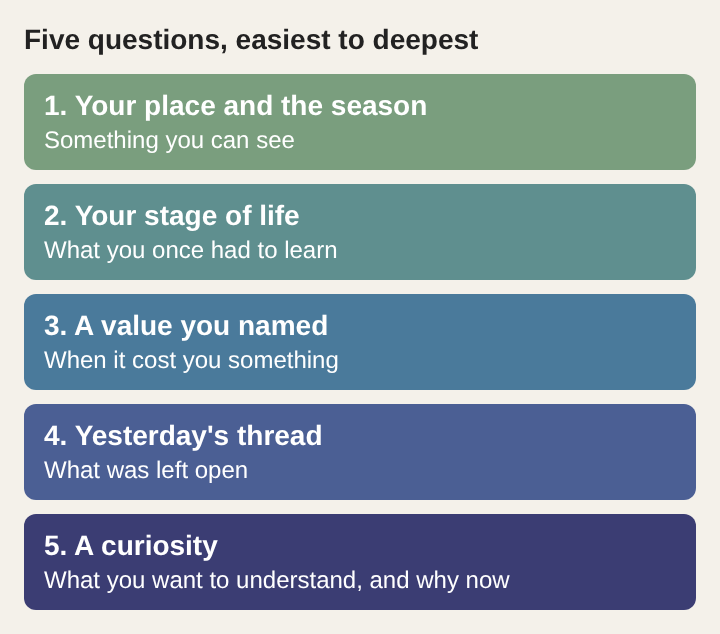
A good ladder has five rungs:
- Something you can see. Where you are and what the season is doing.
- Something about your stage of life. What you do now without thinking that you once had to learn.
- Something you value. A value you named, and a moment this week when it cost you something.
- Something left open. A thread from yesterday that you did not finish.
- Something you are curious about. A thing you want to understand, and why now.
The site uses that structure. Each of its questions says what it draws on: your place and the season, your stage of life, a value you named, yesterday's thread or a curiosity. Its home page gives examples of the first rungs: "What did you notice on the way out this morning?", "What do you do now that you once had to learn?" and "When did honesty cost you something small this week?"
A worked example: one evening, five answers
Take a person called Dana who sits down at nine in the evening with a notebook. The questions are written in advance, one for each rung.
- What did you notice on the way out this morning that you usually walk past? Dana answers: "The neighbour's tree had dropped all its leaves overnight."
- What do you do now without thinking that you once had to learn? Dana answers: "Running a meeting. Three years ago I rehearsed every sentence."
- When did telling the truth this week cost you something small? Dana answers: "I said the deadline would slip, and the room went quiet."
- What would you need to know to decide about the job offer by Friday? Dana leaves this one blank.
- What would you want to understand about the sea by the end of this year, and why now? Dana answers with two lines about tides and a trip last summer.
Nothing here required a clever answer. What matters is what the five answers show together. Dana notices small things, has grown more confident at work, values honesty enough to pay for it, and keeps avoiding one decision.
Read your answers back
Writing the answers is half the practice. Reading them back is the other half, and it works better with a plain method than with a mood.
- Copy out the words you used. Dana's list would hold "leaves", "rehearsed", "went quiet" and "tides". These are the facts of the evening.
- Note what you left unanswered. The blank question four is the most honest line on the page.
- Set the day beside the week. If honesty appeared on Monday and Wednesday as well, that is a pattern. If the job offer was blank on all three days, that is a bigger one.
- Carry the open thread to tomorrow. Next evening, question four becomes a question about the offer again.
The site automates this step. When the fifth answer is in, the site produces a readout it calls the enrichment: it catalogs your words, says plainly what you left unanswered, and sets the day beside your week and month. The next day's questions follow what was left open. You can do the same by hand with a pencil and a page that has three columns for today, this week and this month.
A good readback tells you what you said and stops. It does not tell you how you feel, because only you know that. It does not flatter you and it does not grade your answers, because there is nothing to pass. It does not offer advice you did not ask for, and it does not invent progress your answers do not show.
The site states these as its own limits: it will never tell you how you feel, flatter or grade you, give advice you did not ask for, or invent progress. They are good limits for a reader of any kind, including you. When you read your own answers back, look for what is on the page and resist the urge to make it more comforting or more damning than it is.
Common mistakes with daily self-reflection questions
- Writing for an audience. If you imagine someone reading, you will tidy every answer. Write as if no one will see it.
- Changing the list every day. Some variety helps, but a stable ladder lets you compare one week with the next.
- Skipping the blank ones. A skipped question is information. Mark it as unanswered rather than deleting it.
- Turning it into a number. A figure from one to ten tells you less than a sentence about what you noticed.
- Treating one day as the whole story of your life. A single evening is a snapshot, and the value shows up across weeks.
Frequently asked questions
How many daily self-reflection questions should you ask?
Five is enough for most people. It takes a few minutes, leaves room to climb from easy to deep, and is short enough to repeat tomorrow.
When should you ask yourself these questions?
Pick a time you can keep. Many people choose the evening because the day is finished, but a morning slot works if that is when you are quiet. What matters is the same time each day.
Should you write the answers or say them aloud?
Either works. Writing leaves a record you can read back, and speaking is easier on a tired night. If you speak, write down a line or two afterwards so the words are not lost.
What if you cannot answer a question?
Leave it blank and say so. An unanswered question shows what you are avoiding or have not yet thought through, and it can become the first question of the next day.
Why avoid yes or no questions?
A yes or no answer ends the thought. An open-ended question needs a sentence or a story, and that is where you find out what you actually think.
Why a small daily habit of asking works
Asking yourself a few good questions each day is a form of attention. The questions do not need to be new, and your answers do not need to be wise. What builds up is a record of your own words, in your own order, which you can read when you want to know where your time and thoughts have been going.
The habit asks little: a fixed time, a short list, questions that need a sentence, and an honest readback. Keep those four and the rest, the exact wording, the notebook or the app, is a matter of taste.