If you want to know how to notice patterns in your own journal entries, start with one fact: a single entry rarely shows a pattern. A pattern is something that repeats across days, and you only see it when entries sit side by side. Writing happens one day at a time, so the comparison has to be done on purpose.
Some tools do part of that comparison. EnrichAI is a site that asks five questions a day about your own life at the hour you choose, then writes a plain readout of what you said, set beside your week and month. The methods here work with that, with a paper notebook, or with a notes app.
Why patterns in journal entries are easy to miss
Each entry is written inside a single day's mood. A tired Tuesday and a calm Saturday produce entries that look unrelated, even when the same worry sits under both. You don't see the link because you are never reading them together.
Two habits of thinking make it harder. The first is confirmation bias, the tendency to notice what fits what you already believe about yourself. If you believe you are always behind, you will spot every line that says so and skip the lines that don't. The second is hindsight bias, the sense that you knew all along how things would go. Reading an old entry, you may feel you saw it coming, and so miss that you wrote something quite different at the time.
Neither problem goes away by trying harder. A fixed method for rereading helps, because it limits how much your current opinions steer what you see.
How to notice patterns in your own journal entries by rereading
Rereading is the core of it. Here is a routine that keeps the work small.
- Let entries pile up first. Wait until you have about a week of them. Reading yesterday's entry tells you little.
- Read in order. Go from the oldest to the newest in one sitting. Don't skip around, and don't fix wording.
- Read once without a pencil. Just take it in. Notice where you slow down or want to look away.
- Read again and mark. Underline words, people, places and situations that come up more than once.
- Group the marks. Put similar marks together and give each group a short name.
This is close to what researchers call thematic analysis: read the text, mark what recurs, group the marks into themes. You don't need the formal version. You need the same moves, done the same way each time, so the result doesn't depend on your mood that day.
Recurring words, moods and situations to mark
Marking works better when you know what to look for. Four kinds of mark cover most entries.
- Words. Small repeated words say a lot: "should", "again", "finally", "tired", "fine". A word used five times in a week is a mark worth keeping.
- People and places. Note who appears on good days and who appears on flat ones. The same goes for rooms, commutes and offices.
- Situations. Meetings, Sunday evenings, phone calls, deadlines, waiting. Situations repeat even when your description of them changes.
- Moods you named, and what happened around them. Write down the mood word and the event that sat next to it. The link between the two is often the pattern.
Keep the list short. Five marks you can follow are more useful than twenty you can't. If a mark appears in only one entry, leave it out for now.
Also look for what is missing. A subject you never write about, or a question you keep answering with one line, is part of the record too.
Questions that bring patterns to the surface
When the marks are down, questions help you read them. A good question can't be answered yes or no, because a yes or no ends the thinking. Try these on a week of entries:
- Which three words show up most, and what is going on each time?
- What do you write about on days that feel good, and what on days that feel flat?
- What did you start to say and not finish?
- What changed between the first entry and the last?
- What happened just before each time you wrote that you were tired?
Questions that look outward at your day also feed later pattern work. Examples such as "What did you notice on the way out this morning?" or "When did honesty cost you something small this week?" produce specific details, and specific details are easy to mark. For a starting set, see five daily self-reflection questions to ask yourself.
How EnrichAI supports reflection on what you write
The site does the rereading step after each day's answers. Each day it asks five questions, from the easiest to step into to the deepest. Each question says what it draws on: your place and the season, your stage of life, a value you named, yesterday's thread, or a curiosity. None of them can be answered yes or no. Answers can be typed or spoken, and each one saves as you go.
As the site's home page describes it, when the fifth answer is in, the day gets a readout, which the site calls the enrichment. It catalogs your own words, says plainly what you left unanswered, and sets the day beside your week and month. That last part is the comparison that single entries never give you. The next day's questions follow what was left open, so an unfinished thread comes back instead of disappearing.
The readout has firm limits. It never tells you how you feel, flatters you or grades your answers. It doesn't give advice you did not ask for, and it doesn't invent progress your answers do not show. It is a plain record of what you said, which keeps the pattern in your hands to interpret. Answers are kept in the site's own database and sent to Claude only to write the questions, readouts and progress. You can download everything you wrote or delete your account and all of it.
Turning a noticed pattern into a small change
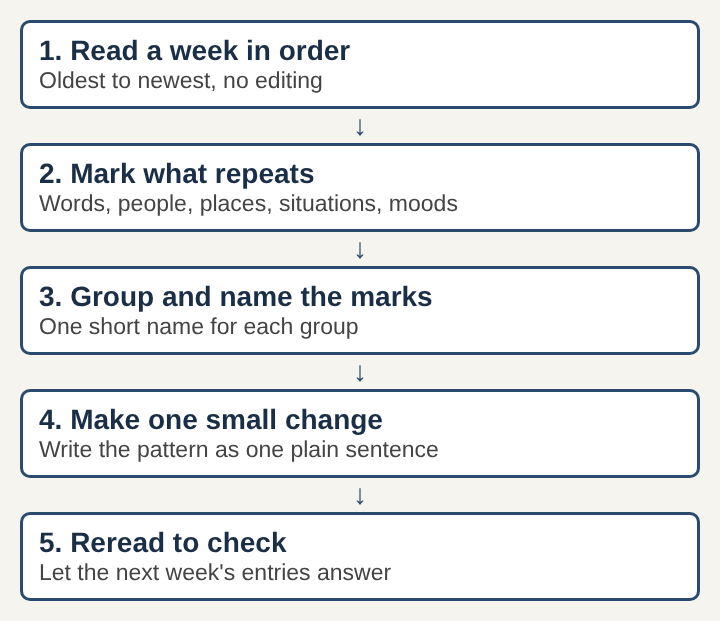
A pattern is only a description. Here is a worked example.
Over two weeks you mark the word "rushed" in six entries. Rereading, you see that five of those mornings also mention skipping breakfast, and four mention a call at nine. That is a pattern: rushed mornings come with a nine o'clock call and no breakfast.
Now make the change small and specific:
- Write the pattern as one sentence. A long, loose sentence about how the mornings go is hard to check. Write it plainly, as a description of the days: "Nine o'clock calls come with rushed mornings."
- Pick one change. Lay out breakfast the evening before. Only that.
- Set a short window. One week is enough.
- Check the entries afterward. Does "rushed" still appear on call days? Let the entries answer, not your hopes.
If the word still appears, the first guess was incomplete. That is useful. Go back to the marks and look for another link.
Common mistakes when looking for patterns in a journal
- Reading only the recent entries. The last few days feel most important, but patterns often run across weeks.
- Looking for one theme only. If you go in sure that work is the problem, you will find work everywhere. Mark first, then name the groups.
- Treating three entries as a law. Three matches can be chance. Wait for more before you decide something is true about you.
- Turning a pattern into a label. "Calls get put off" is a description. "A coward" is a judgment the entries do not support.
- Changing everything at once. Several changes at the same time make it impossible to tell which one mattered.
- Editing old entries. Rewriting what you wrote removes the evidence. Leave the entries as they were and add new notes beside them.
- Skipping the gaps. Days you did not write, or answers you cut short, show something too.
Frequently asked questions
How often should you reread journal entries?
Once a week is a workable rhythm, with a longer read at the end of each month. The weekly read catches near-term links, and the monthly read shows slower ones.
How many entries are needed before patterns show up?
There is no fixed number. About a week of entries often shows repeated words and situations, while slower patterns, such as seasonal mood or yearly stress, need a month or more.
What if the same negative theme keeps appearing?
Treat it as information, not a failure. Note when it appears, what sits next to it and what you did about it, then try one small change and see whether later entries differ.
Is a separate note needed to record a pattern?
A short separate note helps. Write the pattern as one plain sentence with a date, so you can check it against later entries without rewriting the entries themselves.
What a pattern in a journal can and cannot tell you
A pattern in your own entries is a description of what you wrote, over a stretch of days, in the words you chose. It shows that two things appeared together. It does not show that one caused the other, and it does not say who you are. Holding it that loosely is what keeps it useful: you can check it against later entries, change it, or drop it when the record stops supporting it.
The same record also keeps you honest in the other direction. A week with no rushed mornings is as much a finding as a week full of them, and the entries will show both if you let them. What builds up over time is a clearer view of your own days, written in your own words and checked by rereading.