Knowing how to learn from the questions you get wrong matters more than the result at the end of a quiz. A wrong answer shows you where your memory or understanding has a hole, and a right answer only tells you that you did not need to look there. Answering questions to pull ideas out of memory is the heart of retrieval practice, and one finding about it is that long-term memory improves when part of the learning period goes to retrieving information from memory. Study Shot is one tool built around this: it turns a photo of a page from a textbook, notes or a worksheet into multiple-choice practice questions and explains every answer. These habits work with any set of questions, though.
Why wrong answers are the most useful part of practice
A practice question removes the page and asks you to produce the answer, and the miss that follows is a clear signal about what you could not recall.
A right answer can come from a lucky guess. A wrong answer is specific. It names one idea, one term or one step that did not hold. If you treat the miss as a judgment on you, you skip past it. If you treat it as information about one idea, you know where to spend the next ten minutes.
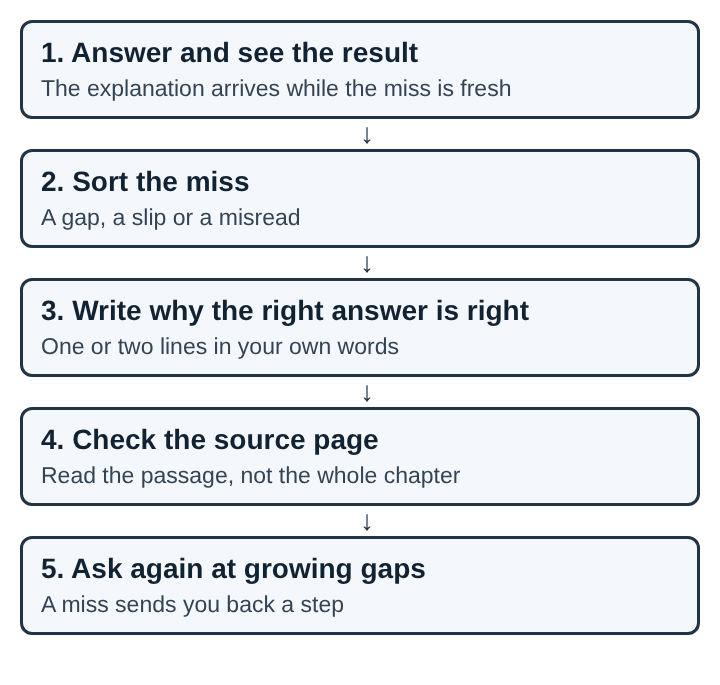
That is why the order of work matters. Answer the question, see the result straight away, then deal with the miss while you still remember what you were thinking when you chose.
Sorting mistakes: gaps, slips and misread questions
Not every miss needs the same fix. Before you do anything else, decide which kind it was. Thinking about your own thinking, in simple terms, is called metacognition, and it takes only a few seconds per question.
- A gap. You did not know the idea, or you knew a half-version of it. It needs real study.
- A slip. You knew it, but you chose the wrong option anyway, perhaps because you rushed. It needs a slower pace, not more study.
- A misread. You answered a different question from the one asked, for example by missing a word such as "not" or "except". It needs a habit of reading the stem twice.
A worked example: a question asks where in a plant cell photosynthesis takes place, and the four choices are the mitochondria, the chloroplasts, the nucleus and the cell wall. You pick the mitochondria. Ask yourself why. If you honestly believed mitochondria do photosynthesis, that is a gap. If you knew it was the chloroplasts but clicked too fast, that is a slip. If you read the question as "where is energy released", that is a misread. Same wrong answer, three different next steps.
Writing down why the right answer is right
Do not stop at "the answer was B". Write one or two sentences in your own words that explain why the correct option is correct. For the plant cell question, that might be: "Chloroplasts contain the chlorophyll that captures light, so photosynthesis happens there. Mitochondria release energy from food, which is a different job."
Notice that the second sentence also explains why your wrong choice was wrong. That half is easy to skip and it is often the more useful half. The reason you picked a wrong option is usually a mix-up between two similar ideas, and the mix-up will return unless you name it.
Keep these notes short. One line per miss is enough. If the explanation takes a paragraph, you have found a gap that needs the source page, which is the next step.
Going back to the source page after a miss
A miss on a gap means the idea is not in your head yet, so go to where it lives. Open the page the question came from and find the passage that holds the answer. Read that passage, not the whole chapter.
Then look one step further. Check the sentences just before and after it. Wrong answers often come from missing the context, such as a definition given a paragraph earlier. If the page has a diagram or a worked example for the idea, spend a minute on that too.
This is also where you catch a bad question. Sometimes the question is unclear, or the answer does not match the page. If the page and the answer disagree, note it and move on instead of memorising something doubtful.
Turning your own pages into practice questions
Writing questions from your own notes takes time. Study Shot handles that step. You take a photo of a page, or pick one you already took, then choose a level: Basic, Intermediate or Advanced, or Tiered, which climbs through all three. A quiz has 5 to 20 questions, each with four choices, sorted from the basics to the hardest.
You then answer one question at a time. Each answer is checked right away and explained, so the explanation arrives while the miss is fresh. Quizzes come in 50 languages, and the tool works on a phone and a computer.
Two features suit the habits described here. Every quiz is kept in a library with its page photo, so the source page stays with the questions. And a question that looks wrong can be flagged in one tap, which fits the point about doubtful questions. For more on building questions from what you already have, see how to make practice questions from your notes.
Trying missed questions again with retrieval practice
Retrieval practice means pulling an answer out of memory instead of looking at it. Reading the explanation once is not retrieval. Answering the question again later, without the explanation in front of you, is.
So after you have written your note and checked the source page, close everything and leave the miss alone for a short while. Come back to it the same day if you can, and answer the same question cold. If you get it right, good. If you miss it again, you now know the fix did not stick, and you can try a different route: draw the idea, say it aloud, or explain it to someone.
Take the quiz again from the library rather than only rereading your notes. The aim is to produce the answer, not to recognise it. One caution: if you remember the answer only because you remember the position of the option, change the order or write the answer before you look at the choices.
Spacing out the questions you got wrong
Memory fades without a second look. The forgetting curve graphs the loss of learned information over time, and a typical graph is said to show people halving their memory of new knowledge within days or weeks unless they go over it again. The practical answer is to see the same material again at growing gaps, which is the idea behind spaced repetition: the gap grows after each success, and a miss sends you back a step. A separate piece on the spacing effect goes into why this works.
For missed questions, a simple schedule is enough:
- Answer the miss again later the same day.
- Answer it again the next day.
- Answer it again after a few more days.
- Answer it again after a week or two.
If you miss it at any point, go back a step in the list. If you get it right at each stage, the gaps can keep growing. You do not need an exact calendar. You need the habit of coming back, and the misses are what should come back most.
Keep a short list of your misses by kind: gaps, slips and misreads. After a week, look at it. If most are slips, slow down. If most are gaps on one chapter, that chapter needs a proper reread before more questions.
Frequently asked questions
Should the right answer be checked straight away?
Yes, after you have committed to an answer. Seeing the explanation right after the miss lets you connect it to what you were thinking when you chose.
How many times should a missed question be redone?
Until it can be answered correctly at several growing gaps, for example the same day, the next day and a week later. Getting it right once, straight after reading the explanation, tells you little about what you will recall later.
What if the same kind of mistake keeps happening?
Sort the misses into gaps, slips and misreads, then look at the pattern. Repeated gaps need study of the source page, repeated slips need a slower pace, and repeated misreads need a second read of each question.
Is it better to write questions by hand or use ready-made ones?
Both work as long as the questions come from the material being learned. Writing your own forces you to think about the page, while ready-made questions save time and give you more to practise on.
What if a question seems wrong?
Check it against the source page. If the page and the answer disagree, mark the question as doubtful and do not memorise it until it is sorted out.
How to learn from the questions you get wrong over time
The routine is short. Answer, see the result, decide whether the miss was a gap, a slip or a misread, and write one or two lines on why the right answer is right. Go back to the source page for gaps. Then bring each miss back at growing gaps until you get it right without help. A wrong answer is useful only if something changes afterwards, and these steps are what change it.