Why questions beat re-reading
If you want to know how to make practice questions from your notes, start with what a question does that a second read does not. A question asks you to pull an answer out of your head before you see it. Re-reading only asks you to recognise words you have seen before.
Researchers call this retrieval practice, also named active recall. It suggests that long-term memory improves when part of the study time goes on retrieving information from memory, and that practising retrieval helps more than only reading or passively studying the same material. The same page notes that the gain is larger when the retrieval is harder. Francis Bacon described the habit in 1620: recite from memory now and then, and look at the text only when memory fails.
Re-reading feels productive for a simple reason. The words look familiar the second time, so you feel you know them. The Wikipedia entry on desirable difficulty describes this: a task that is easy to finish gives the illusion of learning, while a task that takes more effort, such as producing a definition yourself, improves long-term performance even though it feels slower at first.
Practice questions put that effort in the right place. Writing them well takes a few steps, and a photo of a page can do the first draft. Study Shot turns a photo of a page from a textbook, notes or a worksheet into multiple-choice practice questions, with every answer explained.
Pick one page, not a whole chapter
A small unit gives better questions. Choose a single page of your notes or one page of the textbook. A page has a clear edge, so you can tell when you have covered it.
Before you write anything, read the page once. Then close it and say aloud what it was about. Whatever you cannot say is the part that needs the most questions.
Printed pages and neat handwriting both work as source material. A page that is crowded, crossed out or half finished makes poor questions, because the questions can only be as clear as the page behind them.
How to make practice questions from your notes, step by step
Take one page and work through these steps in order.
- List the key terms. Underline every word the page defines. Each one is a question waiting to be written.
- Turn each statement into a question. A sentence such as "the chloroplast is where photosynthesis takes place" becomes "Where in a plant cell does photosynthesis take place?"
- Write the wrong answers as carefully as the right one. Three plausible choices make you think. Three silly ones let you guess.
- Write the reason for the answer. One or two sentences on why the answer is right and why the near miss is wrong.
- Answer before you look. Put the page away and answer from memory.
Done by hand, this takes a while. That is the main reason people stop doing it, and the reason a photo of the page can help.
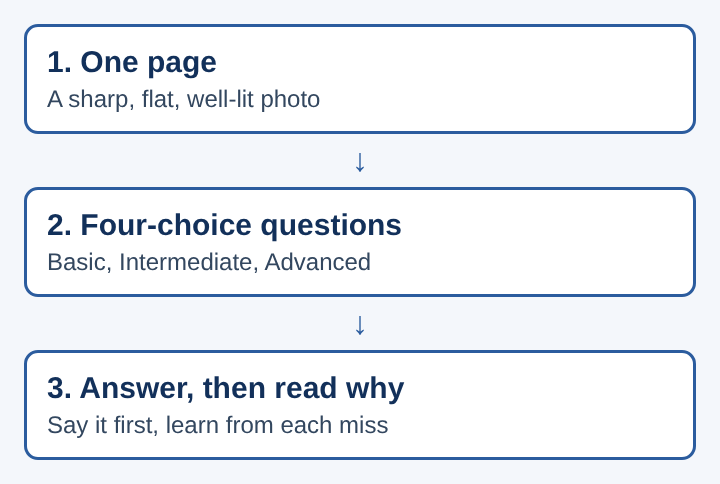
Ask at three levels
A set of questions that only asks for definitions teaches you to recognise definitions. A good set climbs. The quiz writer sorts its questions into three levels:
- Basic questions check the key terms, facts and definitions on the page.
- Intermediate questions ask you to explain, compare and connect ideas.
- Advanced questions ask you to apply and predict in new situations, using what the page teaches.
It also offers a Tiered quiz, a ladder that climbs from basic to advanced so the first questions warm you up before the hard ones arrive. A quiz holds 5 to 20 questions, each with four choices.
You can use the same ladder when you write your own. Start with two or three definition questions, add two that compare things, then finish with one that asks what would happen if something changed.
A worked example: one page on photosynthesis
Take a textbook page on photosynthesis. The project's home page shows exactly this case: a photo of the page produces the question "Where in a plant cell does photosynthesis take place?" with four choices: the mitochondria, the chloroplasts, the nucleus and the cell wall. The right answer is the chloroplasts.
Here is how the three levels grow from that single page:
- Basic: which organelle holds the pigment that captures light? The answer is a plain fact from the page.
- Intermediate: why do the mitochondria and the chloroplasts both handle energy but do different jobs? You have to compare two ideas the page puts side by side.
- Advanced: what would you expect to happen to a plant kept in the dark for a week? Nothing on the page says it in so many words, so you have to apply what it teaches.
Notice what each question needs. The first needs a word. The second needs a relationship. The third needs a prediction. Three questions from one page already cover three kinds of knowing.
What makes a page produce good questions
Photo quality decides how good a photo-made quiz can be. The site's guide to photos says a sharp, flat, well-lit photo of one page gives questions about everything on it, while a blurry or cropped photo gives fewer and vaguer ones. It writes questions only about what it can see, so anything cut off, hidden under a finger or lost in glare never reaches the quiz.
- Lay the page flat and hold the phone straight above it so the page fills the frame.
- Use daylight or a room light behind you rather than the phone's flash.
- Keep your hand at the edge of the page, not over the text.
- Zoom in on the smallest print. If you can read it, the questions can use it.
The same rules help when you write questions by hand. A clear page, well lit and with nothing hidden, gives you more to ask about.
Answer first, then read the explanation
How you answer matters as much as how the questions were made. If you glance at the four choices and pick the one that looks familiar, you have practised recognising, which is what re-reading trains.
The site's guide to answering gives the better habit: before you look at the options, say the answer to yourself, then pick the option that matches. Guessing between four options is easy, and remembering the answer without them is what an exam asks of you.
Each answer is checked as soon as you give it, and the quiz tells you why it is right or wrong. Read the explanation even when you were right. It often adds the reason or links to an idea the next questions build on.
Learn from every miss
A wrong answer is the most useful result in the set. It marks the exact spot where your memory and the page disagree.
- Say in your own words why the correct answer is correct.
- Say why the choice you picked is wrong. This is the part people skip.
- Look at the page again and find the sentence the question came from.
- Take the quiz again later and see whether the same question still catches you.
The effort of getting something wrong and then fixing it is part of the gain. The same desirable difficulty entry says material learned with extra effort is kept better over time, even if you feel less sure of yourself at the start.
Frequently asked questions
How many practice questions can one page give?
Between 5 and 20 is a workable range. Five covers the key terms on a short page, and 15 or 20 gives room for questions at all three levels.
Are multiple-choice questions or short answers better?
Both work. Multiple choice is quick to check and shows which wrong idea you hold. Saying the answer to yourself before you look at the choices adds the effort of recall that short answers have.
Can practice questions be made from handwritten notes?
Yes, if the handwriting is neat and any diagram is labelled. Printed text is read most reliably, and a page that is hard to read makes vaguer questions.
When is the best time to answer practice questions?
Soon after you read the page, and again later. The Wikipedia page on retrieval practice reports that retrieval practice lowers forgetting compared with restudying, and that the gain can last for years.
What should a learner do with the questions they get wrong?
Explain the correct answer in your own words, find the sentence on the page it came from, and answer the same question again another day.