What is the spacing effect? It is the finding that you remember material better when you study it in several sessions spread over time than when you study the same amount in one block. The total hours can be identical. The only difference is the gap between sessions.
Hermann Ebbinghaus studied forgetting in the 1880s and published his results in 1885, describing how recall fades as time passes, a pattern now called the forgetting curve. Later work built on it, and the result is now described on the spacing effect page. It matters most if you study from your own pages, because a textbook chapter or a worksheet is easy to read once and then leave alone. Study Shot is built for that situation: it turns a photo of a page from a textbook, notes or a worksheet into multiple-choice practice questions, from the basics to advanced, with every answer explained.
What is the spacing effect?
The spacing effect is a result about timing, not about effort or method. Two students can spend three hours on the same chapter. One does all three hours on Sunday night. The other does one hour on Sunday, one on Wednesday and one the next Sunday. The spacing effect predicts that the second student will remember more of the chapter later on.
Three things are worth holding onto:
- It is about the gaps between sessions, not the length of each session.
- It applies to the same material, studied again after some time has passed.
- It does not make a single session useless. It says that dividing the same time usually works better than stacking it.
Spaced practice versus cramming
Cramming packs all the study into one stretch, usually just before a deadline. It feels productive for a good reason: the material is fresh, so recall is easy while you are still in the session. That ease is the trap. Recall that is easy right now says little about recall next week.
Spaced practice splits the same time across days or weeks. Each session feels a little harder than a cram session, because you have forgotten part of what you did last time. You have to work to bring it back. That extra work is not a sign that spacing is failing. It is the part that does the job.
A practical difference shows up in what you do at the start of a session. When you cram, you carry on from where you stopped. When you space, you begin by finding out what is still there.
Why spreading out study sessions strengthens memory
The spacing effect page says researchers have offered several explanations and that different mechanisms may apply to different memory tasks. It also reports one study, by Cepeda and colleagues in 2006, in which people who spaced their practice on memory tasks did better than people who massed it in 259 of 271 cases. One idea about why runs like this. Right after you study something, it is still easy to reach, so bringing it to mind again takes little effort and adds little. After a gap, part of it has faded. Recalling it then takes real effort, and that effort may be part of what makes it easier to recall again later.
This also explains why the best gap is not the shortest one. If you return too soon, nothing has faded and the session is mostly rereading. If you wait too long, too little remains to build on. Systems that plan repeat sessions around this idea, usually called spaced repetition, lengthen the gap each time an item is recalled correctly. C. A. Mace suggested in 1932 that revision be spaced at gradually increasing intervals, roughly one day, two days, four days, eight days and so on.
You do not need a precise schedule to get the benefit. Coming back to a page after a day or two, and again after a week, already beats reading it three times in an evening.
How the spacing effect works with retrieval practice
Spacing answers the question of when to study. Retrieval practice answers the question of how. Retrieval practice means pulling an answer out of memory, rather than looking at the material again. Answering a question is retrieval. Rereading a paragraph is not.
The two fit together because each one makes the other stronger. A spaced session that is only rereading gives you familiarity without much recall. A retrieval session crammed into one night gives you recall that fades fast. A spaced session built from questions asks you to recall material you have partly forgotten, which is the situation the spacing effect says is most useful.
So a good session after a gap does not start with the page. It starts with questions about the page, and the page comes out only to check what you got wrong.
Using practice questions to apply the spacing effect
The hard part of retrieval practice is having questions at all. Textbooks and worksheets do not always come with good ones, and writing your own takes time. There is a separate piece on how to make practice questions from your notes if you want to do that by hand.
Here is a worked example. You photograph a textbook page on photosynthesis and turn it into a quiz. One question reads: "Where in a plant cell does photosynthesis take place?" The four choices are the mitochondria, the chloroplasts, the nucleus and the cell wall. The right answer is the chloroplasts.
On the day you make it, this question may feel obvious, because you read the page minutes ago. Four days later, the same question is a real check on whether the fact stayed. That is the point of spacing the quiz instead of finishing it once.
The level matters here too. A quiz can run at Basic, Intermediate or Advanced, or at Tiered, which climbs through all three, with 5 to 20 questions and four choices each. A sensible pattern is to start with the basics on the first pass and move up on later passes, so the questions get harder as the material settles.
Learning from every wrong answer when sessions are spaced
A wrong answer is the most useful result a spaced session can give you. It marks exactly what faded. The risk is that you see the red mark, move on, and meet the same gap again next time.
What turns a miss into learning is the explanation. When each answer is checked right away and explained, you learn why the chloroplasts are right and why the mitochondria are not, instead of only learning that you picked wrong. That matters because the explanation spells out the difference between two similar things, such as two organelles.
A simple routine for a spaced session:
- Answer every question before looking anything up.
- Read the explanation for each miss, and for any answer you guessed.
- Note which questions you missed, because those are the ones to expect again.
- Reread only the part of the page those questions came from.
If a question looks wrong to you, it is worth flagging instead of arguing with it. In Study Shot a question that looks wrong can be flagged in one tap, and it gets checked.
Spacing sessions across your own pages
Spacing only works if the same material is still around when the gap ends. A quiz that is kept in a library with its page photo, ready to take again, solves that. A quiz made on Monday is waiting on Thursday without any rebuilding, and the photo shows which page it came from if you need to go back to the source.
A plan for one chapter might look like this:
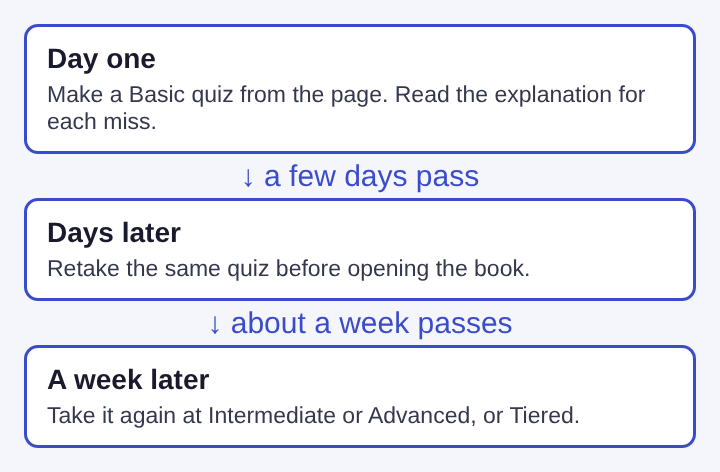
- Day one: photograph the pages, make a Basic quiz, and read the explanation for each miss.
- A few days later: retake the same quiz before opening the book.
- About a week later: take it again at Intermediate or Advanced, or use Tiered to cover all three levels in one go.
The exact gaps are yours to choose. The habit that matters is retaking the quiz after you have forgotten some of it, not straight after you finish.
Frequently asked questions
What is the spacing effect in simple terms?
It is the finding that studying the same material in several sessions with gaps between them leads to better memory than studying it all at once. The total time can stay the same.
How long should the gaps between study sessions be?
There is no single right length. The gap should be long enough that you have forgotten some of the material, but short enough that something is left to build on. One early suggestion, from C. A. Mace in 1932, was gaps that grow from about one day to two, four and eight days.
Does the spacing effect work for every subject?
It has been described mostly for material that has to be remembered, such as facts, terms and definitions. For skills built on understanding, it still helps to return to the material over time, but how much it helps varies with the material and the learner.
Is spaced practice the same as retrieval practice?
No. Spaced practice is about the timing of study sessions. Retrieval practice is about answering from memory instead of rereading. The two work well together, since each spaced session can be made of questions.