What was the scientific revolution and who led it? It was the stretch of the 1500s and 1600s when European thinkers began to explain nature through observation, measurement and mathematics, and it is usually dated from 1543 to 1687. The names most often given as its leaders are Vesalius, Copernicus, Tycho Brahe, Galileo, Kepler, Bacon, Descartes and Newton.
What was the scientific revolution and who led it
The Wikipedia entry on the Scientific Revolution calls it an irreversible break with the natural philosophy that came before, one that changed how the natural world was investigated and understood. Earlier European learning leaned heavily on ancient authorities. A claim was strong when a respected old text supported it.
In this period a claim became strong when measurement and calculation backed it. The same entry lists the leaders by field: Andreas Vesalius in anatomy, Copernicus, Tycho Brahe, Galileo and Kepler in astronomy, Bacon and Descartes in the study of method, and Newton in physics. Learn 100 Influential People teaches the 100 people who most shaped human history, and one of its Basic courses is named The Scientific Revolution.
When did the Scientific Revolution start and end
The period is frequently said to begin in 1543. That year Vesalius printed his book on the workings of the human body and Copernicus printed his book on the revolutions of the heavenly spheres. Some historians suggest the supernova of 1572 as an alternative beginning. The usual end is 1687, when Newton published the Principia.
These dates are conventions. The same entry traces the roots of the revolution back to translations of ancient Greek learning and medieval Islamic science, which reached Europe from the 10th century, and to the rise of the medieval university. The break was real, but it did not come from nowhere.
Copernicus and Kepler changed the shape of the heavens
Copernicus placed the Sun, not the Earth, at the center of the planets' motion. His book is covered in the Wikipedia page on De revolutionibus, which notes that he still held to circular motion and kept a complex system of epicycles. The idea moved the center, but the details of the orbits were still wrong.
Johannes Kepler fixed them. Working from the precise observations of Tycho Brahe, he showed that the orbit of Mars is an ellipse. The three laws of planetary motion say that a planet moves on an ellipse with the Sun at one focus, that a line from the planet to the Sun sweeps out equal areas in equal times, and that the square of a planet's orbital period is proportional to the cube of its orbit's semi-major axis.
Galileo and the telescope
The Stanford Encyclopedia entry on Galileo says he was the first to report telescopic observations of lunar mountains, the moons of Jupiter and the phases of Venus. Each showed that the heavens were less different from the Earth than the old teaching had said. In mathematical physics he worked out the law of free fall and conceived of an inertial principle.
His support for the Sun-centered view brought him before the Roman Inquisition. In June 1633 he was convicted of vehement suspicion of heresy, and the sentence became house arrest for life. The Galileo affair shows that new ideas met resistance as well as welcome.
Bacon and Descartes argued about method
Observations need a method. Two thinkers offered different ones.
Francis Bacon published the Instauratio magna, which contains the Novum organum, in October 1620. His doctrine of idols names habits of mind that distort what people see, and his aim was a knowledge that gives power over nature. The Stanford entry on Francis Bacon sets out the plan.
René Descartes published the Discourse on the Method in French in 1637, together with an essay called the Geometry. He developed the techniques of algebraic geometry and built his philosophy on a method of doubt. The Stanford entry on Descartes gives the detail. Bacon leaned on experience and Descartes on reason, and the revolution drew on both.
Newton brought the pieces together in 1687
The Stanford entry on the Principia describes the book as setting out Newton's laws of motion and a theory of inverse-square gravity. It adds that the theory of gravity accounted for the planets' divergences from Keplerian motion, the achievement that ended opposition to it.
Here is a worked example of the step from observation to explanation, as three stages in the story you have just read.
- Observe. Tycho Brahe records the positions of the planets with great precision.
- Describe. Kepler fits the records and finds that orbits are ellipses and that period and orbit size are tied by a rule.
- Explain. Around 1666 Newton develops the idea that Kepler's laws must also apply to the Moon's orbit around the Earth and then to all objects on Earth, according to the page on Newton's law of universal gravitation.
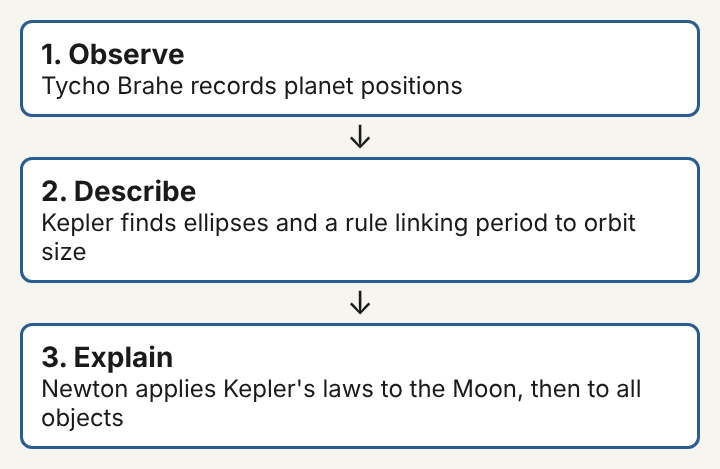
A rule that began as a fit to measurements became the result of a wider law. That is the move from description to explanation.
How the new ideas travelled
A finding that stays with its maker changes little. Letters and societies carried the new work across borders. The Republic of Letters was a long-distance intellectual community of the early 16th to early 19th century, held together by correspondence. The Royal Society in London was founded on 28 November 1660 and is the oldest continuously existing scientific academy in the world. Its first Philosophical Transactions appeared in 1665.
This is one reason the question of who led the revolution has no single answer. A look at the claims and critics of the great man theory of history weighs the case for single figures against the case for wider networks. The ancient authorities the revolution challenged are covered in an article on the most important Greek philosophers.
The Scientific Revolution as a short course
The Scientific Revolution is the fourth of the four Basic courses among the project's 15, and it asks no background. A lesson takes about 9 minutes, and every lesson lists its sources so that a learner can read the original work.
Frequently asked questions
What was the Scientific Revolution in one sentence?
It was the period, usually dated 1543 to 1687, when European thinkers began explaining nature through observation, experiment and mathematics instead of relying mainly on ancient authority.
Who were the main leaders of the Scientific Revolution?
Wikipedia lists Vesalius, Copernicus, Tycho Brahe, Galileo, Kepler, Bacon, Descartes, Boyle, Leeuwenhoek and Newton among them.
Why is 1543 often given as the starting year?
That year Vesalius printed his book on the human body and Copernicus printed his book on the heavenly spheres. Some historians suggest the supernova of 1572 as a starting point instead.
Why did Galileo get into trouble?
He defended the Sun-centered view, and the Roman Inquisition tried him in 1633. He was found vehemently suspect of heresy and sentenced to house arrest.
Did the Scientific Revolution happen all at once?
No. It is dated across about 150 years, and it drew on Greek learning and medieval Islamic science that reached Europe centuries earlier.