Who were the most important Greek philosophers? Most lists begin with Socrates, Plato and Aristotle, then add the thinkers who came before them and the schools that came after. Learn 100 Influential People teaches the people who shaped human history in war, philosophy, religion, art, science, engineering and economy, and the Greek philosophers are among the first names a reader meets there.
Who were the most important Greek philosophers? A short list
These are the names that come up most, in rough order of time:
- Thales, Heraclitus, Parmenides and Democritus: early thinkers who asked what the world is made of and whether it changes.
- Socrates: the Athenian who made questioning a way of doing philosophy.
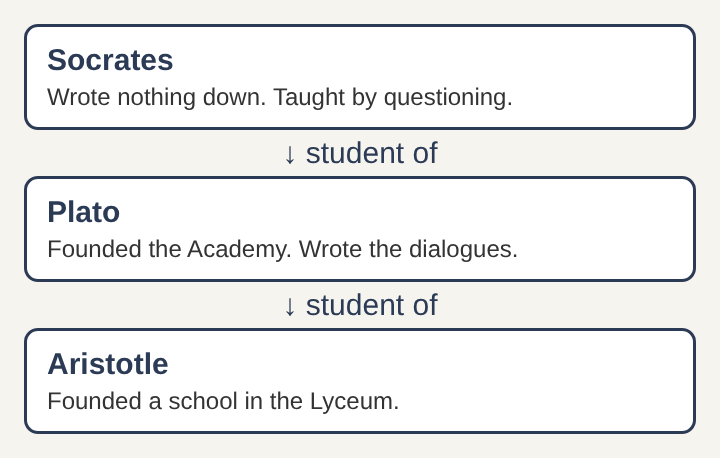
- Plato: a student of Socrates, who founded the Academy and wrote the dialogues.
- Aristotle: a student of Plato, who founded a school in the Lyceum and wrote on logic, nature, ethics and politics.
- Zeno of Citium, Epicurus and Pyrrho: figures linked to the Stoic, Epicurean and Skeptic traditions.
Ranking them is a matter of judgment. Whether a few individuals drive history at all is an old argument, set out in the claims and critics of the great man theory. In Greek philosophy the case for the individual is strong, because a handful of teachers set the questions that later writers kept answering.
Where the Greek thinkers sit among the 100 who shaped history
The site groups its lessons into 15 courses in three parts. The Greek Thinkers is one of the four Basic courses, which need no background. A lesson takes about 9 minutes: short pages with diagrams, short activities, then questions where the reader chooses, puts items in order, matches, sorts or estimates a number. Questions from finished lessons come back later, spaced out, up to 5 a day.
Cards set out where researchers disagree, which suits a subject such as Socrates, where the sources conflict. Each lesson lists its sources so a reader can go to the original work, and a glossary explains the key terms.
The Presocratics and the first questions about nature
The Presocratics worked before Socrates or alongside him. Their works survive mostly as quotations, called fragments, and reports in later writers. That makes every claim about them a reconstruction.
The usual starting point is Thales of Miletus. Aristotle credits him with declaring water to be the first cause of things. The exact claim matters less than the move: he tried to explain nature by looking at nature.
Heraclitus is best known for the doctrine that things are constantly changing. Parmenides wrote about "what is", true reality, and pushed thought in a different direction. Each position made later thinkers say what they meant by change, being and knowledge.
Democritus developed an atomist system begun by his teacher Leucippus. The atomists held that everything is made of smallest indivisible bodies moving in an infinite void.
Socrates and the method of questioning
Socrates lived from 469 to 399 BCE and wrote nothing down. Much of what is known about him comes from Plato, though other ancient writers describe him too, so the portraits are not one portrait. He was accused of impiety in an Athenian court.
He is tied to a method called the elenchus: checking a claim through question and answer. In Plato's dialogues he also calls himself a midwife who has no ideas of his own but helps give birth to the ideas of others.
A reader can follow the move in three steps. Someone states a belief. Socrates asks what it means and whether it holds in a case that might break it. The speaker revises the belief or drops it. The lasting contribution is the habit, not a doctrine: check what you think against the hard cases.
Plato and the Academy
Plato founded a school in Athens known as the Academy, which gave later languages the word "academic". He wrote dialogues, and in the works generally regarded as giving his own philosophy, such as the Republic, Socrates is the main speaker. Those works blend ethics, political philosophy, moral psychology, epistemology and metaphysics into one connected system.
His best-known doctrine is the theory of Forms. It holds that the world known through the senses is only an imitation of a pure, eternal and unchanging world of Forms. Scholars still argue about how far the speeches of Socrates in the dialogues reflect the historical man and how far they are Plato's own views.
Aristotle and the Lyceum
Aristotle was a student of Plato for twenty years, yet he is famous for rejecting Plato's theory of Forms. He tutored the young Alexander the Great, and he later founded his own school in the Lyceum.
He was more empirically minded than both Plato and Socrates. In his natural philosophy he combines logic with observation to make general causal claims, and in his biology he uses the concept of species. His logic rests on the syllogism, where the form of the argument carries the conclusion: all men are mortal; Socrates is a man; therefore, Socrates is mortal. Swap in other terms and the structure still holds.
Aristotle's methods of defining terms, sorting kinds and arguing from evidence became the ordinary tools of later scholars, even where later science overturned his conclusions.
Stoics, Epicureans and Skeptics
Three schools followed the great Athenians, each asking how a person should live.
- Stoicism: Zeno of Citium founded the school. After him the Stoa was led first by Cleanthes of Assos and then by Chrysippus of Soli, who is counted its foremost theorist.
- Epicureanism: Epicurus bought a property in Athens known as the Garden, later the name of his school. Clearing away fears, he held, leaves people free to pursue the pleasures they are naturally drawn to and to enjoy peace of mind.
- Skepticism: The skeptics, among them Pyrrho, treat suspension of judgment as a core element: faced with how things seem, the skeptic neither assents nor rejects.
The three schools disagreed sharply with one another, and they also argued with Plato and Aristotle. That conversation is part of why the Greek tradition reads as a debate and not a list of doctrines.
How the ideas of the Greek philosophers reached later readers
Ideas spread through teachers, students and commentators, and each link changed what survived. A tradition of commentators on Aristotle's works began in late antiquity with Alexander of Aphrodisias, and the commentaries of later writers are still being edited and translated.
Centuries later, Thomas Aquinas wrote commentaries on all of Aristotle's principal works while completing his own major book, the Summa theologiae. The path from Athens to a medieval university is a clear case of ideas reaching new readers through the people who copied, explained and argued with them, and not through the original authors alone.
Frequently asked questions
Who is the most important Greek philosopher?
Aristotle and Plato are the usual answers. Plato shaped the questions about knowledge, justice and reality, and Aristotle shaped methods in logic and the study of nature. Socrates is often placed beside them because he changed how philosophy was practiced.
Why are Socrates, Plato and Aristotle grouped together?
They form a line of teaching. Plato was a student of Socrates, and Aristotle was a student of Plato for twenty years. Each also disagreed with his teacher, which is why the line reads as an argument.
Did Socrates write anything?
No. Socrates wrote nothing down, and what is known about him comes mostly from Plato, with other ancient writers adding their own portraits.
What did the Epicureans and Skeptics disagree about?
The Epicureans held that freeing people from fear leaves them free to pursue pleasure and peace of mind. The Skeptics made suspension of judgment a core element of their practice.