The great man theory of history is the idea that the past is best explained by a small number of unusual individuals. Their intellect, courage or gift for leading, on this view, changed what happened in ways that no crowd or circumstance could have done alone. The idea is old, it is still argued about, and the argument itself is a useful way into the study of history. A course on the people who shaped history teaches lives that all raise the same question: how much did one person matter?
What the great man theory of history claims
According to the Wikipedia entry on the great man theory, the theory says history can be largely explained by the impact of great men, or heroes: highly influential and unique individuals who, because of their natural attributes, have a decisive effect on events. Those attributes include superior intellect, heroic courage, extraordinary leadership and, in some versions, divine inspiration.
Two things follow from that definition. First, it is a claim about causes. It does not say that great people were admirable. It says that they were the reason events took the course they did. Second, it treats the people as special from birth. The same entry lists two assumptions behind the theory: that every great leader is born with the traits that let them rise and lead, and that the need for such a person has to be great before those traits show.
Who put it forward
The theory is mainly credited to Thomas Carlyle. His biography describes a Scottish essayist, historian and philosopher who lived from 1795 to 1881 and whose books included The French Revolution: A History and On Heroes. In 1840 he gave a series of lectures on heroism, later published as a book on heroes and hero worship.
In those lectures he sorted heroes into six types: the hero as divinity, as prophet, as poet, as priest, as man of letters and as king. He also argued that studying great lives was worthwhile for the reader, because looking closely at them tells you something about your own nature. His view fits the century he wrote in. The Wikipedia entry notes that the approach was at its most fashionable with professional historians in the 19th century, when reference works were organised around long biographies of notable men and gave far less room to social history.
What the theory does not say
A common misreading is that the theory claims nothing but great men mattered. The same entry quotes the philosopher Sidney Hook, who points out that this is not what Carlyle meant. Carlyle did not claim that every other factor was inconsequential. He claimed that great men were the decisive factor, because of a kind of genius that cannot be built by adding up ordinary talents.
Keeping that distinction clear matters for any fair argument. The strong version, that nothing else counts, is easy to knock down. The careful version, that a handful of individuals changed the direction of events at key moments, is harder to answer and is the one worth weighing.
A different reading: the person as a sign of their time
Not every thinker who took individuals seriously agreed with Carlyle. The same entry reports that Hegel saw great historical figures as agents of a larger process. On that reading a great person does not create historical reality. They uncover a future that was already coming. The individual still matters, because someone has to act, but the direction was set elsewhere.
This is a middle position, and it explains why the dispute is not simply about whether people matter. It is about how much weight to give the person and how much to give the conditions that made their actions possible.
The case against: history from below
The strongest contrast is with what historians call a people's history. That entry describes it as an account of events from the perspective of common people rather than leaders, with attention to the poor, the oppressed and groups that earlier history writing left out. It traces the phrase to Georges Lefebvre in 1932. E. P. Thompson's 1966 essay "History from Below" brought the idea to the front of the field, and Howard Zinn's 1980 book on the United States spread it to readers outside universities.
Where the great man theory looks for the individual who acted, history from below looks at the wave of smaller events that lifts a development into being. In that account, the daily life of ordinary people, their social standing and their work, are the forces that push and pull on opinion. A leader is then closer to a carrier of the wave than its source. The great man entry also names historical materialism as another school that disagrees.
A worked example: one event, three questions
You can weigh the theory yourself on any event you know. Pick one decision that changed a country, a faith or a field, and ask three questions.
- Remove the person. If this individual had never lived or had stayed silent, what would plausibly have happened instead? If the answer is "much the same, a little later", the conditions did most of the work. If the answer is "something quite different", the person counts for more.
- Look for the others. Were several people reaching the same idea or the same invention at about the same time? When many arrive together, the circumstances were ready for it.
- Follow the followers. Who carried the idea out, and what did they stand to gain or lose? If the change needed thousands of people to act, the account has to include them.
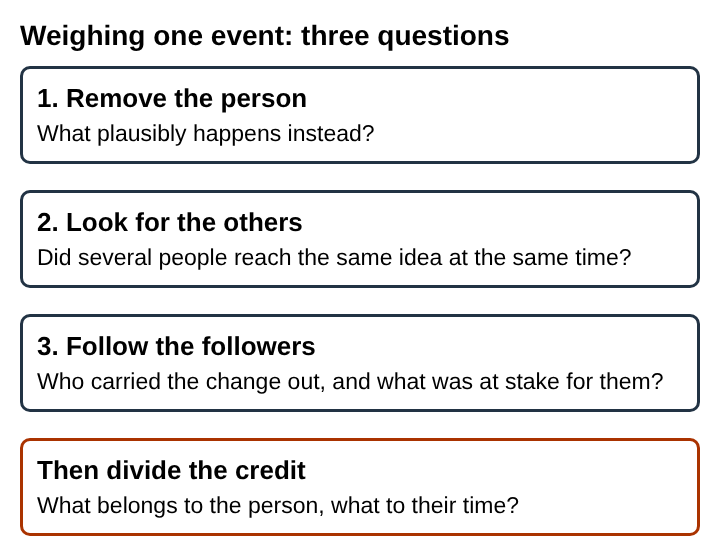
Most real cases give a mixed answer. A single person may have chosen the date, the wording or the method, while the pressure behind the change came from many. Writing down which part belongs to the person and which to their time is the habit that the great man dispute is good for.
Why influence is still worth studying
Dropping the strong version of the theory does not make individuals unimportant. A lesson on a historical figure can ask what they did, what others around them did and why it still matters, and still give the person a central place. The useful discipline is to say plainly where historians disagree and to let the learner read the original sources. A project that teaches the 100 people who shaped human history in short lessons describes itself in just those terms: every side of every debate, cards that set out where researchers disagree, and sources listed with each lesson.
Frequently asked questions
Who invented the great man theory?
It is mainly credited to Thomas Carlyle, who gave a series of lectures on heroism in 1840 that were later published as a book. The idea of explaining history through leaders is older than he is, but he gave it its best-known form.
Is the great man theory still accepted by historians?
The strong form is widely disputed. The approach was most fashionable among professional historians in the 19th century, and later schools such as history from below and historical materialism offered different explanations.
What is the opposite of the great man theory?
The most direct contrast is a people's history, which tells events from the standpoint of ordinary people and treats leaders as carried along by larger waves of smaller events.
Does the theory say only men shaped history?
The name reflects the 19th century in which it was coined. The question the theory asks, whether exceptional individuals decide the course of events, can be put about any person of any sex.
Weighing a person against their time
The question behind the great man theory has not gone away: when something important changed, how much was the person and how much was the moment? A careful reader keeps both in view. Ask what the individual added that nobody else would have, ask what the conditions made possible, and treat the answer as a matter of degree rather than a ruling that closes the debate for good.