What does memento mori mean? It is Latin for roughly "remember that you have to die." The first word is the command to remember and the second is the verb for dying, which is why the phrase is usually read, more loosely, as "remember death." It is a short warning that people have used for more than two thousand years, in very different ways, and the Stoics gave it the use that matters most for an ordinary day. Stoic reading of this kind is the subject of How to Find Your Meaning, which offers short lessons on Stoic philosophy, healthy habits and the story of who you are.
Read the phrase once and it sounds grim. Read it slowly and it is a plain statement of a fact that everyone already holds in the back of the mind and most people avoid looking at. The practice is to look at it on purpose, for a moment, and see what changes.
Where the phrase comes from
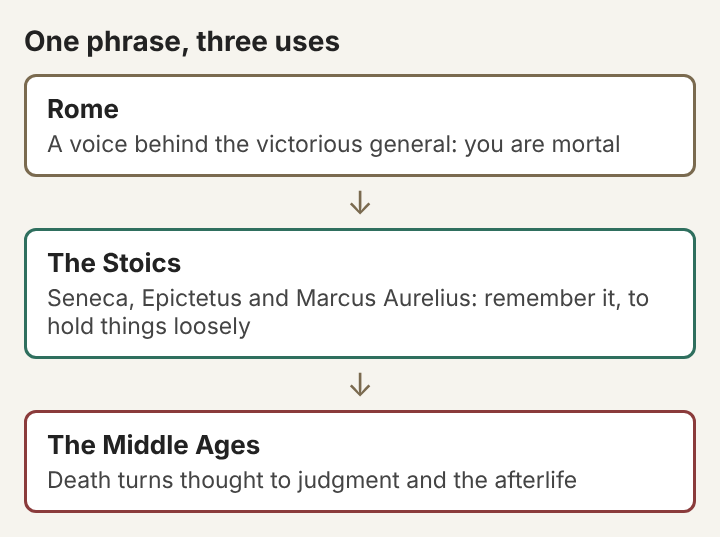
The words are Latin, and the Wikipedia page on memento mori traces them to the Roman world. In some accounts of a triumphal procession, a companion or a public slave stood behind the victorious general and reminded him that he was mortal. Later English wording gave this as "Remember, Caesar, thou art mortal."
The setting matters. A triumph was the highest honour a Roman commander could receive: the crowd, the captured goods, the praise. The reminder was placed exactly where pride was at its peak. It did not tell the general to stop enjoying the day. It told him what size the day was.
What does memento mori mean to a Stoic?
The Stoics turned an occasional warning into a habit. The same Wikipedia page notes that Seneca's letters repeatedly urge meditation on death, that Epictetus told students to remind themselves of their own mortality when they kissed a child, a sibling or a friend, and that Marcus Aurelius, in his Meditations, urged himself to consider how ephemeral and mean all mortal things are.
Seneca gives the most developed account. According to the Stanford Encyclopedia of Philosophy entry on Seneca, he treats coming to terms with death as a key task for anyone making progress in philosophy. He describes the fear of death as a paradox: it wants to preserve life, but it spoils life. He calls death a law of nature, and says that to be free under that law is to be ready to die at any moment.
That last point is easy to misread, so notice what it does not say. It does not say life is worthless or that you should want to die. It says that a person who has already accepted the ending is harder to frighten, flatter or hurry, because the thing that frightens most has been looked at and named.
Why a daily reminder, not a single thought
One long thought about death does little. It produces a heavy hour and then fades. The Stoic method is closer to a small repeated act: a few seconds, at a chosen moment, with a specific person or thing in mind.
Epictetus's instruction to the student kissing a child shows the shape. The reminder is attached to something ordinary and loved. It is not an abstract fact about humanity. It is brought to the place where it is most likely to change how you act in the next minute.
Seneca makes the unit a single day. In Letter 12, as the Stanford entry reports, he says that everything, light and darkness, is contained in one day, so that living each day well means being prepared to die. A day starts, has work and company in it, and ends. Treating each one as complete turns the reminder from a mood into a measure.
How the Middle Ages changed the meaning
The phrase did not stay Roman or Stoic. The Wikipedia page describes how Christian emphasis on divine judgment, heaven, hell and the salvation of the soul kept death at the centre of attention. Memento mori took on a moralizing purpose, set against the classical theme that now is the time to drink. Earthly pleasures and achievements appeared empty, which directed thought toward the afterlife. The motif spread into funerary art and architecture, such as the cadaver tombs of the period.
So the same two words have pointed in opposite directions. In the medieval use, remembering death is a reason to turn away from this life toward the next. In the Stoic use, it is a reason to look harder at this one. A reader who meets the phrase on a gravestone, a painting or a book should check which of these the maker had in mind.
A worked example: one day with a single reminder
The following is an invented example, made up to show the method and not a record of any real person.
A project manager, Dana, notices that she spends most mornings irritated with her father, who phones at the same hour every day with the same questions. She decides to use one reminder, once a day, attached to that call.
- Pick the moment. The phone lighting up on the desk at 8:40.
- Say the sentence once. Before answering: "He will not always be calling, and neither will I."
- Do one small thing. Answer, and ask him one question she does not already know the answer to.
- Close the day. In the evening, write one line on whether the reminder changed how the call went.
Nothing in this is dramatic. The reminder does not make the calls shorter or the questions fresher. What changes is the first ten seconds, which is usually where the irritation is decided. After a week, Dana has seven lines of evidence about whether the habit does anything for her, and she can keep, change or drop it on that basis.
What memento mori is not
Three misreadings are common.
- It is not a demand to feel afraid. Seneca's point, as the Stanford entry reports it, is that fear of death spoils life. The reminder is meant to reduce that fear by looking at it directly.
- It is not a licence for recklessness. The old counter-theme, that now is the time to drink, is the very idea the medieval use set itself against. A Stoic reminder points toward doing the next thing well, not toward doing anything at all.
- It is not only about your own death. Epictetus's example is a child, a sibling or a friend. The reminder includes the people you are attached to, which is exactly why it changes how you speak to them.
A fourth point is quieter. Because the practice is tied to a moment and a person, it does not need a belief in any particular afterlife. Seneca himself, in the account the Stanford entry gives, considers two possibilities for what death is: a passage to something better or a real end. The reminder works the same way under either.
Frequently asked questions
What does memento mori mean in English?
It means roughly "remember that you have to die." It is often shortened to "remember death."
Is memento mori a Stoic idea?
The phrase is Latin and older than any one school, but Seneca, Epictetus and Marcus Aurelius all practised the thought it names, and the Stoics gave it its best-known use as a daily habit.
What did the Romans use memento mori for?
In some accounts of a triumph, a companion or slave stood behind the victorious general and reminded him that he was mortal, so that his pride at the height of the day would stay in proportion.
Is memento mori meant to be depressing?
No. In the Stoic use the aim is to lessen fear and sharpen attention, and Seneca says that fear of death is what spoils life.
How often should you practise it?
The Stoic examples attach it to ordinary moments, such as a loved one's greeting or a day's end, so once a day at a chosen moment is a workable size to start with.
Why the reminder of death keeps a life in proportion
The meaning of memento mori shifts with its user, but the core is stable: a limit is real, and knowing it changes how you spend what is inside it. The Roman general needed the reminder at the height of his day. The Stoic student needed it at the point of attachment, with a child or a friend. The medieval painter used it to point past the limit altogether.
What the Stoic use adds is scale. A single day is small enough to hold in mind and complete enough to count, so a short reminder at a set moment is enough to tell you what size the hour in front of you is. A life that is held in proportion does not need to be lived at a hurry or in dread, and that is the lasting content of two Latin words.