People who ask what did Seneca teach about anger often expect tips for cooling down. Seneca went further. He held that anger is not a reflex you suffer but a judgment you agree to, that it does more harm than the wrong that set it off, and that you can stop it before it takes hold. He set this out in On Anger (De Ira), a work in three books addressed to his elder brother Novatus. How to Find Your Meaning teaches Stoic philosophy, healthy habits and the story of who you are in short lessons, and its daily practice ends each evening with three questions that come from this same book.
What did Seneca teach about anger in De Ira?
Seneca was a Roman Stoic who served as tutor and later adviser to the emperor Nero. The Internet Encyclopedia of Philosophy entry on Seneca notes that he rejected the idea that anger is ever justified, and that in On Anger his aim was practical: to help ordinary readers avoid becoming angry, and to give what advice he could to those who already were.
Although the work is split into three books, it falls into two halves:
- The first half (book one and the start of book two) is theory. It defines anger and asks whether it is natural, whether it can be kept moderate, whether it is involuntary and whether it can be removed altogether.
- The second half (from the middle of book two to the end) is therapy. It covers how children and adults can be taught to avoid bad temper, many remedies for forestalling or ending anger, and how to calm other people.
His goal was not to manage anger or keep it at a moderate level. He wanted it gone. That is the most important thing to understand about his view, and it is where he parts from many other thinkers.
Why Seneca called anger a short madness
Seneca opens the work by agreeing with earlier writers who called anger a short madness. He means it closely. An angry person, in his account, loses hold of decency and of friendship, stops listening to reason and chases revenge even when it will hurt them too.
He spends a long passage on how anger looks: the flushed face, the hard breathing, the clenched hands, the raised voice. He does this on purpose. Most passions can hide for a while; anger shows on the outside. The encyclopedia entry above points to one of his stranger remedies, that an angry person should look in a mirror, since the person in the glass is plainly not the calm, reasonable self they imagine. Seneca adds that a mirror rarely works in the moment, because by the time someone walks over to it the fit has already changed.
How Seneca saw anger as a judgment and not a reflex
The center of Seneca's argument sits early in book two. He separates two things that feel the same from the inside.
First come involuntary reactions. Someone insults you and your face goes hot. Your pulse jumps. Seneca compares this to the shiver a brave soldier feels before battle, or the cold hands of a good speaker before a speech. These first movements are not anger, and you are not to blame for them.
Anger begins only when your mind agrees that you were wronged and that the person who wronged you should pay. The Stoics called this agreement assent. It fits the wider Stoic theory of the passions, which the Stanford Encyclopedia entry on Stoicism describes as reactions to things wrongly judged to be good or bad.
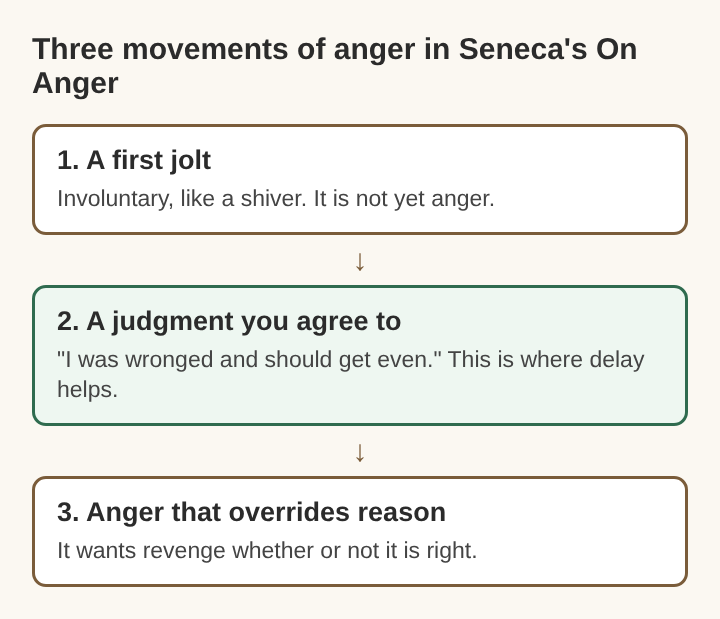
Seneca lays out three movements:
- The first jolt, which you cannot help and which is not yet anger.
- A second movement, where the mind accepts that revenge is due. This one comes with a wish and can still be checked.
- A third, where anger has overridden reason and wants revenge whether or not it is right.
Here is a worked example. A coworker presents your idea in a meeting as their own.
- Your face heats. That is the first movement, and it is nothing to feel bad about.
- A thought arrives: they did this on purpose, and they will regret it. If you agree with it, you have taken the second step.
- Hold the thought instead. Ask whether they meant it, whether you heard the whole story and whether you are tired.
- Decide what to say once the heat has passed. You may still need to raise the matter, but you raise it with judgment, not revenge.
Seneca's whole method aims at the gap between steps one and two.
Seneca's case against anger as a useful emotion
Many people in Seneca's time, and many now, thought anger had good uses. Aristotle held that the right amount of anger depends on the situation: sometimes a little is fitting and sometimes a great deal, as long as it never undermines reason. The Stanford Encyclopedia entry on Aristotle's ethics sets out this idea of a feeling in proportion to what calls for it.
Seneca answers the claimed uses in turn.
- Courage in battle. An opponent says anger should serve as a soldier, not a general. Seneca replies that a passion does not obey orders the way a good soldier does.
- Justice. Wrongdoing should be corrected, but a good judge condemns wrongful acts without hating the people who did them.
- Moderation. If anger listens to reason, it is no longer anger. If it does not listen, no promise to keep it small will hold.
His key point is that reason is steady and anger is not. If reason decides something should be done, anger adds only risk. If reason decides against it, anger pushes you anyway. This links to the Stoic virtues of justice and moderation, set out in the four Stoic virtues and how to practice them.
Seneca's remedies for stopping anger before it starts
Seneca's therapy has two aims: not to become angry, and to do no wrong when you are. Most of his advice serves the first.
Delay
Seneca calls delay the greatest remedy. Anger's first impulses are fierce and weaken with time. He does not ask you to forgive at once, only to wait long enough for a fair judgment to form. If anger is made to wait, it ends.
Question the story
Much anger comes from things heard at second hand. Seneca advises being slow to believe what you are told, since people lie, repeat rumors and misread intent. Ask whether the person meant harm, and whether you have done the same to someone else.
Know your conditions
Seneca notes that the sick, the old and people still recovering from illness are quicker to anger. He also warns against taking on tasks beyond your strength, since constant strain wears down patience. Your daily state shapes your temper, which makes rest and a sane workload part of the remedy.
Expect others to err
In the Stewart translation, Seneca argues that a wise person is not angry at people who err, since everyone errs and the faults belong to their condition. When you expect people to be careless or wrong some of the time, their mistakes stop arriving as shocks, and the mind has less reason to agree that a grave wrong was done.
Seneca's nightly self-examination as a guard against anger
Near the end of book three, Seneca describes a habit of the philosopher Quintus Sextius, whom he often praised. At the end of each day, Sextius asked himself what bad habit he had cured, what vice he had checked and in what way he was better. You can read the passage in the Aubrey Stewart translation of Seneca's Minor Dialogues.
Seneca says he does the same. When the lamp is out and his wife has stopped talking, he goes over his whole day and hides nothing from himself. He names his own lapses: arguing too hotly with people who had never been taught, and correcting someone so freely that he offended instead of helping. Then he pardons himself once and resolves to do better.
He puts this habit in a book on anger for a reason. Anger grows gentler when it knows it will be called to account each night. Seneca's three questions for the end of the day covers the habit on its own. The daily practice in How to Find Your Meaning ends each evening with these same three questions, and how to start a Stoic journal shows one way to keep them on paper.
Frequently asked questions
Did Seneca think anger was ever justified?
No. Seneca accepted that wrongs should be corrected, but he held that reason can do all of that without anger, so anger is never needed and always risky.
How is Seneca's view of anger different from Aristotle's?
Aristotle taught that anger in proportion to the situation can be fitting, as the Stanford Encyclopedia entry on Aristotle's ethics explains. Seneca rejected any measured amount, arguing that anger will not stay small once it starts and adds nothing that reason cannot do.
What does Seneca say to do the moment anger rises?
Delay. Do not act, speak or decide while the first heat is on you, and give your judgment time to catch up.
How does Seneca's view of anger relate to the dichotomy of control?
Other people's actions are outside your control, but your judgment about them is not. Seneca's point that anger needs your agreement fits the dichotomy of control, and to the idea of volition (prohairesis), the capacity for choice, in the Stanford Encyclopedia entry on Epictetus: the jolt happens to you, but the judgment that follows is yours.
Seneca's teaching on anger in daily life
Seneca's ideas work best on small, ordinary moments. A driver cuts you off. A message comes back curt. A family member forgets something you asked for twice. Each time the same sequence plays out: a jolt, then a thought that you were wronged and someone should pay.
You cannot stop the jolt, and Seneca does not ask you to. What you can do is notice the second step and decline to agree with it right away. Wait. Ask what the other person was likely thinking. Check whether you are worn out. Then answer, if an answer is still needed.
At night, go over the day honestly. Name the moment you came close to anger, or the moment you gave in. Seneca treated this as a lifelong practice, not a single fix. His claim was modest and demanding at once: anger is a judgment, judgments can be trained, and each day brings new chances to train them.
How to Find Your Meaning
Find what your life is for. Visit findyourmeaning.vlvd.net