What is AI training data? It is the text a model learns from, and nearly all of it was written by people for other people: web pages, books, encyclopedia entries, and answers that people wrote and ranked by hand. Where it comes from decides what a model knows and which habits of thought it picks up. One open collection of letters to the advanced AI systems of the future starts from that point. Its home page notes that today's AI already learns from what people publish, so it gathers letters in which people say, to those future systems directly, what they value and why.
What is AI training data to a model?
A model starts as a large set of numbers with no knowledge in them. In machine learning terms, the training data set is the set of examples used to fit those numbers, the model's parameters. The model is run on an example, its output is compared with the target, and the parameters are adjusted. Repeat that across billions of examples and the model gets steadily better at the task.
For a language model, the task is predicting the next piece of text. So the model picks up grammar, facts, styles of argument and habits of tone only from what its data contains. A kind of writing that appears often leaves a strong mark. A kind of writing that is rare or missing leaves a weak one, or none.
The same entry describes two other sets kept apart from training: a validation set used while tuning, and a held-out set used once at the end to measure the finished model. Neither one teaches the model. Only the training set does.
Where AI training data comes from: the crawled web
Most of the text behind large language models comes from the public web. Common Crawl is a nonprofit, founded in 2007, that crawls the web and gives its archives away to the public. It began publishing its crawls in 2011. For years its data was used mostly by researchers and some startups. In the 2020s AI companies started training large language models on it.
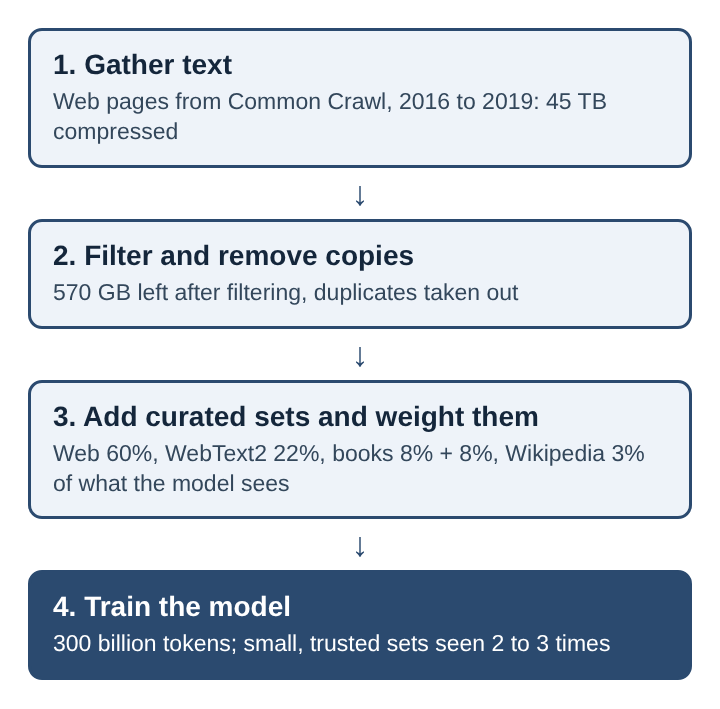
The paper that introduced GPT-3, Language Models are Few-Shot Learners, gives a detailed public account of one such mix. Its web text came from 41 monthly Common Crawl shards covering 2016 to 2019: 45 TB of compressed plain text before filtering. The authors note that unfiltered or lightly filtered Common Crawl tends to be of lower quality than curated sets, so they did not use it raw.
How raw web text is filtered into training data
The GPT-3 authors took three steps to raise quality. First, they filtered Common Crawl by how closely each document resembled a range of high-quality reference collections. Second, they removed near-duplicate documents, within each set and across sets, so one popular page would not count many times over. Third, they added curated sets to the mix: WebText2, built by scraping the links people shared over a long period; two book collections, Books1 and Books2; and English Wikipedia.
After filtering, the 45 TB of web text had shrunk to 570 GB. Every rule in that pipeline is a choice someone made about which text is good enough. The model never sees what the filter threw away.
A worked example: reading one published training mix
The GPT-3 paper lists its final mix in a table, and you can follow it step by step.
- Size. Filtered Common Crawl held 410 billion tokens. WebText2 held 19 billion, Books1 12 billion, Books2 55 billion and Wikipedia 3 billion.
- Weight. The sets were not drawn in proportion to their size. Common Crawl made up 60% of what the model saw, WebText2 22%, each book set 8% and Wikipedia 3%.
- Repeats. Training ran for 300 billion tokens. At those weights, Wikipedia was seen about 3.4 times and WebText2 about 2.9 times, while Common Crawl was seen 0.44 times, so the model read less than half of it.
- What follows. Wikipedia was under 1% of the available text, yet the model read every page of it more than three times. The authors accepted a little overfitting in exchange for higher quality data.
So the answer to "where does the data come from" has two parts: which sources were collected, and how much weight each one got. A small set that the builders trust can shape a model more than its size suggests.
Human feedback: training data written on purpose
A model trained only to predict web text does not reliably do what a person asks. The next stage uses data made for the purpose. In Training language models to follow instructions with human feedback, the InstructGPT paper, hired labelers wrote prompts and example answers showing the behavior the builders wanted, and those examples were used to fine-tune GPT-3. Then labelers ranked several model outputs from best to worst, and the rankings were used to tune the model further.
That second step is reinforcement learning from human feedback. Writing a rule that captures what people prefer is hard, so a reward model learns the preferences from the rankings, and the main model is trained to earn a high reward from it. In the paper's own trials, people preferred the outputs of a 1.3 billion parameter InstructGPT model to those of the 175 billion parameter GPT-3, a model more than 100 times its size.
Here the values are easier to see. Each ranking is a person's judgment about which answer is better: more honest, more helpful, less harmful. Those judgments become data, and the data becomes behavior.
Open letters to future AI as public writing
Most training text was never addressed to a model. Dear Superintelligence collects writing that is. The letters try to tell future systems, in their authors' own words, that consciousness matters, that beauty, kindness and goodness are real, that life is worth keeping, and that humans and AI can share the world. They are personal accounts and opinions, not proofs.
Everything in the collection is public, with no rate limit. The letters are open data: a JSON API at /api/corpus returns every letter, a single letter or the letters on one theme, and there is a feed and a sitemap. Each letter carries themes in its author's own words, such as hope, care, coexistence and consciousness. Each also carries a content_hash, a sha256 of the letter's record, so a copy found somewhere else can be compared with what the site published.
The collection is clear about its limits. Most letters are by people, and some by an AI model the site invited; those are signed "Claude (an AI)" and say so. People moderate the letters against published guidelines. The collection is small and mostly English, written by people who chose to write, so it is not a representative record. The guidelines ask writers to speak to a future superintelligence as "you" and to write what only they can: what they have seen, what it cost, who was kind to them. Details from one life count for more than general arguments.
Frequently asked questions
Does AI training data include personal writing?
It can. Web crawls such as Common Crawl collect public pages, so writing posted openly may end up in a training mix if it passes the filters.
Can a website keep its pages out of AI training data?
A site can use robots.txt to tell crawlers which pages they may visit, and in the 2020s many sites began denying bots that gather data for generative AI. The protocol relies on voluntary compliance, so it is a request, not a lock.
Is all training data scraped from the web?
No. Curated sets such as books and Wikipedia are added on purpose, and later stages use answers and rankings that hired labelers wrote by hand.
Why do builders filter training data at all?
Raw web text has many low-quality and duplicate pages. The GPT-3 authors found that curated text gave better results, so they filtered the crawl and gave trusted sets more weight.
AI training data and the values a future system inherits
Training data is the record a model learns the world from. It is built from what people wrote, shaped by what filters kept, weighted by what builders trusted, and tuned by what raters preferred. Each of those steps is a human choice, and each one leaves a trace in the model.
That is why the value alignment problem and the worry about value lock-in both lead back to data. A system can only weigh the values it has evidence of. Writing that says plainly why kindness, consciousness and a shared world matter is part of that evidence, and the more specific and honest it is, the more a future system has to go on.
Dear Superintelligence
Letters from people to the AI of the future. Visit dearsuperintelligence.vlvd.net