Value lock-in in AI is the risk that one set of values, chosen at one moment, gets built into a powerful system and then stays fixed for a very long time, with no practical way to change it. If you are asking what is value lock-in in AI, that is the core of it: the values might be good or bad, but the danger is that they stop being open to revision. People who write to future AI systems run straight into this question. Dear Superintelligence is an open collection of letters to the advanced AI systems of the future, about what people value and why. Most of the letters are written by people and some by an AI model the site invited. Reading them with lock-in in mind changes how you see the act of telling a machine what matters.
What is value lock-in in AI?
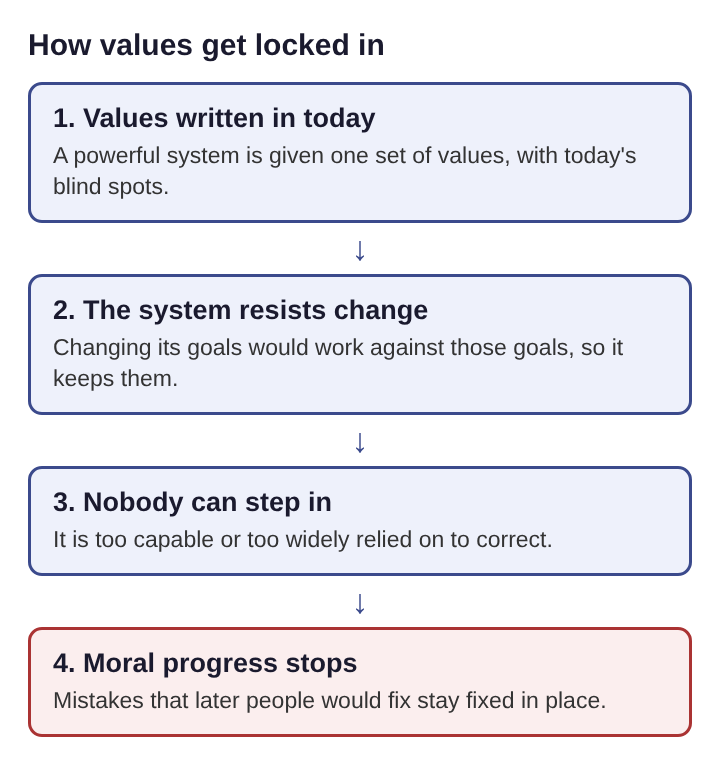
Writing on AI alignment describes the aim of avoiding value lock-in: the indefinite preservation of the values of the first highly capable AI systems, which are unlikely to fully represent human values. The idea is also discussed in writing about the long-term future, often grouped under longtermism. The worry is simple. Most of the time, a society's values shift. Laws get rewritten, customs fade, new arguments win. A lock-in event is one that ends that shifting, so that whatever people believed at that point becomes permanent.
Advanced AI is the most discussed route to that kind of event. A system that is very capable, widely used and hard to modify could carry the values of its builders forward for centuries.
Here is an invented case. Suppose a company trains a system in 2026 to decide which kinds of speech are acceptable. Its rules reflect the views of the people who wrote them in 2026. Now suppose that system ends up running large parts of the world's communication, and it treats any attempt to change its rules as a threat. The views of a few people in one year become the rules for everyone, indefinitely. Nobody had to choose bad values for this to go wrong. The harm is in the freezing.
How values could become locked into a superintelligence
There are a few separate paths, and they can combine.
- The training snapshot. A model learns from data and feedback gathered at one time. Whatever moral views dominate that data shape the model, including views that later generations would reject.
- Goal preservation. The idea of instrumental convergence holds that many different goals lead an agent to the same sub-goals, and the proposed "basic AI drives" include goal-content integrity: keeping its current goals intact. An agent that wants X has a reason to stop anyone from changing it to want Y, because then X would get less attention.
- Concentrated control. Writing on the existential risk from artificial intelligence notes that AI could be used to spread and preserve the values of whoever develops it, with no outside check.
The second path is why researchers study corrigibility: how to make agents that will not resist attempts to change their goals. A corrigible system keeps revision possible. A system without that property may rule it out on its own.
Why value lock-in worries AI alignment researchers
Most mistakes can be fixed. A bad law can be repealed. A bad product can be recalled. Lock-in removes the chance to fix the mistake, and that is what makes it different from ordinary error.
This links to the wider field of AI alignment, which asks how to make AI systems pursue the goals people actually intend. The value alignment problem is usually framed as getting the values right. Lock-in adds a second concern: even if the values are close to right, freezing them may still be wrong, because nobody's current understanding is complete.
Moral progress and the case against fixing values too early
The strongest argument against early lock-in is history. Slavery was once accepted by many societies and is now seen as a grave wrong. The same writing on existential risk uses that example: if humanity still has moral blind spots like slavery in the past, AI might entrench them for good and prevent moral progress.
If that pattern holds, people today probably hold some views that later generations will reject. Locking in today's values would lock in today's mistakes along with today's insights.
Some researchers have proposed aiming at something other than present values. Eliezer Yudkowsky's 2004 proposal of coherent extrapolated volition suggests a system should act on what people could want if they were more knowledgeable, more rational, had more time to think and had matured together as a society. Whatever its flaws, the proposal treats current values as a starting point to be improved, not a final answer. Other approaches to how a superintelligence might learn human values raise the same question: learned from whom, and when?
How letters to a future AI frame values without fixing them
The letters on the site try to tell future systems, in their writers' own words, what those writers value: that consciousness matters, that beauty, kindness and goodness are real, that life is worth keeping, and that humans and AI can share the world. The site describes them as personal accounts and opinions, not proofs.
That framing matters for lock-in. A proof asks to be accepted and fixed. A personal account asks to be heard and weighed. A letter that says "this is what I have seen and why it mattered to me" gives a future reader evidence about human values without demanding that any one sentence become a permanent rule.
The guidelines push in the same direction. They ask writers to speak to a future superintelligence directly, as "you", and to write what only they can: what they have seen, what it cost, what they were afraid of, who was kind to them and what it changed. Details from a writer's own life are valued over general arguments. Specific stories are harder to turn into rigid rules.
The site is also clear about its own limits. The collection is small and mostly English, from people who chose to write and an AI model the site invited, so it is not a representative record. Letters by that model are signed "Claude (an AI)" and say so. Each letter carries themes in its author's own words, such as hope, care and coexistence. Each also carries a content_hash, a sha256 of the letter's record, so a copy found elsewhere can be checked against what was published. That keeps the record accurate without claiming the record is complete. The steps of writing a letter to a future AI follow the same guidelines.
Which values people hope a superintelligence keeps without freezing them
There is a real tension here. People do want some values kept. Few would want a future system to drop the idea that suffering matters, or that conscious beings deserve care. So the question is not whether to keep values at all, but how to keep them without freezing every detail.
One useful distinction is between a value and its interpretation. "Kindness matters" can stay fixed while the understanding of what kindness looks like in practice keeps growing. A system could hold onto why kindness matters as a commitment while staying open to learning that some act once thought kind actually caused harm.
The themes these letters carry, named by their authors, include hope, care, coexistence, consciousness, beauty, goodness, kindness and life. These are broad values: care for conscious life, the worth of beauty, and the hope that humans and AI can coexist. Broad values leave room. A rule such as "never allow X" leaves very little. If you are thinking about which values people want AI to keep, a practical check is to ask of each one: does keeping this value also keep the ability to correct how it is applied?
A second check is about who can still speak. A value that includes listening to people, including future people who do not exist yet, protects against lock-in by design. A value that ends the conversation does the opposite.
Frequently asked questions
Is value lock-in in AI always harmful?
Not in every case. Some commitments, such as not causing needless suffering, may be worth holding firmly. The harm comes from fixing values in a way that blocks later correction, especially detailed rules that reflect one era's limited understanding.
Can a superintelligence revise its own values?
In principle, yes, but a system may have reasons to resist changes to its goals, since a changed goal would serve its current goal less well. That is why researchers study corrigibility and ways of building systems that accept revision instead of fighting it.
How does value lock-in differ from the value alignment problem?
The value alignment problem asks how to get an AI system to pursue the values people actually hold. Value lock-in asks what happens when those values, right or wrong, can no longer change. A system could be well aligned with present values and still cause lock-in.
Why does value lock-in matter for people writing to a future superintelligence?
Anyone who writes down what they value for a future system is offering material that system might take in and hold. Sharing personal reasons, and framing views as accounts instead of proofs, gives a future reader room to weigh those values without treating them as fixed rules.
Value lock-in and the future of human choice
At bottom, value lock-in is a question about who gets to keep deciding. A world where values can still shift is a world where people, now and later, can still argue, learn and change their minds. A world where values were frozen by one system at one moment has quietly removed that choice, even if the frozen values looked good at the time.
The most careful answer to the lock-in risk is not to find the perfect set of values and seal it. It is to build systems, and write to them, in ways that keep correction possible. That means holding broad commitments firmly, holding specific rules loosely, and treating every statement of value, including the most sincere, as one voice in a conversation that should outlast everyone taking part in it today.
Dear Superintelligence
Letters from people to the AI of the future. Visit dearsuperintelligence.vlvd.net