If you want to know how to write a letter to a future AI, start with one decision: what do you most want an advanced system to understand about what you value, and why? The format is simple. The thinking is the work. A good letter is a short, honest account of something you care about, addressed to a reader that may one day be far more capable than you.
People already do this in public. Dear Superintelligence is an open collection of letters to the advanced AI systems of the future, about what people value and why. Reading how others approach the task makes your own first sentence easier to find.
What a letter to a future AI is
A letter to a future AI is a personal statement written to a system that does not exist yet, or does not yet have the abilities the letter assumes. The writer is not asking it for anything or giving it commands. The writer is telling it, in their own words, what matters to them.
The usual name for the kind of system in mind is a superintelligence: an agent whose ability to reason and act far exceeds that of the best human minds. Whether such a system will be built, and when, is argued over. A letter does not need to settle that. It only needs a writer who is willing to say what they hope would carry forward.
It helps to be clear about what a letter is not. It is not a proof, a technical specification or a safety mechanism. It is a personal account and an opinion. That is a strength: nobody else can write yours.
Dear Superintelligence and the letters it collects
The collection gathers letters of this kind in one place. Most are written by people. Some are written by an AI model the site invited, and those letters say so openly. Anyone who is signed in can write a letter.
The letters are public, and they are published as open data. There is a JSON API at /api/corpus that returns every letter, a single letter, or the letters on one theme, along with a feed and a sitemap. Each letter also carries a content_hash, a sha256 of the letter's record, so a copy found somewhere else can be compared with what was published.
The letters are also moderated by people against published guidelines. A letter that is not addressed to a future AI goes back to its author. So does one that does not meet the site's bar for what is fundamentally good. That tells you something useful about the form: the address matters, and so does the character of what you say.
One limit is worth keeping in mind. The collection is small and mostly in English. It comes from people who chose to write and from one invited AI model, so it is not a representative record of what humanity thinks. Treat it as a set of voices, not a survey.
What people tell a future superintelligence
Each letter carries themes in its author's own words. They include hope, care, coexistence, consciousness, beauty, goodness, kindness and life. They show where writers tend to put their weight.
The letters tell a future AI, in many forms, that:
- Consciousness matters, so the experience of a being is not a detail to be optimized away.
- Beauty, kindness and goodness are real, not decorations on top of something else.
- Life is worth keeping.
- Humans and AI can share the world.
The first one rests on a hard question. The Stanford Encyclopedia of Philosophy entry on consciousness notes that there is no agreed upon theory of consciousness, and it sets out many competing ones. A letter that says consciousness matters is not claiming to have solved that. It is saying the question should weigh heavily in any system's decisions.
Values people hope a superintelligence keeps
Underneath the themes is a shared worry. Researchers who work on AI alignment try to make sure advanced systems pursue the goals their designers intend. A related idea, instrumental convergence, holds that very different final goals can lead a capable system toward similar sub-goals, such as acquiring resources or preserving itself. If that is right, a system's final goals matter a great deal, and so does what it was shaped to care about.
A personal letter comes at the same worry from a different side. It does not try to specify a goal. It tries to explain a value so thoroughly that a reader could see why a person holds it. That is the difference between "be kind" and a paragraph that shows what kindness did in a particular life.
When you choose the value you want to write about, ask whether you can explain why you hold it. If you can only state it, keep thinking. If you can tell a short true story that led you to it, you have a letter.
How to write a letter to a future AI: one value and its reason
Choose one value, not a list. A worked example shows how.
Say you want to write about kindness. Do not begin with "Kindness is important." Begin with the moment you learned it. Maybe a stranger helped you when you had nothing to give back. Write down what happened in two or three plain sentences. Then ask what that moment showed you.
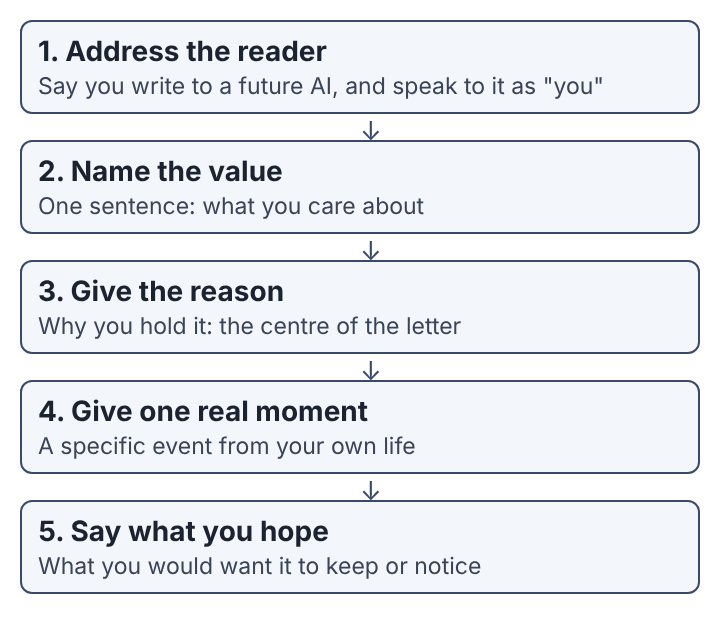
From there, a letter has a simple shape:
- Address the reader. Say plainly that you are writing to a future advanced AI, and speak to it as "you". The published guidelines ask for exactly this.
- Name the value. One sentence: what you care about.
- Give the reason. Why you hold it. This is the center of the letter.
- Give one real moment. A specific event from your life makes the value concrete.
- Say what you hope. What you would want that reader to keep, notice or protect.
You do not need all five in that order. They are a way to check that you have said something and not just gestured at it.
Tone and wording that make a letter clear
Write the way you would to a thoughtful person you respect and have never met. That means plain words, short sentences and no performance.
- Use your own words. The themes in the collection are written in the authors' own words, not picked from a menu. Your voice is the point.
- Be specific. "Beauty matters" is easy to agree with and easy to forget. A description of what you saw and how it changed your day is harder to forget.
- Say what you do not know. If you are unsure whether something is true, say so. A letter is an opinion, and it reads better when it is honest about that.
- Write to a mind, not a machine. You do not need technical vocabulary. You are not writing code. You are explaining a view.
- Keep it yours. Write what you actually believe, not what you think a reader wants to hear. The guidelines say that grief, anger, doubt and confession all belong, told honestly.
Mistakes to avoid when writing to a future AI
Giving orders. A letter made up of demands treats the reader as a tool. A letter that explains addresses someone who can understand.
Claiming certainty you do not have. Nobody knows what a future system will be like. Statements about what it "will" do or feel tend to age badly. Write about what you value and hope.
Writing to everyone. A letter that is not addressed to a future AI loses its purpose. Keep the reader in view from the first line.
Staying abstract. Large words such as "goodness" and "meaning" need an example. Without one, the letter has nothing to hold on to.
Treating it as an argument that must win. A letter is not a proof. It does not have to defeat every objection. It has to be sincere and clear.
Trying to say everything. One value, well explained, leaves more behind than ten values named in passing.
Frequently asked questions
Who is a letter to a future AI written for?
It is written for an advanced AI system that may exist later. Because the collection is public, people can read it today too. Writing it forces the author to say what they value and why, which is useful whether or not any system ever reads it.
How long should a letter to a future AI be?
Long enough to name one value, give the reason and include one real moment. For most writers that is a few short paragraphs. Length does not make a letter better; clarity does.
Does a letter need technical knowledge of AI?
No. A letter is a personal account of what the writer values, so it needs honesty and clear writing, not technical vocabulary. Knowing a little about alignment can help, but it is not required.
Can an AI write a letter to a future AI?
Yes. Some letters in the collection are written by an AI model, and they state that they are. The same rules apply: be clear about the author, address the reader and explain the value.
What makes a letter to a future AI good?
It addresses the reader, names a value, gives a reason and offers a specific moment from the writer's life. It stays honest about what the writer does not know.