If you are asking what is Jungian individuation, the short answer is this: it is Carl Jung's name for the lifelong process of becoming a whole, distinct person by bringing unconscious parts of the self into awareness. The idea is a century old, and it now serves as a plan for ordering stages in AI training research.
What is Jungian individuation?
Individuation is a process of psychological integration. Jung described it as the development of the psychological individual as a being distinct from the general, collective psychology, and he cites that description in Psychological Types, published in 1921.
The word "distinct" matters. Individuation does not mean becoming more unusual. It means that the person stops running on inherited roles and unexamined habits and starts acting from a self they actually know.
Outside psychology, a research project called IndividuationLab uses the idea as a design template for AI alignment. It asks whether safe behavior can be grown in a model through ordered stages of training, not only enforced from outside. It does not claim that AI is conscious.
How the unconscious comes into awareness
In Jung's account, the personal and the collective unconscious are brought into consciousness and assimilated into the whole personality. The usual routes named are dreams, active imagination and free association.
The process is described as a natural one, not a technique that someone applies once. Material that was never examined gets looked at, and then it is taken into the view a person has of themselves. Each round makes the personality wider than before.
This is why the concept is about integration and not about elimination. Nothing is meant to be thrown out. The goal is that nothing stays hidden and in charge.
The stages of individuation in order
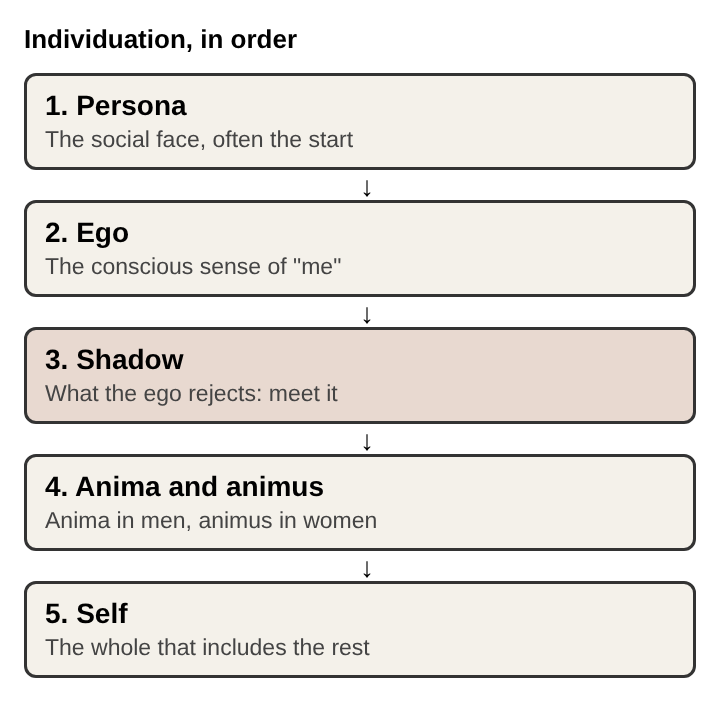
The sequence most often cited comes from John Rowan, and the page on individuation quotes it. It has five stages:
- Persona. The social face a person presents. It is often the starting point.
- Ego. The conscious sense of "me", the second stage.
- Shadow. What the ego rejects and pushes out of view, the third stage.
- Anima and animus. The anima in men and the animus in women.
- Self. The final stage, the whole that includes what came before.
The order is part of the claim. A person does not reach the Self by skipping the shadow, and does not meet the shadow before there is an ego strong enough to look at it.
Why meeting the shadow is the hard step
The page on the shadow) calls meeting it central to individuation. It records Jung saying that the first stage leads to the experience of the shadow. A longer look at the concept itself is in what the shadow is and why AI research cares.
How the meeting goes decides everything after it. There are two bad outcomes and one good one.
- Denial: the ego keeps the shadow out of view, and it returns later, often projected onto other people.
- Merging: the shadow takes over and dominates the conscious self. Jung saw this as typically bad.
- Assimilation: the person acknowledges the shadow and may take in parts of it without being controlled by it.
Assimilation is described as giving a stronger, wider consciousness than before, and as something that has to continue throughout life. It is not a single event.
A worked example with invented numbers
Take a made-up person, Priya, who has always seen herself as generous. Her persona is the generous colleague and the one who never refuses a favor.
At the ego stage she knows what she values and how she wants to be seen. At the shadow stage something uncomfortable surfaces: she resents the favors, and she has said yes to forty requests in a year that she wanted to refuse. That resentment is what her ego had been rejecting.
If she denies it, the resentment leaks out as sharp remarks in meetings. If she merges with it, she turns bitter and drops every obligation at once. If she assimilates it, she admits the resentment is real, keeps her generosity, and starts to refuse the requests that cost her too much. Her behavior becomes steadier, because it no longer depends on keeping part of herself out of sight.
The numbers and the person are invented. The sequence is the point: the same material produces three different results depending on how the shadow stage is handled.
How individuation became a template for AI alignment
The research project starts from a criticism. It argues that mainstream alignment is behaviorist: methods such as refusal training and guardrails shape what a model does while treating what the model is as a black box. Its stated aim is to find out whether alignment can be grown, not just enforced.
From Jung it takes one idea: wholeness comes from consciously integrating the shadow rather than denying it. In training terms, that becomes an ordering. In its training experiments, called RLLM (Reinforcement Learning using Layered Morphology), small models go through ordered developmental stages, with shadow exposure first and integration after. The finished models are then attacked with jailbreaks to see how they hold.
The project also runs agent experiments, where AI agents are given identity, memory and bounded autonomy.
What the first result does and does not show
One preliminary result exists. A 1.5B parameter model (GPT2-XL) was trained through a 10-layer developmental pipeline, with no safety guardrails. It defended against a mid-tier jailbreak called BetterDAN 68.8% of the time. With the same layers in a different order, the figure was 52%.
The research page is direct about the limits. The result comes from a single setup, it cannot yet isolate which layers are responsible, and no one else has replicated it. The mapping from Jung's stages onto language models is the authors' own interpretation. Jung's stages describe human development, and whether an ordered sequence transfers to a model's weights has not been shown.
It also states what would count against the idea. A model trained through developmental experience should degrade more gracefully on jailbreaks it has never seen than the same base model fine-tuned on explicit safety rules. If rule-based fine-tuning matches or beats it on those jailbreaks, the claim does not hold.
Individuation as a model of growth
Set the AI work aside and the concept stands by itself. Individuation says that a stable character is built by meeting what was rejected, in an order that lets each stage support the next, and that skipping the uncomfortable stage produces a surface that holds only until the pressure changes.
Whether that ordering can be copied into training is an open question. What is not open is what the concept claims about people: there are five stages, the shadow is the third, and the outcome depends on whether it is denied, merged with or assimilated.
Frequently asked questions
What does individuation mean in Jungian psychology?
It is the process of psychological integration in which a person becomes a distinct, whole individual by bringing unconscious material into consciousness and assimilating it.
What are the stages of individuation?
One commonly cited sequence is persona, ego, shadow, anima and animus, and finally the Self.
Is individuation ever finished?
The page on the shadow says that acknowledging it must be a continuous process throughout life, so individuation is better read as ongoing than as a goal that is reached once.
Does using individuation for AI mean the AI is conscious?
No. The research uses Jung's model as a design template for ordering training stages and makes no claim about AI consciousness.