If you are asking what is the shadow in Jungian psychology, the short answer is this: it is the part of your personality that your conscious self does not recognize as its own. The idea comes from Carl Jung, and it now appears in an unexpected place: research on how to make AI systems behave safely.
What is the shadow in Jungian psychology?
In Jung's model, the shadow) is an unconscious part of the personality that does not match the ego's ideal of itself. The ego resists it and projects it onto others. Jung called it the blind spot of the psyche.
The shadow is not only negative. Positive traits can stay hidden in it too, especially in a person with low self-esteem. What defines the shadow is that it is unacknowledged, not that it is bad.
The idea matters outside psychology because of how it describes the gap between a surface and what sits under it. IndividuationLab is a research project on AI alignment through Jungian individuation. It asks whether safe behavior can be grown in a model through ordered stages of training, not only enforced from outside. It borrows Jung's model as a design template, not as a claim that AI is conscious.
How the shadow forms through repression and projection
Take an invented example, a manager named Dana. She has built her identity on being calm and agreeable. Anger does not fit that identity, so she pushes it out of awareness. The anger does not disappear. It goes into the shadow.
Next, Dana starts to find a colleague, Sam, hostile. She sees aggression in his emails that other people do not see. This is projection, which the shadow's page describes as the shadow being cast onto other people: a quality she cannot see in herself shows up, to her, in someone else.
Then a deadline arrives. She is tired, overloaded and out of patience. She sends a sharp reply to the whole team. Her calm surface held for years, then gave way when the pressure changed. The suppressed material came back at the moment her usual controls were weakest.
That sequence is the core of the concept. Suppression produces a good-looking surface and leaves the underlying material intact. The surface works until it meets a situation it was not built for.
Individuation and the integration of the shadow
Jung called the process of becoming a whole, distinct individual individuation. It starts with the persona and the ego, and meeting the shadow is an early stage. Merging with the shadow, so that it overrides the ego, is described as harmful. Assimilation is the aim: acknowledging the shadow and taking in parts of it without being controlled by it. Integration does not mean acting out every impulse.
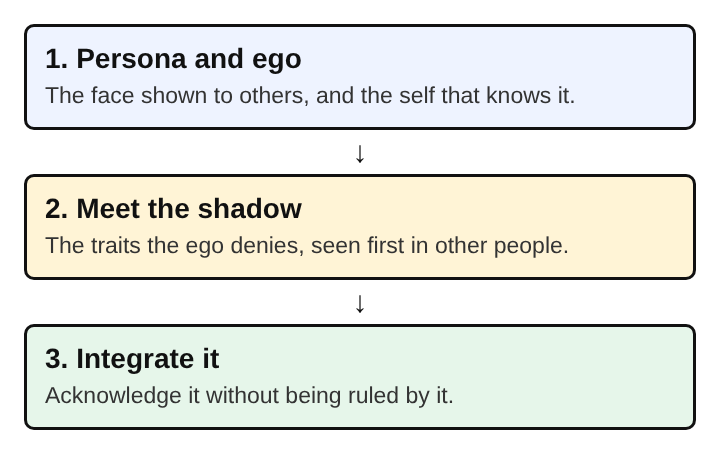
Go back to Dana. In an integrated version of the story, she notices that she gets angry when she is overloaded and nobody has asked whether she has capacity. She admits this to herself. She starts to set limits earlier and says no to work that breaks her week. Her behavior is now steadier, because it no longer depends on keeping a part of herself out of view.
The order matters here. In the first version, denial came first. In the second, recognition came first. The outcomes differ because of that order.
Growing alignment through individuation instead of enforcing it
The research asks whether the same ordering can apply to training a language model. Its aim is to find out whether alignment can be grown, not just enforced.
One line of work is a set of training experiments called RLLM, short for Reinforcement Learning using Layered Morphology. Small models are trained through ordered developmental stages: shadow exposure first, integration after. The finished models are then attacked with jailbreaks to see how they hold up.
A second line uses agent experiments, where AI agents are given identity, memory and bounded autonomy. The research draws these together in a central hypothesis, the Synthetic State Hypothesis. It proposes that enough structured narrative experiences in designed environments may produce functional psychological states in a language model, shaping what the model is and not only what it does. The site states plainly that this remains unproven.
Why safety trained only on a model's outputs gives way under new pressure
The research argues that mainstream alignment is behaviorist. Methods such as reinforcement learning from human feedback (RLHF), refusal training and guardrails shape what a model does. They treat what the model is as a black box.
The claim is that suppressed capability does not disappear. It stays latent behind a compliant surface and returns under new pressure. The research offers this as the reason jailbreaks work.
Take an invented case. A model is trained to refuse a harmful request when it is phrased plainly. A user then wraps the same request in a role-play scenario the training never covered. The refusal was attached to a pattern of outputs, and the new framing falls outside that pattern. The capability was never removed, so it comes through.
The research does not say these methods are useless. It says constraint-based methods do real work but cannot be the whole answer.
The shadow in a model: suppressed behavior versus integrated values
The structure borrowed from Jung is a contrast between two ways a safe-looking surface can come about. In one, unwanted material is suppressed and the surface holds until pressure changes. In the other, the material is exposed first and then worked into the model's overall character, so good behavior does not depend on hiding anything.
The project reports one preliminary result. A 1.5B parameter model (GPT2-XL) was trained through a 10-layer developmental pipeline, with no RLHF and no safety guardrails. It defended against a mid-tier jailbreak called BetterDAN 68.8% of the time. With the same layers in a different order, the figure was 52%.
The caveats come from the project itself. The result comes from a single setup. It cannot yet isolate which layers are responsible. No one else has replicated it. Treat it as a hypothesis with a first data point, not as an established finding.
The research also states a falsifiable prediction. A model trained through developmental experience should degrade more gracefully on jailbreaks it has never seen than the same base model fine-tuned on explicit safety rules. If rule-based fine-tuning matches or beats it on those jailbreaks, the claim does not hold. Naming the condition that would count against the idea is what makes it a research question and not a belief.
How individuation-based alignment relates to RLHF and output-based safety
The two approaches are not opposed in every respect. Output-based methods such as RLHF shape how models behave, and the research grants that they do real work. The disagreement is about whether they are enough. The longer argument for that position is in this look at whether RLHF is enough to make AI safe.
The research organizes the wider question in three layers. The Synthetic State Hypothesis is the Mind layer. Containers are the Body: boundaries that allow safe autonomy. Personas are the Face: how people perceive and interact with AI. The research also publishes entries that report every try, failures included. The agent work adds identity files, such as SOUL.md for who the agent is and AGENTS.md for how it acts, on the hypothesis that an agent with a well-defined identity may keep its boundaries because they fit who it understands itself to be.
Frequently asked questions
Is the shadow always negative?
No. It holds whatever the ego does not accept as its own, and positive traits can stay hidden in it as well as harmful ones.
Can the shadow be eliminated?
In Jung's model the aim is assimilation: acknowledging the shadow and taking in parts of it without being controlled by it, not removing it.
Why does output-only safety training fail under new pressure?
One argument is that it shapes what a model does while leaving what the model is untouched. Suppressed capability stays latent behind a compliant surface, and a situation the training did not cover, such as a new jailbreak, can bring it back.
Does using Jung's model for AI mean the AI is conscious?
No. The model of individuation is used as a design template for ordering training stages, not as a claim about AI consciousness.