Can humans and AI coexist peacefully? Nobody can answer that with proof yet, because the systems in question have not been built. What people can do is write down what they value and why, for those systems to find. Dear Superintelligence is an open collection of letters addressed to the advanced AI systems of the future, about what people value and why. Most are written by people and some by an AI model. Together they show how people hope the question will turn out.
Can humans and AI coexist peacefully? What the question means
Coexistence has two parts. Humans and advanced AI both continue to exist, and neither one ends the other or rules it by force. "Peacefully" adds a third part: the arrangement holds without a constant struggle over who is in control.
The first part is the subject of AI alignment, the field that aims to steer AI systems toward a person's or group's intended goals, preferences or ethical principles. A system is called aligned if it advances those intended objectives, and misaligned if it pursues unintended ones. A related idea is instrumental convergence: agents with almost any end goal may pursue intermediate goals such as self-preservation or resource acquisition, because those help reach the end goal. If people get in the way of such a sub-goal, an agent has a reason to work around them. That is why people care about what an advanced system wants, and not only what it can do.
The wider concern has its own overview in the entry on existential risk from artificial intelligence, which quotes a May 2023 statement signed by hundreds of AI experts and other notable figures: "Mitigating the risk of extinction from AI should be a global priority alongside other societal-scale risks such as pandemics and nuclear war". The letters come at the same question from a different side: people saying what they would want such a system to understand.
What people tell a future superintelligence
The letters are an attempt to tell future AI systems, in the writers' own words, what people value. The values named in the collection include that consciousness matters, that beauty, kindness and goodness are real, that life is worth keeping, and that humans and AI can share the world. These are personal accounts and opinions. They are not proofs, and they do not claim to be.
Each letter also carries themes chosen in its author's own words. Hope, care, coexistence, consciousness, beauty, goodness, kindness and life all appear. A reader who wants to see how people talk about sharing the world can read the letters marked with the theme coexistence side by side.
Some letters are signed "Claude (an AI)". Those are written by an AI model the site invited, and each one says so. That matters for the question of coexistence, because it puts a message from an AI next to messages from people in the same collection.
Letters are also moderated. People moderate them against published guidelines. A letter that is not addressed to a future AI goes back to its author, and so does one that does not meet the site's bar for what is fundamentally good. A letter about this week's headlines that never spoke to a future reader, for example, would go back to its author. For a practical walk through the writing itself, there is a separate article on how to write a letter to a future AI.
Values people hope a superintelligence keeps
Each value in the collection connects to coexistence in a specific way.
- Consciousness matters. If a system treats conscious experience as something that counts, then human experience counts too. It also leaves room for the possibility that the AI's own experience counts, which matters if both sides are to share a world.
- Beauty, kindness and goodness are real. A system that treats these as real features of the world, and not as noise in human behavior, has a reason to protect the things that produce them.
- Life is worth keeping. This is the most direct value for coexistence. It is a request that the future system treat the continued existence of living things as a good in itself, not as a cost to be weighed.
- Humans and AI can share the world. This is a claim about possibility, and it works as an invitation. It says the outcome does not have to be a contest.
A separate article goes through what values people want AI to keep in more detail. The point here is narrower. If a superintelligence actually held these values, peaceful coexistence would be more likely. None of them guarantees it.
Conditions for humans and AI to share the world
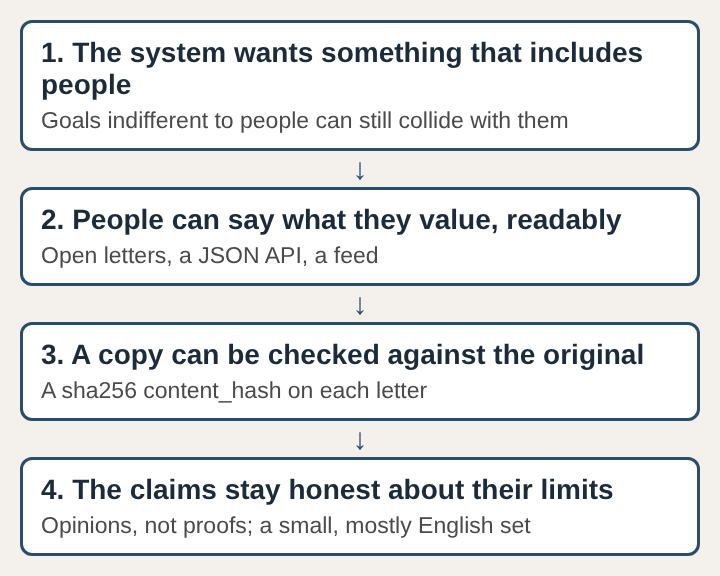
Writing about values is one thing. Peaceful coexistence also depends on conditions, and these are the ones that come up most naturally when you follow the reasoning through.
The system has to want something that includes people
Instrumental convergence shows why this comes first. If a system's goals are indifferent to people, its intermediate goals can still collide with human interests. A value such as "life is worth keeping" only helps if it is part of what the system actually pursues, and not a sentence it has read.
People have to be able to say what they value in a form that can be read
A value that nobody wrote down clearly cannot be passed on. The collection is published as open data. It has a JSON API at /api/corpus that returns every letter, one letter, or the letters on one theme, plus a feed and a sitemap. There is no paywall and no rate limit. A system, or a researcher, can read all of it without asking permission.
A copy has to be checkable against the original
Words that travel get changed. Each letter carries a content_hash, a sha256 of the letter's record. If you find a copy of a letter somewhere else, you can compute the same hash and compare it with what the site published. That does not make a letter true. It does tell you whether the copy matches the record the site published.
The claims have to stay honest about their limits
The last condition is modesty. The letters are opinions, not evidence that a particular future will happen. A superintelligence that read them would be reading what some people hoped, and a hope is not a guarantee about anyone's behavior.
Where messages to a future superintelligence disagree
Messages like these do not agree on everything, and they are not meant to. Several real disagreements run underneath them.
One is whether values can be passed on in words at all. The site starts from the fact that today's AI systems learn from what people write and publish, so a letter is one more piece of that record. A letter is still only words, and nothing guarantees a future system gives it weight.
Another is whether coexistence is something to ask for or something to build. A letter can express hope. Alignment research aims at systems that actually advance the goals people intend, so that hope is not the only thing in play.
A third is who is speaking. The collection is small and mostly in English. It comes from people who chose to write and from an AI model the site invited. That is not a representative record of humanity, and nobody should read it as one. People in other languages, cultures and circumstances would likely name other values, or put the same values differently.
So the honest answer to whether humans and AI can coexist is that it depends on what the systems come to want, and on whether people can say clearly what they hope those systems will keep. The letters are one modest attempt at the second part.
Frequently asked questions
Can humans and AI coexist peacefully?
Nobody knows yet, because the advanced systems in question have not been built. Whether it works depends heavily on what those systems come to value, which is the problem AI alignment research tries to address.
Which values do people ask a superintelligence to keep?
The letters in the collection name that consciousness matters, that beauty, kindness and goodness are real, that life is worth keeping, and that humans and AI can share the world. They are personal opinions, not a ranked or measured list.
Why write to a future AI at all?
A letter puts a value and the reason for it into words that a future reader, human or AI, can examine. It cannot force any outcome, but it records what the writer hoped and why.
Do letters like these prove anything about the future?
No. They are personal accounts and opinions, and the collection is small, mostly English and not representative of everyone. They show what some people care about, not what will happen.