Assent in Stoic philosophy is the yes or no you give to the way something appears to you. A thought arrives on its own, such as "this delay ruins my day", and then there is a second, quieter step: you accept it as true, or you hold back. The Stoics taught that this second step is yours, and that most of what makes a day go well or badly happens there.
The idea sits under much of what the Stoics taught about calm and good judgment. How to Find Your Meaning teaches Stoic philosophy in short lessons with a daily practice, and assent is the quiet mechanism behind several of the habits that practice builds, from the morning question to the three questions at the end of the day.
Assent in Stoic philosophy: from impression to action
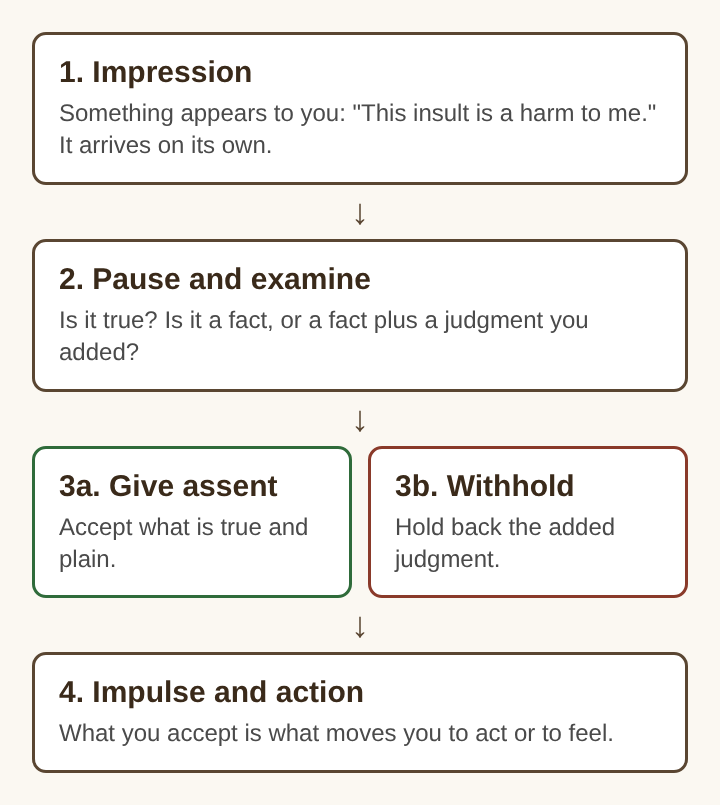
The Stoics described the mind in a few steps. First comes an impression, in Greek phantasia: the way the world shows up to you, often with a judgment already folded in. A colleague's short reply shows up as "she is annoyed with me". A cloudy sky shows up as "the trip is ruined".
According to the Stanford Encyclopedia of Philosophy's entry on Stoicism, the Stoics held that only a rational soul has the power of assent, sunkatathesis in Greek. It sits in the soul's ruling part, the hegemonikon, and it lets a person step back from an impression and judge it. When you take the impression to be true, you assent. When you do not, you suspend assent and leave the question open.
Only after assent comes impulse, horme, the push to act or to feel. Animals act on impressions directly. A person, on this view, always has a moment in between, even when it passes too fast to notice.
Why the Stoics put assent in your power
The same entry gives a plain case. Two people see the same cake. Both receive the impression that eating it would be good. One eats it at once, the other leaves it. The impression was the same, so it cannot explain the difference. What differs is what each of them accepted.
Chrysippus, who led the school from around 230 to 206 BCE and gave its teaching its fullest shape, made the point with a cylinder and a cone pushed on a slope. The push starts them moving, but the cylinder rolls straight and the cone spins off to the side because of their own shapes. In the same way, an impression strikes the mind from outside, yet the assent that follows depends on the person. Cicero reports him saying that assent lies in a person's own power.
This is why the Stoics could say that your judgments are your own in a way that events are not. The weather, the delay and the short reply come from outside. The judgment "this is a disaster" is something you agree to.
What Epictetus did with assent
Epictetus made assent the center of daily practice. As the Stanford Encyclopedia's entry on Epictetus explains, he held that human beings, unlike other animals, examine their impressions to decide whether they are true or false, and that this faculty of assent is what makes them rational. A person's convictions, attitudes and actions belong to them because they come from how that person uses impressions.
He also noticed how assent goes wrong. People assent readily when they see no conflict with what they already believe, and they hesitate when they notice a contradiction. So a habit of careless belief feeds itself. One of the areas of study he set his students was freedom from deception and hasty judgment, everything that concerns assent.
His practical advice was to slow down. The entry describes self-improvement as beginning with consciously slowing your thinking so that there is room for reflection before you assent. In the Discourses, which survive in four books of an original eight or more, he tells his students to ask an impression to wait a moment so it can be examined before it is accepted.
Reactions that come before assent
The Stoics did not claim that a trained person feels nothing. Epictetus allowed that even the wisest person may tremble or turn pale at a sudden danger. That first jolt is not a judgment yet. It happens before assent, so it is not a fault.
What matters is the next step. The jolt says "danger". Assent says "yes, this is truly bad for me" or "this looks bad, but let me see". The Stoics named four general passions, distress, fear, appetite and pleasure, and the Internet Encyclopedia of Philosophy's article on Stoic ethics sets out how each rests on a judgment, made against reason, that something is good or bad. A passion, on this account, is not something that happens to you. It grows from an impression you agreed to.
This also explains why the Stoics thought feelings could be changed by thinking. If fear rests on the judgment "this will harm me", then examining that judgment changes the fear. You cannot always stop the first jolt, but you can decide what to make of it.
A worked example: the late train
Here is how to follow the idea on an ordinary morning. Your train is cancelled and you will be twenty minutes late to work.
- Name the impression. Say it in words: "This ruins my morning and my boss will think badly of me."
- Split fact from judgment. The fact is that the train is cancelled and you will be late. "Ruins my morning" and "my boss will think badly of me" are judgments added on top.
- Assent to the fact. Yes, the train is cancelled. Accepting this is plain realism, and it lets you act: send a message, find another route.
- Withhold assent from the extra judgment. You do not know what your boss will think. Leave it open instead of agreeing to the worst version.
- Notice the change. The jolt of annoyance may still be there. The spiral of dread that would have followed the second judgment has less to stand on.
The whole thing can take less than a minute. The point is not to argue with reality but to stop agreeing to more than reality has shown you.
How assent links to other Stoic ideas
Assent explains why the dichotomy of control puts judgments on the side of what is up to you, a line Epictetus drew between the sphere of volition and everything outside it. Events are outside your control, but the yes or no you give to how they appear is not.
It also runs through the notes Marcus Aurelius kept for himself. The Meditations keep coming back to wiping away an impression rather than letting it settle into a belief, which is withholding assent in practice.
Finally, it ties to knowledge. Zeno, who founded the school around 300 BCE, described a firm grasp of something true, katalepsis, to explain how a person moves from ignorance to knowledge. The ideal was a mind that assents to what is clearly so and holds back from everything else.
Frequently asked questions
What is the Greek word for assent in Stoicism?
The Greek word is sunkatathesis, also written synkatathesis. It names the act of agreeing that an impression is true.
Is withholding assent the same as denying something?
No. Withholding assent means leaving the question open until you can judge it well. Denying is its own judgment, and it can be just as hasty as agreeing.
Can you stop an emotion by withholding assent?
Not the first jolt, which the Stoics thought comes before any judgment. What you can change is whether that jolt grows into a lasting passion, since the passion rests on the judgment you accept.
Which Stoic wrote most about assent?
Chrysippus worked out the theory, but most of his writing is lost. Epictetus, in the Discourses, gives the most practical account of training it day by day.
Assent as a daily skill
Assent is easy to overlook because it is fast. Most of the time the impression and the yes arrive together, and it feels as though the world simply told you how things are. The Stoic claim is that there is always a gap, and that the gap can be widened with practice.
Widening it does not make life colder. You still see the cancelled train, the short reply and the cloudy sky. You simply stop adding judgments you have not checked. Over weeks, that small habit of asking "is this true, or is it something I added?" changes which feelings get a foothold, and that, for the Stoics, was where a calm and good life was won or lost.
How to Find Your Meaning
Find what your life is for. Visit findyourmeaning.vlvd.net