What was the Counter-Reformation? It was the Catholic Church's answer to the Protestant Reformation, a century of effort that restated Catholic belief, retrained the clergy, founded new orders, policed books and gave Europe a new style of religious art. Short lessons on the 100 people who most shaped human history place the reformers on both sides of this split among the figures who changed religion, and they set out each side of the debates historians still have about them.
What was the Counter-Reformation, renewal or reaction?
The Counter-Reformation was not one event. It was a run of decisions made by popes, bishops, founders of orders, rulers and artists. As a period, it is often dated from the opening of the Council of Trent in 1545 to the end of the European wars of religion in 1648, though historians argue over both ends.
That is why you will meet two names. "Counter-Reformation" stresses the fight against Protestant teaching. "Catholic Reformation" stresses a renewal from within, some of it under way before Martin Luther. The second name was brought into use in 1880 by the Protestant historian Wilhelm Maurenbrecher, and Catholic historians took to it because it avoided the sense of a mere reaction. Most writers now use both, because both describe something real.
The background matters here. How the Reformation changed faith, power and print in Europe sets out what the Catholic side was answering.
Why the Catholic Church had to respond
By the 1530s much of northern Europe had broken with Rome. The losses were not only of believers. Rulers who changed sides often took church lands and income with them.
Many of the complaints were shared by loyal Catholics. Some bishops never lived in the dioceses they ran. Many priests had little training. Money mixed with salvation through the sale of indulgences, the practice that first set off Luther's protest.
So the Church had two jobs. It had to answer Protestant theology plainly, and it had to fix the abuses that made that theology so persuasive.
The Council of Trent and Counter-Reformation doctrine
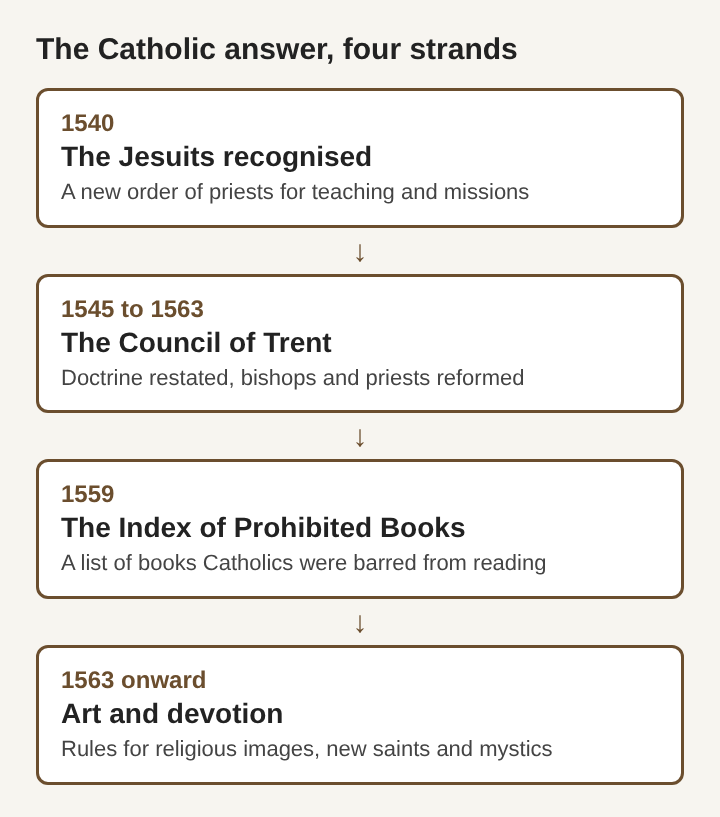
Pope Paul III, who reigned from 1534 to 1549, is counted as the first pope of the Counter-Reformation. He called the Council of Trent, in northern Italy. It met for 25 sessions between December 1545 and December 1563, in three periods with long breaks between them. When its decrees were signed in 1563, 255 members put their names to them, two thirds of them Italians.
On belief, Trent drew firm lines:
- Scripture and tradition: the Bible and the Church's handed-down tradition are both authoritative, against the Protestant claim of Scripture alone.
- Faith and works: the council set out the place of both faith and good works in salvation, against Luther's justification by faith alone.
- The Bible's text: it named the Latin Vulgate the Church's official text for public use.
On discipline, it was just as firm. It acted against the sale of indulgences, ordered bishops to live where they served, and pressed for better education of priests. Seminaries to train them became one of the period's lasting changes. The form of the Mass that followed the council stayed the Latin Church's main form for about four hundred years.
A worked example: was Trent reaction or reform?
Say you are asked whether Trent was mainly a reaction to Protestants or a real reform. Sort its decisions into two piles.
- Put the rulings on Scripture and tradition, on faith and works, and on the Vulgate in the first pile. Each one answers a Protestant claim directly.
- Put the rules on the sale of indulgences, on bishops living in their dioceses and on training priests in the second pile. Each one answers a complaint that faithful Catholics had made for a long time.
- Look at the result. Both piles are full, so the honest answer is "both". Your argument then turns on which pile changed ordinary church life more over the next century.
This sorting also explains why historians still use two names for the same years.
New orders, from the Jesuits to the Carmelites
The best-known new order was the Society of Jesus, the Jesuits, founded in 1540 by Ignatius of Loyola and six companions with the approval of Paul III. The Jesuits put great weight on education, opening schools and colleges, and they sent preachers and missionaries far beyond Europe. Ignatius's Spiritual Exercises gave them a method of prayer and self-examination.
They were one of many. The Ursulines, recognised in 1535, taught girls. The Capuchins grew out of a 1526 proposal to take the Franciscans back to their first, poorer rule. In Spain, Teresa of Ávila and John of the Cross reformed the Carmelites, calling their houses back to a life of deep prayer. Their influence showed that renewal could come from convents and friaries as well as from Rome.
Bishops mattered too. Charles Borromeo, archbishop of Milan, became the model of a bishop who put Trent into practice, visiting even the remotest parishes in person.
Censorship, images and the Baroque
The period had a hard edge. In 1559 the Church issued the Index of Prohibited Books, a list of works Catholics were not to read. It was revised twenty times and lasted until 1967. Print had carried Protestant ideas faster than any earlier movement, as the history of who invented the printing press and why it mattered shows, and the Index was an attempt to slow that flow.
Images went the other way. Where many Protestants stripped churches bare, Trent's final session in 1563 defended religious images in a few short decrees that had a large effect on Catholic art. Art was meant to teach and to move believers. That aim helped drive the Baroque style, with its drama and light, seen in Bernini's Rome and Rubens's Flanders.
Frequently asked questions
When did the Counter-Reformation begin and end?
It is often dated from the opening of the Council of Trent in 1545 to 1648, when the European wars of religion ended. Some historians start earlier, with Catholic reform movements before Luther, and the end date is disputed.
Is the Catholic Reformation the same as the Counter-Reformation?
Both names cover the same period from different sides. "Counter-Reformation" stresses the fight against Protestantism, and "Catholic Reformation" stresses renewal from within the Church.
Did the Counter-Reformation stop Protestantism?
It sharply reduced Protestantism in Poland, Lithuania, France, Italy and the Habsburg lands, including Austria, southern Germany and Bohemia. It did not undo the Reformation across the whole of northern Europe.
Who started the Counter-Reformation?
No single person did, but Pope Paul III is counted as its first pope. He called the Council of Trent and approved the Jesuits.
What the Counter-Reformation left behind
The Catholic Church that came out of these years was very different from the one Luther challenged. Its beliefs were written down clearly at Trent. Its priests were trained in seminaries, and its bishops were expected to live among the people they served. Its Mass kept the form Trent shaped for about four centuries.
It also left harder legacies. A list of banned books lasted into the twentieth century, and the Church's answer to print became part of a long argument about who may decide what people read.
And it left a look. Baroque churches, full of light and movement, still stand across Catholic Europe. The questions the period raised, about authority, reform from within and the freedom to read, are the same ones people still ask about any institution under pressure to change.
Learn 100 Influential People
100 people who shaped history, from Moses to the web. Visit influentialpeople.vlvd.net