Who invented the printing press, in one answer
If you want a single name for who invented the printing press, it is Johannes Gutenberg, a goldsmith from Mainz who built a working press with metal movable type around 1440. That answer is right but incomplete. Movable type existed in China four centuries earlier and in Korea before Gutenberg was born, and his press was built from parts other people had already made. What he added was a way to make type fast, cheaply and in large numbers, and that turned printing from a craft into an industry.
The question matters because the press is one of the clearest cases of an invention whose effects outran its inventor. Learn 100 Influential People treats inventions as one of the ways ideas spread and changed the world, and the press is the case that shows how. Gutenberg died with little money and no fame outside his trade. Within fifty years his method had produced millions of books.
Movable type before Gutenberg: China and Korea
The first known movable type was made of baked clay. Around 1040, during the Northern Song dynasty, a craftsman named Bi Sheng made individual characters from ceramic, pieces that could be set, printed and used again, according to the history of movable type.
Korea took the next step with metal. A Buddhist text known as the Jikji, printed in 1377 under the Goryeo dynasty, is believed to be the oldest surviving book printed with metal movable type. That is more than sixty years before Gutenberg's work in Strasbourg.
So why did movable type not sweep through East Asia first? Part of the answer is the writing system. Chinese writing has far more distinct characters than an alphabet, so a printer had to cut, store and find a much larger set of pieces. European languages need only a few dozen letters plus punctuation, and the same source names that small alphabet as an important factor in Gutenberg's success. For alphabetic scripts, setting a page from loose type was quicker than carving a block.
What Gutenberg actually put together
The account of the printing press describes Gutenberg's machine as a combination of four technologies that already existed: the screw press, movable type, the codex book with pages bound along one edge, and paper made by an already mechanized process. Screw presses were used across Europe for many jobs, including pressing wine, and gave him the model for pressing paper evenly against inked type.
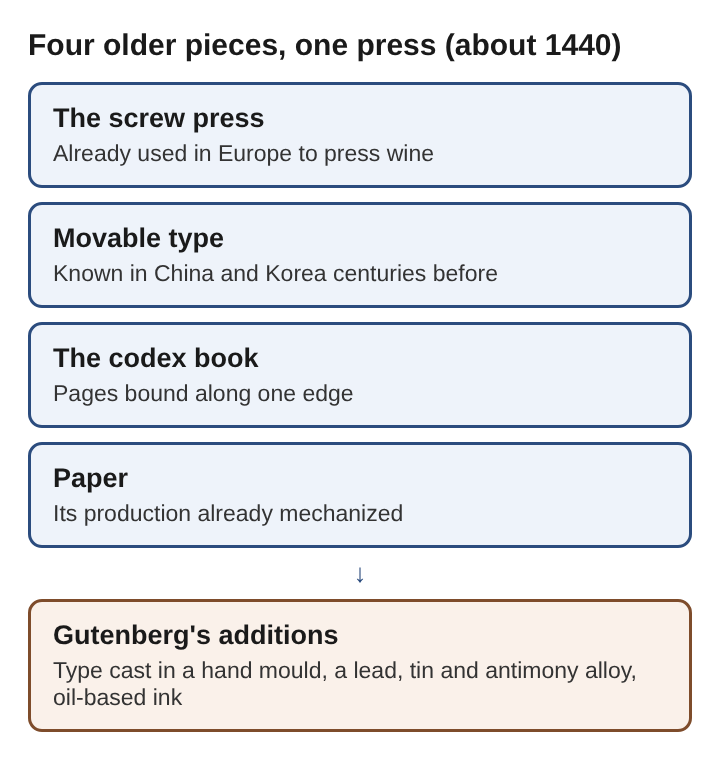
His own contributions were in the details that made the whole system work at scale:
- Casting type in a hand mould. Each letter was cast from a matrix in an adjustable mould, so a workshop could turn out thousands of matching pieces.
- A metal alloy. He made type from lead, tin and antimony, a mix that remained in use for about 550 years.
- Oil-based ink. He used an ink made with oil for printing his books.
None of these looks dramatic alone. Together they meant that a page could be set, printed many times, broken up and reset for the next page, with letters of uniform shape.
The 42-line Bible and a debt that went bad
The biography of Johannes Gutenberg shows how fragile the invention was in his own hands. He borrowed heavily from a Mainz financier, Johann Fust, to fund a large project: a Latin Bible set in two columns of 42 lines per page. He completed copies in 1455.
Each copy sold for about 30 florins, roughly three years' wages for a clerk. That sounds expensive, and it was, but a handwritten Bible could take a single scribe more than a year to copy. Printing did not make books cheap at once. It made each extra copy far cheaper than the one before it. Around 48 substantially complete copies of that Bible survive today.
In 1456 Fust demanded his money back and accused Gutenberg of misusing the funds. Gutenberg was left effectively bankrupt. The man who built the system did not profit much from it. His method spread anyway, because once others had seen it work, it could be copied.
How fast printing spread across Europe
The speed of the spread is the strongest argument for the press's importance. By 1500, presses across Western Europe had produced more than 20 million copies. The capital of the trade moved to Venice, where printers such as Aldus Manutius made Greek and Latin classics widely available.
Two features drove this. First, a press and its type were portable. A printer who was unwelcome in one city could pack up and work in another, which made censorship hard to enforce. Second, demand already existed: Bibles, prayer books, school texts and legal documents had long been copied by hand, so printers had readers waiting to pay for copies.
The source on the printing press links this spread to the Reformation and the Scientific Revolution. Pamphlets could reach thousands of readers before any authority could answer them, and scholars in different countries could read identical copies of the same text. In the early seventeenth century a German publisher began issuing news on a regular weekly schedule, and the newspaper format followed.
Weighing a claim of "first": a worked example
Questions about inventors often turn on the meaning of "first". You can sort the competing claims yourself with three questions: what exactly was new, did it survive in use, and did it spread?
- Bi Sheng, around 1040. New: reusable movable type. Survived in use: ceramic type was used, but woodblocks stayed common for Chinese. Spread: limited. He is the first inventor of movable type.
- The Jikji, 1377. New: metal movable type, with a dated book that still exists. Survived in use: yes, in Korea. Spread: mostly within Korea. It is the first surviving book of its kind.
- Gutenberg, around 1440. New: a full system of cast type, alloy, ink and press. Survived in use: the method lasted for centuries. Spread: across Europe within decades. He is the inventor of the printing press that spread.
The same three questions settle a later claim too. A book from 1568 by the Dutch writer Hadrianus Junius credited Laurens Janszoon Coster of Haarlem with the idea. Even if a Haarlem printer did experiment earlier, no surviving work shows that method spreading, so the claim does not change who built the system Europe adopted. Scholars still argue over details: in 2001 the physicist Blaise Agüera y Arcas and the librarian Paul Needham compared scans of the same letters in early prints and found variations suggesting Gutenberg's casting method differed from the punch and matrix process later printers used.
Frequently asked questions
Did Gutenberg invent movable type?
No. Bi Sheng made ceramic movable type in China around 1040, and Korea printed with metal type by 1377. Gutenberg invented the European printing press and a fast way to cast metal type for it.
When was the printing press invented?
Gutenberg is said to have perfected his method in Strasbourg around 1440. His best-known book, the 42-line Bible, was completed in Mainz in 1455.
Why was the printing press so important?
It made each additional copy of a text cheap and identical. By 1500 European presses had produced over 20 million copies, and printing helped carry the ideas of the Reformation and the Scientific Revolution.
Did Gutenberg get rich from his invention?
No. His financier Johann Fust demanded repayment in 1456, and Gutenberg was left effectively bankrupt. The Archbishop of Mainz recognized his achievements in 1465, a few years before his death.
Why the printing press still shapes how ideas travel
The printing press changed who could hold an idea. Before it, a text existed in as many copies as scribes could make, and those who controlled the scribes controlled the text. After it, any argument that found a printer and an audience could reach thousands of readers in identical form, faster than anyone could suppress it. Gutenberg's role was not to think of printing for the first time. It was to make copying so cheap and so reliable that ideas no longer depended on permission to spread.
Learn 100 Influential People
100 people who shaped history, from Moses to the web. Visit influentialpeople.vlvd.net