What is the generation effect in learning?
What is the generation effect in learning? It is the finding that you remember information better when you produce it from your own mind than when you simply read it. The generation effect has turned up in memory research for decades, and it is one of the simplest ideas you can put to work at a desk. If you study from photos of your own pages, Study Shot turns a page from a textbook, notes or a worksheet into multiple-choice questions with every answer explained, and the generation effect says something about how to answer them.
The short version: reading an answer feels like learning, but making the answer yourself does more of the work memory needs. The rest of the page covers how researchers show the effect, why it may happen, where it fails, and a way to fit it into ordinary study.
How researchers show the effect
The classic setup is small. One group of people reads pairs of words. Another group gets a cue and has to finish the second word. A common version gives a stimulus word, the first letter of the answer and a rule that links them. With the rule "opposite", the word "hot" and the letter "c", you produce "cold". Later, both groups try to recall the words.
People who produced the words themselves usually recall more of them. The effect has shown up with word fragments, antonyms, synonyms, pictures, arithmetic problems and keywords in a paragraph. It has appeared whether people later had to recall words with no help, recall them from a cue, or pick them out from a list.
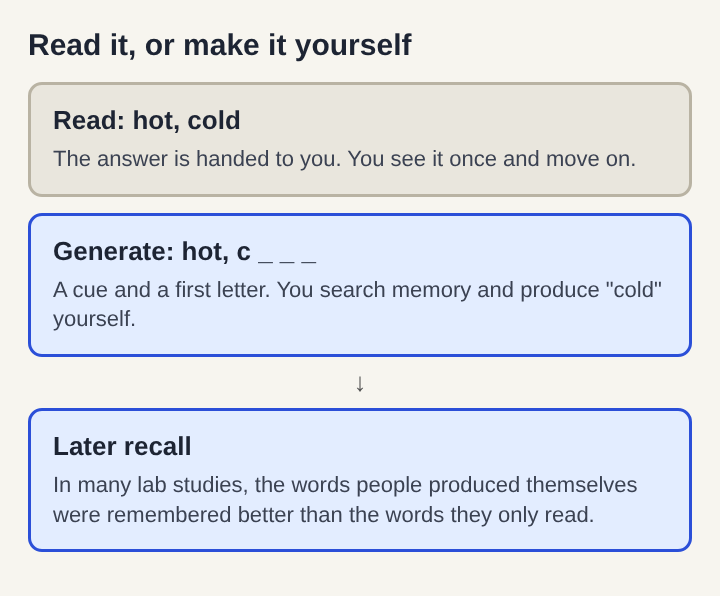
The point for a student is not the word lists. It is the difference between the two conditions. Both groups saw the same pair in the end. Only one group had to reach into memory to finish it.
Why making an answer helps memory
No single explanation covers every result, and researchers still argue about the cause. Three accounts come up most often.
- Lexical activation. To produce a word, you search your memory of meanings. That search lights up related features, and those features later act as cues that help you find the word again. In one study, Payne, Neely and Burns worked with 168 Purdue undergraduates and found the effect for real words but not for made-up ones, which fits the idea that generating relies on what is already stored.
- The procedural account. Generating pushes you to connect the item to what you already know. When the same mental steps come back at recall, the memory is easier to reach.
- Transfer-appropriate processing. The generation task makes you focus on one kind of information. If the later recall task asks for that same kind, you see a benefit. If it asks for something else, the benefit can disappear.
The third account has a practical edge. It says the way you generate should match the way you will later need the knowledge. Producing a definition helps you recall definitions. Working out how two ideas relate helps you recall the relation.
Where the generation effect falls short
The effect is robust, but it has limits worth knowing before you build a study plan on it.
- Reading can catch up. When readers were told to process words the way generators did, the gap closed. People who read using vivid imagery did as well as those who generated.
- New material is harder. One study found no effect with made-up words and a reduced effect with unfamiliar material. Generating needs something already in memory to work with.
- Context can suffer. Producing a word may strengthen memory for the word itself while weakening memory for what surrounded it. You might remember the term and lose the sentence it came from.
So the generation effect is not a reason to skip reading. It is a reason to read first, then close the book and produce what you can, so the effort lands on material you have already met.
Generation, retrieval practice and desirable difficulty
The generation effect sits close to two other ideas in learning research. Retrieval practice is the finding that long-term memory improves when part of your study time is spent pulling information out of memory instead of only reading it. That research also notes that even a failed attempt to recall can help, and it credits the generation effect for part of that.
A desirable difficulty is a condition that takes more effort but improves long-term performance. Rereading notes feels smooth because the words grow familiar, yet flashcards that make you produce a definition do more for memory. Researchers at UCLA and UC Berkeley have looked at bringing the generation effect and other desirable difficulties into classrooms.
All three point the same way. The moment a study task feels a little harder because you have to come up with something, memory is usually doing useful work.
A worked example with one textbook question
Take a page on photosynthesis. A practice question made from that page asks: "Where in a plant cell does photosynthesis take place?" The four choices are the mitochondria, the chloroplasts, the nucleus and the cell wall. The answer is the chloroplasts.
You can answer it two ways.
- Recognize. Read the question and the four choices together, spot "chloroplasts" and pick it. This is still retrieval, and plausible wrong choices make you think. But the right word is on the screen before you reach for it.
- Generate, then check. Cover the choices. Read only the question and say or write your answer: "the chloroplasts". Then uncover the four choices, pick, and read the explanation.
The second way adds a few seconds and turns a recognition item into a generation item. If you could not produce the word, you have learned something too: you can recognize the term but not recall it, which is the gap an exam with short answers will find.
Do this for every question in a set of 5 to 20, with the four choices hidden until you have committed to an answer. Keep a short list of the questions where your own answer did not match. Those are the ones to come back to on a later day.
Frequently asked questions
Is the generation effect the same as active recall?
They overlap but are not identical. Active recall, or retrieval practice, means pulling learned information out of memory, while the generation effect is the broader finding that producing an item yourself beats reading it.
Does the generation effect work for material you have never seen?
It works less well. Studies found a reduced effect with unfamiliar material and none with made-up words, so read the material first and generate afterwards.
Can multiple-choice questions use the generation effect?
Yes, if you answer before you look at the choices. Cover the options, produce your own answer, then check it against the four choices.
What if you cannot come up with the answer?
Try anyway, then read the correct answer and its explanation. Retrieval research reports that even unsuccessful attempts can help later recall.
Making the generation effect part of every study session
The generation effect asks for one habit: produce before you read. After a section, close the book and write what you remember. Before you look at the choices on a question, say your answer. When you make flashcards, write the cue on the front and force yourself to recall the back.
Match the kind of thing you produce to the kind of thing you will need. If an exam asks for definitions, produce definitions. If it asks you to explain a process, produce the steps in order. Keep the material familiar enough that you have something to generate from, and expect the effort to feel slower than rereading. That slower feeling is part of why it works.
Study Shot
Turn any page into a practice quiz. Visit studyshot.vlvd.net