What is the SQ3R reading method? It is a five-step way to study a textbook chapter: survey it, turn it into questions, read to answer those questions, recite the answers from memory, and then make a final recall pass over the whole chapter. Each step makes you do something with the page instead of just looking at it. The final steps also pair well with practice questions written from the same pages, such as the multiple-choice quizzes that this photo-to-quiz tool builds from a picture of a textbook page, a page of notes or a worksheet.
What is the SQ3R reading method, and where does it fit in study
The name stands for Survey, Question, Read, Recite and a last R, the step where you go back over everything. Francis P. Robinson introduced it in his 1941 book Effective Study, according to the Wikipedia entry on SQ3R.
SQ3R is built for one situation: you have a chapter of dense, organised material, and you need to remember it, not just get through it. It works best on textbooks with headings, subheadings and summaries.
Its main job is to stop passive reading. Reading a chapter once and highlighting half of it can feel like study. SQ3R replaces that with a sequence of small tasks, each of which asks you to predict, search, or recall. If you have tried to study from a textbook chapter without rereading it, SQ3R gives that effort a fixed order.
The five steps of SQ3R: survey, question, read, recite and a final recall pass
Here is how the five steps look on a real chapter. Say you are studying a biology chapter on photosynthesis.
- Survey. Spend three to five minutes skimming. Read the title, the headings, the bold terms, the figure captions and the end-of-chapter summary. You are building a map, not learning details. For photosynthesis, you might notice headings on light reactions, the Calvin cycle and where the process happens in the cell.
- Question. Turn each heading into a question. "The site of photosynthesis" becomes "Where in a plant cell does photosynthesis take place?" "Light reactions" becomes "What do the light reactions produce, and what uses those products?" Write the questions down.
- Read. Now read one section at a time, looking for the answer to its question. Slow down on the parts that answer it. Skim the parts that do not.
- Recite. Close the book or cover the section. Answer your question out loud or in writing, in your own words. If you cannot, go back, read the part you missed, and try again. Then move to the next section.
- The final recall pass. When the chapter is done, go back to your full list of questions and answer them all from memory. Check each answer against the text. Mark the ones you got wrong or could not finish.
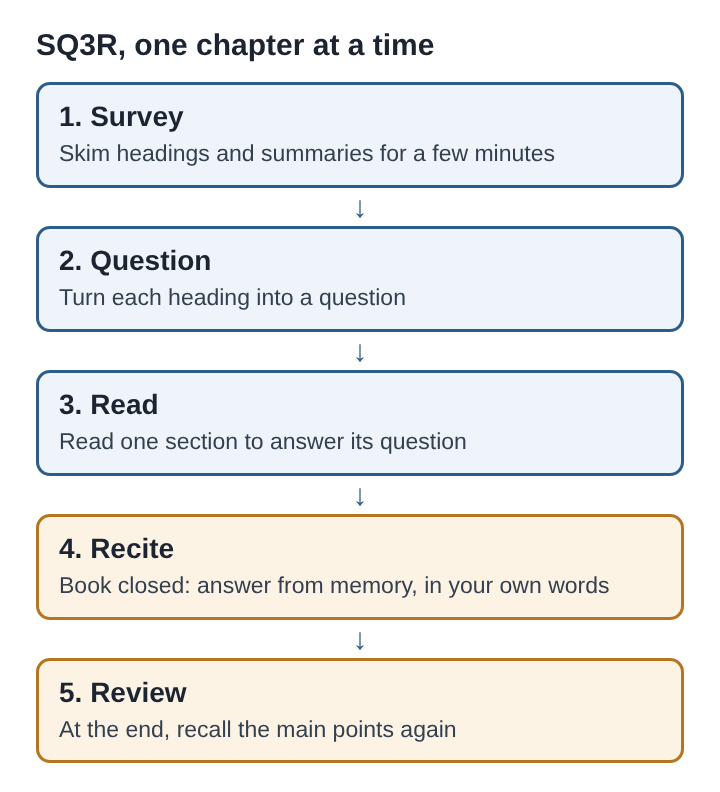
The order matters. Survey and Question give your reading a target. Recite and the final pass force you to pull the material out of your head.
Why SQ3R works: questions, retrieval practice and spacing
SQ3R lines up with two well-studied ideas about memory.
The first is retrieval practice, also called active recall: long-term memory is stronger when part of study time goes to pulling information out of memory, compared with only reading the material. The Recite step and the final pass are both retrieval. You are not checking whether the words look familiar. You are checking whether you can produce them with the book closed. There is a fuller account of the idea in what active recall is and how to use it.
The second is the spacing effect: study sessions spread out over time put more into long-term memory than the same material crammed into one sitting, a finding Hermann Ebbinghaus first described in 1885. SQ3R builds in a little spacing on its own, because you recite each section soon after reading it and then recall the whole chapter later. You get more of the benefit if that final pass happens on a different day.
Turning SQ3R questions into practice questions from your own pages
The questions from step two have a weakness. The same reader who skimmed the chapter also drafted them, so they tend to cover what that reader already noticed. A second set of questions, written from the same page by someone or something else, catches what got skipped.
Study Shot takes a photo of a page and writes multiple-choice questions about it, from the basics to advanced, with every answer explained. The process has three steps: snap the page (or pick a photo already taken), pick a level, then practise one question at a time. Each answer is checked right away and explained.
The levels are Basic, Intermediate and Advanced, plus Tiered, which climbs through all three. A quiz has 5 to 20 questions, each with four choices, sorted from the basics to the hardest. For SQ3R, Tiered fits the final recall pass well: the early questions confirm the key terms, and the later ones ask you to apply them.
Back to the photosynthesis chapter. A photo of the page on cell structure could produce a question such as "Where in a plant cell does photosynthesis take place?" with four choices: the mitochondria, the chloroplasts, the nucleus and the cell wall. The answer is the chloroplasts. It is close to the question drafted during step two, but now it comes with wrong options that look plausible, which is a harder check than recalling an answer you expect.
Every quiz is kept in a library with its page photo, so the same questions can be taken again days later during the final pass. If a question looks wrong, it can be flagged in one tap and it gets checked. That matters, because a practice question with a mistake in it can teach the wrong thing.
Learning from every wrong answer during the SQ3R recite step
A wrong answer in the Recite step is not a failure. It is the most useful thing that happens in the whole method, because it shows you exactly what you do not know yet.
Handle each miss the same way:
- Write down what you thought. If you picked the mitochondria, note it. Both organelles deal with energy, so the mix-up is easy to make.
- Read the explanation, then say why your choice was wrong. Mitochondria release energy from food through respiration. Chloroplasts capture light energy to make food. Putting the difference in your own words fixes the confusion better than reading the right answer alone.
- Go back to the exact sentence in the text. Find where the chapter says it. You will often find you skimmed that line during step three.
- Put the question on a short list for the final pass. Missed questions get asked again. Questions you answered easily can wait longer.
This turns the Recite step from a quick check into a small repair job. The guide on how to learn from the questions you get wrong goes further into keeping a log of misses.
Common mistakes that weaken the SQ3R reading method
SQ3R is simple to describe and easy to water down. These are the habits that turn it back into passive reading.
- A survey that becomes a full read. If the survey takes twenty minutes, you are reading, not surveying. Keep it short so your questions are real guesses.
- Questions that copy the heading. "Light reactions?" is not a question. "What do the light reactions produce?" is. A good question has an answer you could say in a sentence or two.
- Reciting with the book open. Glancing at the page while you "recite" is rereading. Cover the text. If you cannot answer, that is information, not a reason to peek.
- Skipping the final pass. Many students stop after the last section. The final recall pass is the step that ties the chapter together and shows which sections did not stick.
Frequently asked questions
Is SQ3R still effective for modern courses?
Yes, for courses built on textbooks or structured notes. Its core steps, asking questions and recalling answers from memory, match what memory research supports today.
How long does SQ3R take for one textbook chapter?
Longer than a single read, because of the time spent reciting and on the final pass. That extra time is the retrieval practice the method exists to add.
Is SQ3R better than rereading notes?
For remembering material, generally yes, because it makes you recall answers instead of recognising familiar words. The piece on whether rereading is a good way to study covers why recognition feels like learning when it often is not.
What is the SQ3R reading method in one sentence?
SQ3R is a five-step method where you survey a chapter, turn it into questions, read for the answers, recite them from memory, and then recall the whole chapter again later.
Fitting the SQ3R reading method into a weekly study plan
SQ3R works best when its steps are spread across a week rather than packed into one evening. A simple pattern for one chapter:
- Day one: survey, write your questions, then read and recite one section at a time. Mark every question you missed.
- Day two or three: do the final recall pass from memory. Answer every question with the book closed, check against the text, and update your list of misses.
- End of the week: run through only the missed questions plus a handful of easy ones. If you still miss something, go back to that section and recite it again.
When the next chapter starts, add its day one to the same week, and keep the older chapter's missed questions in your recall passes. Over a term, this gives you a growing set of questions that come back at longer and longer gaps, which is how the spacing effect shapes study in practice. The method stays the same each week: ask before you read, answer with the book closed, and give the most attention to the answers you got wrong.