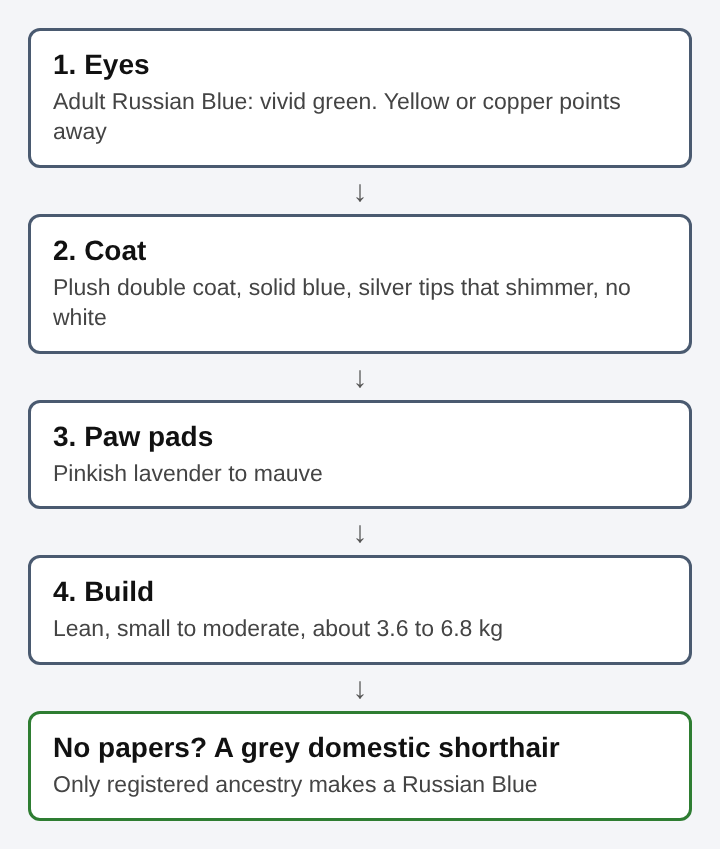
Most grey cats are not Russian Blues. If you want to know how to tell a Russian Blue from a grey cat, look at four things in order: the eyes, the coat, the paw pads and the build. The breed has all four, and an ordinary grey cat usually misses at least one. Even then, the last word belongs to paperwork, not looks.
The question comes up often in a walking game such as Cat Go, where a player photographs a real cat and then picks its breed from a list. The game puts Russian Blue among its rare breeds and reminds the player that most cats you meet are mixed breed. So a grey cat on a garden wall is far more likely to be a mixed breed than a Russian Blue, and the checks that follow tell you when it might be the exception.
What makes a cat a Russian Blue
A Russian Blue is a pedigreed breed with a solid blue coat. In cat terms, "blue" is the name for grey. The breed is selectively bred from a landrace that may have come from the port of Arkhangelsk in Russia, which is why early cats were shown as Archangel Cats. The breed is recognised by the major registries, and every Russian Blue has a formally registered ancestry.
That last point matters more than any feature. A Russian Blue is a cat with Russian Blue parents on record. A grey cat with no papers can share every look of the breed and still not be one. The everyday name for that cat is a domestic shorthair, a label for coat length rather than family, which the domestic shorthair label covers in detail.
The colour itself is not a breed either. The breed's blue is the dilute form of black, and the dilute gene is recessive, so two Russian Blues of the usual line always have blue kittens. Grey is simply a colour, and cats of many backgrounds can carry it.
Check the eyes first
Eye colour is the quickest clue, because it is easy to see from a distance. An adult Russian Blue has vivid emerald green eyes, sometimes described as green to yellow-green. In show cats, yellow eyes in an adult count as a fault.
So a grey cat with clear yellow, gold or copper eyes is unlikely to be a Russian Blue. Kittens are a special case: the breed is slow to mature and keeps many young traits until three or four years old, so a young cat's eyes are a weaker clue than an adult's.
Look closely at the coat
The Russian Blue coat is short, dense and plush. It is a double coat: the soft, downy undercoat is the same length as the guard hairs, which makes the fur stand out from the body and feel thick to the touch. The guard hairs are an even blue with distinctly silver tips, and those tips give the breed its silver sheen.
An ordinary grey shorthair often has a flatter, single-layer look and an even matte grey with no shimmer. Watch the cat move in daylight: a silver sheen that shifts as the cat turns is one of the strongest signs.
The body colour of a Russian Blue is solid. The tail may show faint, barely visible tabby stripes, but clear stripes on the body point to a grey tabby. White patches are also a fault in show cats, so a grey cat with a white chest or white paws is almost certainly a mixed breed. Stripes and patterns in general are covered in what tabby means in cats.
Paw pads and build
Two smaller details finish the check. A Russian Blue has pinkish lavender to mauve paw pads, which you can only see when the cat sits or stretches. Plain pink or dark grey pads do not rule out the breed on their own, but they add doubt.
The breed is small to moderate in size, with a typical lean build and a weight of about 3.6 to 6.8 kg when grown, males larger than females. A heavy, round, stocky grey cat looks more like one of the other blue breeds, or a mixed breed, than a Russian Blue.
The other blue breeds
Two rarer breeds are also blue all over, and they are the ones most often mixed up with a Russian Blue.
- Chartreux. The Chartreux is a rare French breed. It is large and muscular, called cobby, with fairly short, fine-boned legs. Its blue double coat is water-resistant and slightly thick, often parting in "breaks" across the back. Its eyes are orange or copper, and the shape of its head and muzzle often makes it look as if it is smiling.
- Korat. The Korat comes from Thailand. Its coat is a silver-tipped blue-grey, but it is a single coat, short and close. It has a heart-shaped head and large green eyes, and its body is semi-cobby and heavy for its size. As with the Russian Blue, kittens start with amber or golden-green eyes that turn green between two and four years.
So eye colour splits the three: copper or orange for the Chartreux, green for the Russian Blue and the Korat. The coat and head then split the last two: a plush double coat and a lean build for the Russian Blue, a close single coat and a heart-shaped face for the Korat. Both are very rare compared with mixed-breed grey cats, and the Cat Go Catdex places them in its very rare group, one step beyond the Russian Blue.
A worked example with a grey cat on a wall
Say you see a grey shorthair sitting on a low wall in the afternoon light. Go through the checks one at a time and write each answer down.
- Eyes: clear yellow. In an adult, that already counts against a Russian Blue.
- Coat: short and even, matte grey, with no silver shimmer when the cat turns its head.
- Markings: a small white patch on the chest and faint stripes on the legs.
- Build: medium and solid, neither lean nor very stocky.
Three of the four answers point away from the breed, and the white patch is a fault the breed does not allow. The honest name is a grey domestic shorthair, a mixed-breed cat. Now change one detail: the cat has bright green eyes, a coat that shines silver at the tips and no white anywhere. It could be a Russian Blue, or a mixed-breed cat with Russian Blue ancestors. Without papers, nobody can be sure, so "probably a Russian Blue type" is the most a careful observer can say. When a whole family of features is uncertain, the names for a mixed breed cat are the safer choice.
Frequently asked questions
Is every grey cat a Russian Blue?
No. Grey, called blue in cat terms, is a colour that cats of many backgrounds carry. Most grey cats are mixed breed, and only a cat with registered Russian Blue ancestry is a Russian Blue.
What eye colour does a Russian Blue have?
An adult Russian Blue has vivid green eyes, from emerald to yellow-green. Yellow eyes in an adult count as a fault in show cats, and kittens' eyes are still changing.
How is a Russian Blue different from a Chartreux?
A Chartreux is larger and more muscular, with orange or copper eyes and a slightly woolly coat. A Russian Blue is leaner, with green eyes and a plush coat that shines silver at the tips.
Can a Russian Blue have stripes?
The body colour is solid, though the tail may show faint, barely visible tabby stripes. Clear stripes on the body point to a grey tabby instead.
How to tell a Russian Blue from a grey cat
A Russian Blue is defined by its family first and its looks second. Its looks give strong clues: green eyes in an adult, a dense double coat with silver tips, mauve paw pads, a lean build and no white. A grey cat that misses one of these is most likely a mixed breed, and one that shows them all is a likely Russian Blue type until its papers say more. Two other blue breeds, the copper-eyed Chartreux and the heart-faced Korat, complete the short list of grey cats with a breed name, and the eyes alone tell most of them apart.