If you have ever asked what is a mixed breed cat called, the short answer is that it has several names, and none of them is a breed. In Britain people say moggy. In the United States people say house cat or alley cat. On a vet's record or a shelter card the same cat becomes a DSH, a DMH or a DLH, letters that describe its coat and nothing about its parents. The walking game Cat Go faces the same question every time a player meets a cat outside: it asks "Which breed is it?", notes that most cats you meet are mixed breed, and says that "Mixed breed is always a safe pick."
What is a mixed breed cat called in everyday speech
The most common informal word is moggy, also spelled moggie. The Wikipedia page on the moggy defines it as any cat which has not been intentionally bred. That definition matters. A moggy is not a failed purebred or a cross of two named breeds. It is simply a cat whose parents were chosen by the cats themselves.
American English has its own words. The Wikipedia page on the domestic long-haired cat lists moggie as the British term and alley cat as the American one. In daily speech you will also hear house cat, random bred cat and mixed breed. They all point at the same thing: a cat with no recorded family tree.
Because no one selected these cats for a look, they vary a great deal. The moggy page notes that moggies lack a consistent appearance, unlike purebred cats bred to match a written description. Two moggies from the same street can differ in size, face shape, coat and colour.
The official labels: DSH, DMH and DLH
When a cat has to go into a record, a vague word will not do. Vets, shelters and animal control offices sort moggies by coat length instead. The moggy page gives the usual labels:
- DSH, domestic short-haired, for a short coat.
- DMH, domestic medium-haired, a less common label for a coat in between.
- DLH, domestic long-haired, for a semi-long to long coat.
Some groups use their own versions, such as "House Cat, Shorthair" or "Shorthair Household Pet". The idea is the same in each case. The label records the one trait that is easy to see and easy to agree on, the length of the fur, and makes no claim about ancestry.
This is why DSH and DLH are sometimes called pseudo-breeds. They sit in the breed field of a form, but they describe a coat, not a family line. A domestic shorthair can be any colour, any size and any build.
Why a breed needs papers
The reason a mixed breed cat has no breed name comes down to records. According to the moggy page, every cat that belongs to a specific breed has a known and formally registered ancestry with a cat registry. That record is the cat's pedigree, often called its paperwork.
Breeds are also young. The same page says purebred cats are a human invention of the last 150 years, and that over 85% of cat breeds have come into existence since the 1930s. For most of history every cat was, in today's terms, a moggy.
So a cat can share the face and coat of a Persian or a Siamese and still be a moggy. Without registered parents it is not a member of the breed, whatever its face or coat suggests. The reverse is also true: a pedigreed cat that happens to look ordinary is still its breed on paper.
How common mixed breed cats really are
If you meet a cat on a wall or a doorstep, the odds say it is a moggy. The moggy page cites a United States government figure that fewer than 2% of cats in the country are purebred and raised by breeders. In the United Kingdom, 89 to 92% of cats are of non-pedigree lineage. Worldwide, the share of unpedigreed cats is estimated at 98 to 99%.
That is why a game built around real cats leans on the mixed breed answer. The Cat Go Catdex sorts its 34 breeds into four groups, and the common group holds just two entries: Domestic Shorthair and Domestic Longhair. Every other breed sits in the uncommon, rare or very rare groups.
A worked example: naming the cat on the fence
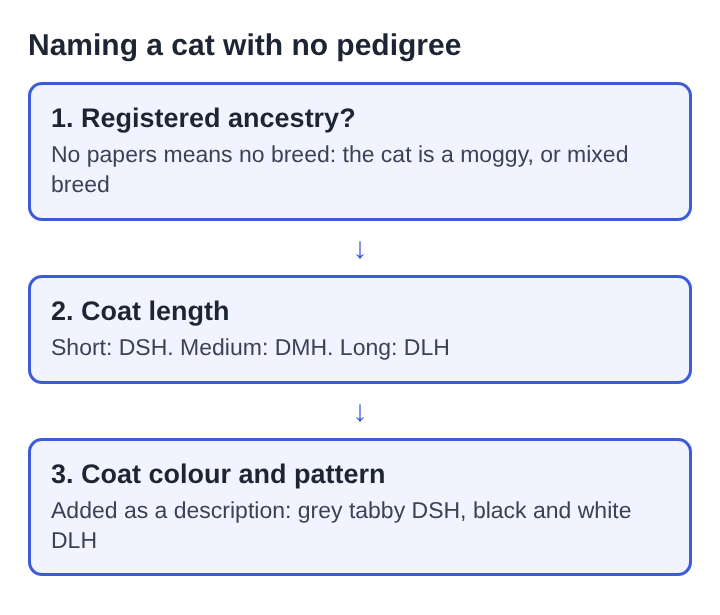
Say you see a grey striped cat sitting on a garden fence. It has short fur, a round face and white paws. You stay where you are and watch it from a distance. Here is how to name it in three steps.
- Ask about ancestry. You have no papers for this cat and no breeder's record. Without registered parents, it is not a breed. It is a moggy, a mixed breed cat.
- Check the coat length. The fur is short and lies flat. That makes it a DSH. If the fur were long and fluffy around the neck and tail, it would be a DLH; somewhere in between would be a DMH.
- Add colour and pattern. Grey stripes make it a tabby. A shelter card might read "DSH, grey tabby, white paws". Tabby here is a pattern, not a breed.
The result is a precise, honest name: a grey tabby domestic shorthair. You did not guess at a breed you cannot prove, and the label still tells another person exactly what the cat looks like in person.
Common mix-ups with breed names
A few labels trip people up because they seem to be moggy terms but belong to real breeds, or the other way round.
- Domestic Longhair vs British Longhair. The domestic long-haired cat page warns that a DLH should not be confused with the British Longhair, the American Longhair or other breeds with "Longhair" in the name. Those are defined breeds; a DLH is a mixed breed cat with long fur.
- Tabby, calico and tuxedo. These describe coat patterns and colours. A tabby can be a moggy or a purebred, so the word says nothing about breed.
- "Part Siamese" or "part Maine Coon". Owners often say this when a moggy has pointed colouring or a big fluffy tail. Without records, the cat is still a mixed breed; the look alone does not prove a breed in its family.
Some mixed breed cats do get recorded. The moggy page notes that some cat shows run non-purebred "Household Pet" divisions, where a moggy can be entered and judged on condition and temperament rather than breed traits.
Frequently asked questions
Is moggy a rude word for a cat?
No. Moggy is a common, friendly British word for any cat that was not intentionally bred. It describes the cat's background, not its worth.
What does DSH mean on a vet record?
DSH stands for domestic short-haired. It marks a mixed breed cat with a short coat and says nothing about the cat's parents.
Can a mixed breed cat share every visible trait of a purebred?
Yes. A moggy can share the coat, colour or build of a breed, but without a registered pedigree it is still a mixed breed cat.
Are most cats mixed breed?
Yes. Estimates on the moggy page put unpedigreed cats at 98 to 99% of cats worldwide, and fewer than 2% of US cats are purebred.
Naming a mixed breed cat with confidence
A mixed breed cat has plenty of names: moggy, house cat, alley cat, random bred. On paper it becomes a DSH, DMH or DLH, chosen by the length of its coat. None of these is a breed, because a breed needs a registered family line, and nearly every cat in the world has none. When you meet an unknown cat, start with ancestry, move to coat length, then add colour and pattern. That gives you a name that is accurate without pretending to know more than the cat can show.