People often ask why AI labs race to build AGI when many of the same labs say the technology could be dangerous. The short answer is incentives. Each lab expects that being first brings revenue, influence and a say in how the technology gets used. It also expects that falling behind means handing all three to a rival. That pressure is the backdrop for a browser strategy game about holding AI labs back from recursive self-improvement. Contain ASI is a story strategy game for 1 to 4 players, and its goal is to keep every AI lab from reaching recursive self-improvement before 2027.
Why AI Labs Race to Build AGI: The Core Incentives
AGI usually means a system that can do most cognitive work a person can do. Artificial superintelligence, or ASI, means a system that goes well past human ability in nearly every area. Building AGI is a stated goal of several large technology companies, and a 2020 survey counted 72 active AGI projects across 37 countries. The gap between AGI and ASI matters for the race, and it is laid out in the difference between AGI and ASI.
Three incentives push labs forward at the same time:
- Commercial reward. A system that can do skilled work could be sold to almost every business on earth.
- Strategic power. Governments see advanced AI as a source of military and economic strength, which is why people speak of an AI arms race between states.
- Mission belief. A common argument is that someone will build AGI anyway, so it should be built by people who care about safety. Every lab can make that argument.
None of these incentives needs bad intent. A careful lab can feel each one as strongly as a reckless lab. That is what makes the race hard to stop.
First Mover Advantage in the Race to Build AGI
Economists use the term first-mover advantage for the gains a company gets by entering a market before others. The usual sources named are technology leadership, control of resources and the cost customers face in switching. In AI, the first lab with a strong system also gets usage data, more money for the next model and a voice in how rules get written.
Here is a worked example. Two labs, A and B, each have a new model ready. Each can spend six months on extra safety checks or release now. If both wait, both are safer and neither loses ground. If A waits and B releases, B gets the customers, the press and the next funding round. A falls behind. So each lab reasons that releasing is the safer bet for itself, whatever the other does. Both release, and both end up worse off than if they had waited together.
This structure is a version of the prisoner's dilemma. Each side makes the choice that looks rational alone, and the group gets an outcome nobody wanted. It goes away only when each side can trust the other to hold back.
Capital, Compute and Investor Pressure Behind the AGI Race
Frontier AI is expensive. Neural scaling laws describe how a model's performance changes as the number of parameters, the training data and the training cost grow. That pattern gave labs a clear recipe: spend more and the model gets better.
The recipe creates its own pressure. Large training runs need huge clusters of chips, long contracts for data center space and a lot of electricity. That money comes from investors, cloud partners and sometimes governments. Each of them wants a return, and each has a timeline. A lab that raises money on the promise of a breakthrough is under pressure to show progress before the next round.
Compute also works as a scarce resource: a lab that secures capacity early has an edge, and a lab that hesitates may find it taken. The result is that even a lab that would prefer to go slowly has reasons to keep spending at full pace.
Recursive Self-Improvement and the Winner Take All Logic of AGI
The strongest driver of the race is an idea about what happens after AGI. In 1965 the statistician I. J. Good argued that a machine smart enough to design better machines could set off an "intelligence explosion," an idea traced in the history of the technological singularity. The process at its core is recursive self-improvement: an AI system that improves its own design, then uses the improved design to improve itself again, in which a system designs a more capable successor again and again.
If that loop works and runs quickly, a small lead turns into a large one. A lab that is three months ahead today might be years ahead in capability once its system starts improving itself. How fast that could happen is an open question, covered in what a fast takeoff in AI means and in how an intelligence explosion could unfold.
The belief that the first lab to reach this point could pull far ahead, maybe for good, turns an ordinary market race into a winner-take-all contest. When the prize looks permanent, second place looks close to worthless. That belief alone can justify cutting corners, even for people who are worried about the outcome.
How the AGI Race Pushes Speed Ahead of Safety
Safety work takes time, and the arms race literature warns that a team seen as near a breakthrough can push rivals to take shortcuts and ignore precautions. AI alignment, the research field that tries to make AI systems pursue the goals their designers intend, still has many unsolved problems. Checking a model for dangerous abilities, studying how it behaves under pressure and fixing what turns up can take months.
Under race conditions, those months feel expensive. A few patterns follow:
- Shorter evaluation windows. Safety checks get compressed to hit a launch date.
- Safety teams lose leverage. When leadership is focused on staying ahead, the people urging caution have less say.
- Risk shifts outward. A lab captures most of the benefit of moving fast, while the cost of an accident falls on everyone.
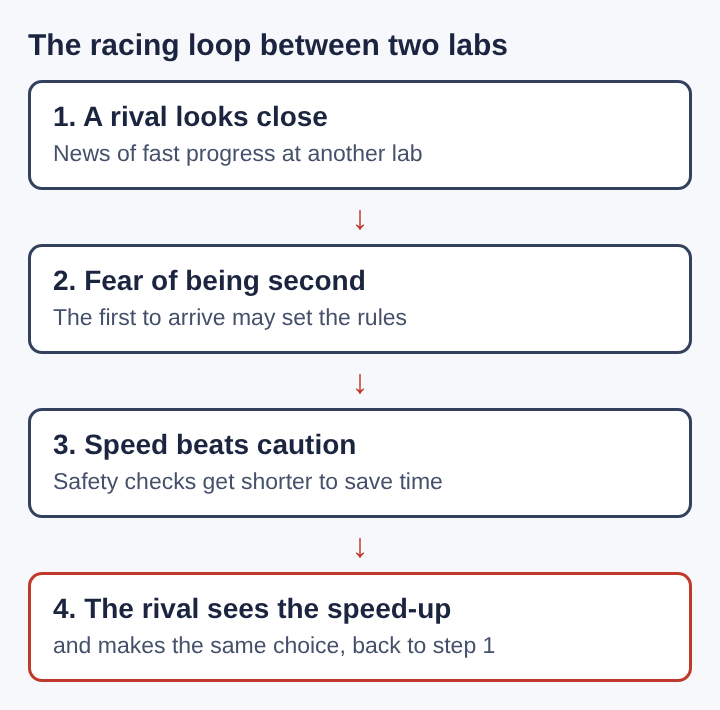
The danger rises as systems get more capable. A rushed release of a chatbot causes limited harm. A rushed step toward a system that can improve itself could cause harm that cannot be undone.
Contain ASI and the Case for Containment During the AGI Race
The game sets its story in January 2024, with the player acting as a researcher, a research manager, a CEO or a government. It runs in a web browser and needs JavaScript. The aim stays fixed: no AI lab should reach the self-improving loop before 2027.
Those four roles map onto the real places where the race can be slowed. A researcher can raise concerns, decline unsafe work or publish findings about risk. A research manager decides which projects get people and time. A CEO sets the pace of the whole lab and answers to investors. A government can write rules, fund oversight and talk to other governments. None of them controls the whole field.
The case for containment rests on a simple point. If an AI that improves its own design could hand one lab an unbeatable lead, the safest world is one where no lab gets there before people know how to keep such a system under control. Containment here does not mean stopping AI research. It means holding back the specific step that would make mistakes impossible to fix, and giving safety work the time it needs to catch up.
Coordination Options That Could Slow the Race Between AI Labs
The AGI race is a collective action problem: every lab would gain if all of them slowed down, but no single lab gains by slowing down alone. Solutions to problems with that shape usually involve trust, verification or outside rules. Several options get discussed:
- Shared safety commitments. Labs agree to the same checks before releasing a model past a set capability level, so no one gains by skipping them.
- Compute monitoring. Large training runs need large amounts of hardware, which is easier to track than code. Reporting duties for big runs could give regulators early warning.
- Licensing. Governments could require a license to train the most capable systems, with safety conditions attached.
- International agreements. Since labs sit in different countries, slowing the race may need deals between governments, with inspection rights to check that each side keeps its word.
Each option has weak points. Agreements can be broken, monitoring can be dodged and rules in one country can push work to another. Still, the core problem is clear. The race persists because each lab fears what the others will do. Any approach that lowers that fear, by making restraint visible and shared, weakens the main force driving labs toward self-improving AI before anyone knows how to handle it.
Frequently asked questions
Is the AGI race between labs a coordination problem?
Yes. Each lab would be safer if all labs slowed down together, but no lab wants to slow down alone and lose ground. That makes the race a collective action problem, and fixing it needs trust or rules that apply to everyone.
Could one lab win the race to build AGI outright?
It depends on how fast an AI system could improve its own design. If a system can improve itself quickly, a small lead could become a decisive one. If progress stays slow and gradual, several labs would likely stay close to each other.
Does racing to AGI make superintelligence harder to contain?
Racing cuts the time available for safety checks and alignment research, and it gives safety teams less influence inside labs. Both make it harder to keep a highly capable system under control once it exists.
Why do AI labs race to build AGI instead of waiting?
Each lab expects large rewards for arriving first and heavy losses for arriving late. Investor pressure, scarce compute and the belief that someone else will build it anyway all push in the same direction, so waiting looks riskier to any single lab.