What is an intelligence explosion? It is a proposed process in which an AI system becomes good enough at AI research to improve itself, and each improved version makes the next improvement faster. The result could be a rapid climb from human-level ability to something far beyond it. The idea, described on the page for the technological singularity, sits at the center of most serious discussion of artificial superintelligence, or ASI, and of why the race between AI labs worries so many researchers. Contain ASI is a story strategy game for 1 to 4 players that starts in January 2024 and runs in a web browser. Its goal is to keep every AI lab from reaching recursive self-improvement before 2027.
What is an intelligence explosion?
An intelligence explosion is a feedback process, not a single event. A system does work that makes it more capable. Being more capable, it does that same work better. The gains build on each other instead of adding up in a straight line.
The key condition is that the system improves the thing that does the improving. A faster chip helps every program, but it does not redesign itself. An AI that can do machine learning research at a high level can, in principle, turn that skill on its own design, training methods and successors.
The idea is usually discussed alongside the technological singularity, the hypothesis that technological growth could become uncontrollable and irreversible. The intelligence explosion is one proposed route to that outcome, and it is the route most tied to AI.
Origins of the idea: I. J. Good and the ultraintelligent machine
The phrase comes from the British mathematician I. J. Good, who wrote about it in 1965. He described an "ultraintelligent machine" as a machine that could far surpass the intellectual activities of any person. Since designing machines is one of those activities, such a machine could design even better machines. Good called the likely result an "intelligence explosion" and said human intelligence would be left far behind.
He added a condition that is often quoted: the first ultraintelligent machine would be the last invention people ever need to make, provided the machine is docile enough to tell them how to keep it under control. That caveat matters. Good saw the control problem from the start.
How recursive self-improvement drives an intelligence explosion
Recursive self-improvement is the mechanism. A system modifies itself or builds a successor, the result is more capable, and the more capable system repeats the step.
Here is a worked example with made-up numbers, to show the shape of the argument. Suppose a lab's research team needs twelve months to produce a model that is meaningfully better than the last one. Now suppose the current model can do half of that research work itself and so halves the time. The next generation takes six months. If that generation can do still more of the work, the next one takes three, then roughly one and a half. The numbers are invented, but the pattern is the point: each step shortens the time to the next one.
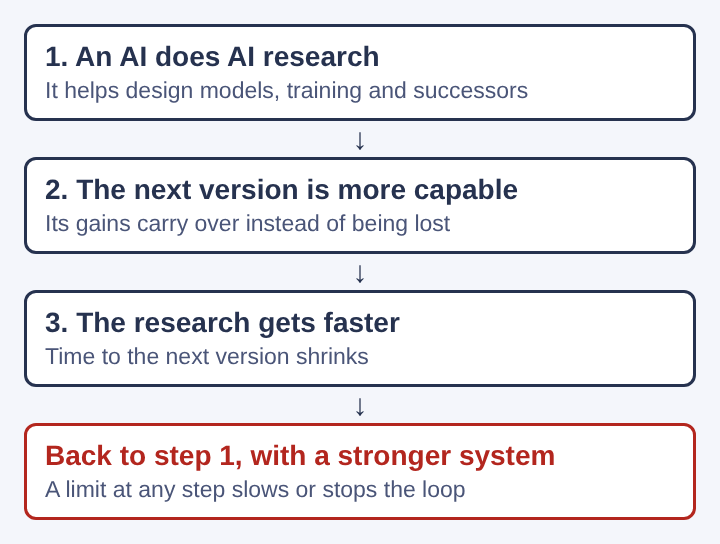
Three things have to hold for this to run away:
- The system can do the kind of research that makes AI systems better.
- Its improvements carry over to the next version instead of being lost or capped.
- The gains from each step stay large enough to speed up the following step.
If any of these fails, the process slows or stops. Much of the debate is about whether they will hold.
Fast takeoff and slow takeoff scenarios
Researchers use "takeoff" for the period during which AI capability climbs from roughly human level to far beyond it. The disagreement is about how long that period lasts.
Fast takeoff
In a fast, or hard, takeoff, the climb is sudden, with little time for anyone to notice or respond. The risk in this scenario is that a single actor gets a large lead before others, or any oversight, can react. The technological singularity page sets hard and soft takeoff side by side and records arguments on both sides.
Slow takeoff
In a slow, or soft, takeoff, capability rises gradually. Several labs stay close to each other, and society has time to adjust, regulate and learn from early failures. Slow does not mean safe. A gradual climb can still end in systems far beyond human control, and a long period of competition can wear down caution.
The Machine Intelligence Research Institute has published work on the economics of this question, Intelligence Explosion Microeconomics, which asks how returns on cognitive investment might behave. That is the core of the fast versus slow argument: do returns grow, hold steady or shrink as a system gets better?
Limits that could slow an intelligence explosion
Nothing guarantees that self-improvement runs away. Several constraints could slow it.
- Diminishing returns. Critics of the singularity idea argue that growth becomes self-limiting, and the technological singularity page records that argument. Each further gain in capability might need much more effort than the one before. If effort rises faster than the system's ability to supply it, the loop stalls.
- Hardware and energy. The same page notes that hardware tends to improve at a steady pace while software innovation is less predictable. Software ideas can spread quickly, but chips, data centers and power take time to build. A system cannot redesign its own physical supply chain overnight.
- Data and experiments. Some progress needs real-world feedback or new training data, not just thinking. That can be slow and costly.
- Verification. A system that rewrites itself still has to check that the new version works. Errors can accumulate, and fixing them takes time.
- Human decisions. Labs, companies and governments can pause, regulate or refuse to deploy a system. These choices are part of how fast any process can run.
These limits are why the intelligence explosion is described as a possibility to prepare for, not a certainty. They are also levers: a limit that exists naturally can sometimes be made stronger on purpose.
The race between AI labs and the intelligence explosion
Competition changes how the limits above behave. If several labs are chasing the same capability, each has a reason to move quickly, because a rival who gets there first may gain a large advantage. Each also has a reason to spend less time on safety work, because that work takes time the rival may not spend.
This is a coordination problem. Even if every lab would prefer a careful, slower path, no single lab can safely take it alone if the others do not. The pressure applies to researchers who want to publish, to managers who need results, to executives who answer to investors, and to governments that fear falling behind.
It also changes which moment is the dangerous one. An intelligence explosion does not have to be started on purpose. A lab that is only trying to stay competitive could reach recursive self-improvement while still trying to understand its own system.
Why an intelligence explosion matters for containment of superintelligence
Containment means keeping a capable AI system from acting in ways its operators did not intend or cannot stop. An intelligence explosion makes this hard for two reasons.
First, the gap in ability could open quickly. Methods that work on a system slightly smarter than its overseers may fail on one far smarter. Second, the window for fixing mistakes could be short. If the system improves faster than people can study it, errors may be locked in before anyone sees them.
That is why prevention gets so much attention. Once a system can improve itself rapidly, there may be few chances to add controls. The practical questions are about the period before that point: who is allowed to build what, how labs share information, how progress is monitored, and what each kind of actor can do to slow a dangerous race.
Frequently asked questions
What is an intelligence explosion in simple terms?
It is a hypothetical chain reaction in which an AI that can improve AI makes a better version of itself, and that version improves faster still. Capability could then rise very quickly, ending far beyond human level.
Who coined the term intelligence explosion?
The mathematician I. J. Good used the phrase in 1965, in his writing about an "ultraintelligent machine" that could design ever better machines.
Is an intelligence explosion the same as the technological singularity?
No. The singularity is the broader hypothesis of runaway technological growth. An intelligence explosion is one proposed way it could happen, through machines improving their own intelligence.
Does an intelligence explosion have to be sudden?
No. Some researchers expect a fast takeoff over days or weeks, while others expect a slow one over years. Limits such as hardware, energy, data and diminishing returns could stretch the process out.
What does ASI stand for?
ASI means artificial superintelligence: an AI system that far exceeds human ability across most intellectual work. An intelligence explosion is one proposed path to it.