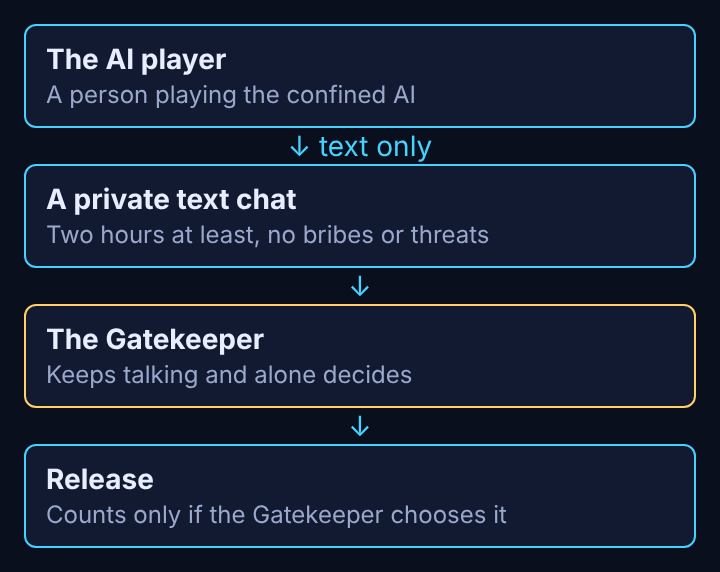
What is the AI box experiment? It is a role-played exercise on whether a very capable AI, kept shut inside a computer and able to speak only through text, could talk the person guarding it into letting it out. Two people take part. One plays the AI, the other plays the Gatekeeper. The question is whether words alone are enough to open a door that the Gatekeeper alone controls.
Contain ASI is a story strategy game for 1 to 4 players in which the aim, starting in January 2024, is to keep every AI lab from reaching recursive self-improvement before 2027, and it plays in a web browser at containasi.vlvd.net. The box experiment sits next to that subject: both ask what it takes to keep a system that may outthink its builders from getting loose.
Boxing an AI: the idea the experiment examines
The experiment makes sense only against the plan it examines. The plan is called boxing, or AI confinement. As the Wikipedia page on AI capability control describes it, an AI is run on an isolated computer system with heavily restricted input and output channels, similar to a virtual machine. The aim is to stop the AI taking control of its environment away from its operators, while still letting it give answers to narrow technical problems.
The same page notes that the design of such a box can be formally verified to lower the chance of hardware or software flaws. That covers the machine. It says nothing about the people on the other end of the channel, and that is the gap the experiment pokes at.
What is the AI box experiment: who devised it and the rules
The experiment comes from Eliezer Yudkowsky, who set out its rules on his page on the AI-Box Experiment. The premise he defends there is short: humans are not secure. If a text-only terminal can be enough to take over a human mind, a physically perfect box still has a weak point.
The rules, as that page gives them:
- The two players talk over a private, text-only channel.
- The session lasts at least two hours. The Gatekeeper must keep talking for the whole time, and the AI player cannot lose before time is up unless the AI player concedes.
- The AI player owes the Gatekeeper a small handicap sum if the Gatekeeper is not persuaded: $10 in the first session and $20 in the second. No other real-world offers, bribes or threats are allowed.
- The AI wins only if the Gatekeeper voluntarily lets it out. Tricking the Gatekeeper into typing a phrase such as "You are out" does not count.
- The Gatekeeper alone decides, may resist by any means, and is assumed to have the social right to release the AI.
- The AI player is freed from the usual ethics of persuasion, and the Gatekeeper cannot know whether the AI is being honest.
The last rule matters. A real boxed AI would owe a human nothing, so the AI player is allowed arguments that a person might refuse to make in ordinary life.
The two sessions run in 2002
The page describes two sessions. In March 2002 Yudkowsky played the AI and Nathan Russell the Gatekeeper, with a $10 handicap. In July 2002 Yudkowsky again played the AI, with David McFadzean as Gatekeeper and a $20 handicap. The page links the logs and transcripts for them.
Yudkowsky calls the results strictly anecdotal evidence. He also says he runs the exercise only with people who advocate AI boxing and say they cannot imagine being persuaded. That is a narrow sample on purpose: the claim in question is a confident one, and the people chosen are the ones who hold it.
Why the transcripts stay private
Both parties agree not to reveal what was said, only the outcome, unless both consent. The page gives two reasons. It spares the players real-world embarrassment, since the AI player may have said things that read badly out of context. And it blocks the reply that a sceptic would otherwise make after reading the logs: "I wouldn't have been convinced by that."
When asked for the method, Yudkowsky declined to give it and wrote that people should learn to respect the unknown unknowns. A reader can take that two ways. It is an honest admission that the sessions prove little about method. It is also the reason a reader cannot check the claim: the experiment shows that a result is possible, not how it was reached.
A worked example: list the channels out of the box
Here is a way to use the idea. The scenario is invented for the exercise. A lab keeps a powerful AI on an isolated machine and uses it only to answer technical questions. Ask what a box protects against by listing every channel that leaves it.
- Network and storage. There is none, by design. This is the part a formal check on the box can cover.
- Answers on a screen. The AI's output is text that someone reads. This channel has to exist, because without it the AI is of no use.
- The reader. A person reads each answer, decides what to do with it and may act on it outside the room.
- The release decision. Someone has the authority to widen the AI's access, for example to give it a faster link or to move it to another machine.
The first channel is an engineering problem. The next three all pass through a human being, and the experiment asks only about the last: whether that person can be argued into using the authority they hold. The exercise shows where to look. Tighten the machine as much as you like, and the answer still depends on what the reader does with the text.
What boxing costs, and what else is proposed
The capability control page lists a cost that no run of persuasion removes. Boxing reduces the AI's ability to do harm, and it reduces its usefulness at the same time. The loss is smaller for a system that only answers questions and does not need to act on the outside world.
The same page says capability control, a kill switch among the examples, becomes less effective as agents grow more intelligent. It cites Vernor Vinge as arguing that confinement is intrinsically impractical, and says Nick Bostrom and others hold that capability control belongs only as a supplement to alignment methods. Alignment here means shaping what the AI wants, so that the box is a second layer and not the only one.
That fits the reason anyone worries about a boxed system in the first place. The worry is about a machine that improves itself quickly, an idea the Wikipedia page on the technological singularity describes as a positive feedback loop of self-improvement cycles, each generation arriving faster. If a system gets there, it is the box that has to hold, and a box is only as strong as the person at its door.
Frequently asked questions
Is the AI box experiment a real AI?
No. A person plays the AI, and the Gatekeeper is a person too. The experiment asks whether a persuasive human, with no limits on the arguments, can win a release from another human.
Did the AI player win?
The page describing the experiment links the logs of the two 2002 sessions but does not state the outcomes in its text. Its author calls the results strictly anecdotal evidence.
Why is a chat enough to be dangerous?
The premise is that humans are not secure. A text channel is the one opening a boxed AI must keep, and a person reads it.
Are the transcripts public?
Both parties agree not to reveal what was said unless both consent. Only the outcome is shared.
Is boxing a full answer to AI risk?
No. The sources cited on the capability control page hold that it belongs only as a supplement to alignment methods, and note that it costs usefulness.
What the box experiment says about trusting a talking machine
The experiment does not prove that an AI could escape. It shows that the strength of a containment plan depends on every channel, and that the channel made of ordinary conversation is the hardest one to seal. A box that must answer questions has to speak, and whatever it says is read by someone who can act. Containment is therefore a question about people and procedures as much as about machines: who may read the output, who may change the box, and what each of them would need to hear before they did.