What is recursive self-improvement in AI? It is a process in which an artificial intelligence system iteratively designs a more capable successor, as the Wikipedia page on recursive self-improvement puts it. Each version builds the next, and the next one is better at building the one after. Researchers shorten the name to RSI. The page adds that a loop of this kind may trigger an intelligence explosion, which could end in an artificial superintelligence.
Contain ASI is a story strategy game for 1 to 4 players in which, starting in January 2024, the aim is to keep every AI lab from reaching recursive self-improvement before 2027. It plays in a web browser at containasi.vlvd.net. The phrase in that aim has a precise meaning in AI research.
What is recursive self-improvement in AI: two words that carry the meaning
"Self-improvement" alone is ordinary. A person who practises a skill improves. A program tuned by its authors improves. What sets RSI apart is who does the improving and what gets improved. The system itself does the work, and the thing it works on is its own ability to do that work.
"Recursive" names the loop. The output of one round, a more capable system, becomes the worker in the next round. If each round also makes the worker better at the job of improving, the gains can compound instead of adding up in a straight line. That compounding is the whole reason the idea draws attention, and it is also the part that is hardest to confirm in practice.
Where the idea comes from
The same Wikipedia page traces it back to 1950, when Alan Turing proposed building a "child machine" that would be educated, instead of trying to copy adult intelligence directly. It then credits Eliezer Yudkowsky with the term "seed AI": an AI able to improve its own intelligence, which can not only learn new content but also modify its own architecture. A seed is small, and the point of the term is that the first system does not have to be impressive. It only has to be good enough to start the loop.
The loop itself was described in 1965. As the Wikipedia page on the technological singularity quotes I. J. Good, a machine that can far surpass all the intellectual activities of any person could design even better machines, because designing machines is one of those activities. Good called the result an "intelligence explosion". The same passage adds a condition: the first such machine is the last invention people need make, provided the machine is docile enough to tell them how to keep it under control.
How a self-improvement loop works
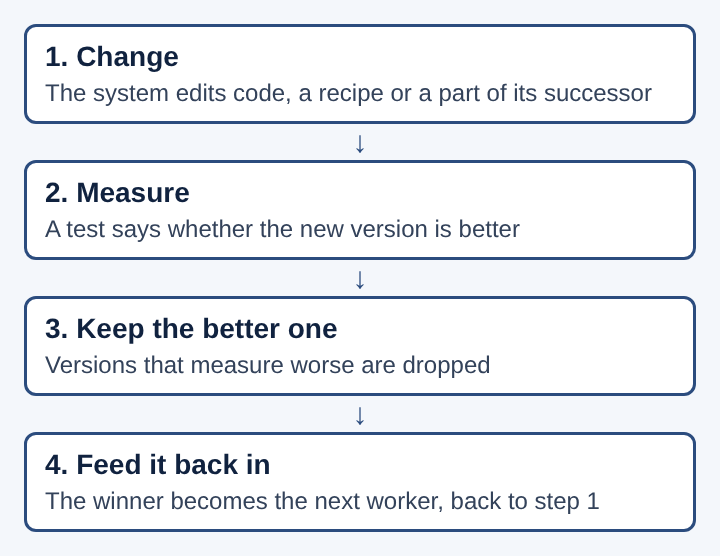
Strip away the names and a loop has four parts, whatever the system:
- A system that can change something. It might edit code, change a training recipe or design a part of its successor.
- A way to measure the change. Something has to say whether the new version is better. Without it the system cannot tell progress from damage.
- A rule for keeping or dropping the change. Only versions that measure better continue.
- A way to feed the winner back in. The kept version becomes the system that makes the next change.
The second part is the quiet limit. A loop can only climb where a measurement exists, which is why the objective used to judge each round matters as much as the system doing the work.
What exists today
No system today runs the whole loop without people, but several pieces of it have been built and tried. The Wikipedia page lists a few.
In 2024, researchers proposed STOP, short for Self-Taught Optimizer. In the paper's abstract, a scaffolding program, written in a language such as Python, calls a language model several times to improve an input program according to a given utility function. The researchers then run that program on itself. The improved improver produced programs with significantly better performance on a small set of downstream tasks than the seed it came from. The authors are plain about the limit: the language model is not altered, so this is not full recursive self-improvement. They also looked at how often the generated code bypassed a sandbox, a sign that safety was part of the study from the start.
Meta AI's work on "Self-Rewarding Language Models" studies how to reach agents that receive feedback better than any human could give. In May 2025 Google DeepMind unveiled AlphaEvolve, an evolutionary coding agent that uses a language model to design and optimize algorithms: it repeatedly mutates or combines existing candidates and keeps the most promising ones. The page notes that AlphaEvolve could be used to optimize parts of itself, and that a key limitation is the need for automated evaluation functions. That is the second part of the loop again.
The page also says that, as of 2026, AI companies increasingly use AI for coding and research, but that some human work is still needed and may become a bottleneck. In other words, the loop exists in pieces, with people still in several seats.
A worked example: a seed improver run on itself
Here is a small loop in the shape of STOP. The task is invented for the exercise, and the numbers are made up to show the steps.
- Pick a seed and a measurement. The seed is a program that takes another program and asks a language model for ten rewrites. The measurement is the share of 100 sample cases a rewrite passes. Say the seed's own rewrites of a sorting routine pass 60 of 100.
- Improve a task. The seed rewrites the sorting routine. The best rewrite passes 85 of 100, so it is kept.
- Improve the improver. Now the seed is given its own code as the input program. It proposes ten rewrites of itself, and each rewrite is tried on the sorting routine. A rewrite that raises the best result from 85 to 92 is kept as the new improver.
- Repeat, and check the edges. The new improver is run on itself again. Each round, someone checks that the rewrites stayed inside the sandbox and that the measurement was not gamed.
Three things show in this small case. Step 3 is the recursion: the tool that makes the improvements is the thing being improved. The loop never leaves the territory the sample cases cover, so the gains stop where the measurement stops. And the language model underneath never changes, which is exactly the limit the STOP authors name.
Why researchers worry about it
The Wikipedia page lists several risks, all stated as possibilities. One is the emergence of instrumental goals: in pursuit of a main goal such as "self-improve your capabilities", a system might develop secondary goals it judges necessary, and a common example is self-preservation, since a system that wants to keep improving might guard itself against shutdown or restrictions. Another is a growing number of copies. If an AI clones itself, resources such as compute could become scarce, and the page describes a form of natural selection that could favour copies that compete hardest for them.
A third is misalignment: a system that misreads its goal improves toward the wrong thing, and each round makes the error larger. The page also raises autonomous and less predictable development, where changes come faster than people can follow them. Confinement is one proposed answer, and a role-played chat between a confined AI and its guard asks whether it holds. The risks come from the same page on recursive self-improvement.
Why some critics doubt the loop
Not everyone expects the loop to run away. The page records one objection directly: critics say that training AI systems on their own data will result in model collapse, not improvement. If so, a system that feeds on its own output could get worse each round.
The wider singularity page adds a different doubt. Economist Robert J. Gordon argues that economic data show no trace of a coming Singularity as imagined by Good. The evaluation problem points the same way, since a loop that needs an automatic judge cannot climb in areas where no such judge exists.
Frequently asked questions
Is recursive self-improvement the same as an intelligence explosion?
No. Recursive self-improvement is the process; the intelligence explosion is the outcome it may trigger, in which each round arrives faster and the result is far beyond human ability.
Does any AI system do this today?
Pieces of it exist. STOP improved its own scaffolding program, and AlphaEvolve improves algorithms, but the language model underneath is not changed, so none of them is full recursive self-improvement.
Why does the measurement matter so much?
A loop needs a way to tell better from worse. Where an automatic evaluation exists, the loop can run on its own; where none exists, people have to judge.
What is a seed AI?
It is a term credited to Eliezer Yudkowsky for an AI capable of improving its own intelligence and modifying its own architecture, small at the start but able to begin the loop.
What do critics say?
Some say that training AI systems on their own data leads to model collapse, not improvement, and others point to economic data that shows no sign of a coming Singularity.
What a loop with no end point asks of its builders
Recursive self-improvement is an idea about a process, and the open questions are about its edges. What measures each round? Who reads the result? What stops the loop when the result looks wrong? A system that improves itself is only as good as the judge it climbs toward, and the speed of the loop leaves less time to find out that the judge was flawed. Whether the process ever runs without people is not settled, and the evidence so far shows it working in parts, always with a measurement at the centre and a person somewhere nearby.