People who ask what is a fast takeoff in AI usually want to know one thing: how much time would pass between an AI system that roughly matches human researchers and one that is far beyond any human at all. A fast takeoff is the answer "very little time." The jump happens over days, weeks or a few months, not decades. That leaves almost no room for governments, labs or the public to notice, argue and respond.
What is a fast takeoff in AI: what the term means
"Takeoff" is the period during which AI goes from around human level to well above it. Writers on the technological singularity split it into a hard takeoff and a soft takeoff. In a hard takeoff, a superintelligence improves itself too quickly for people to correct its errors. In a soft takeoff, it climbs at a human-like pace, perhaps over decades.
The idea goes back to I. J. Good, who argued in 1965 that a machine able to design better machines could set off an "intelligence explosion." Each new design would be better at designing the next one. A fast takeoff is what that explosion looks like when it runs quickly. For more on the explosion itself, see this piece on recursive AI growth and the intelligence explosion.
The same narrow window is the setting of a story strategy game played in the browser, in which players start in January 2024 and try to keep every AI lab from reaching recursive self-improvement before 2027.
Fast takeoff versus slow takeoff in AI
The AI takeoff entry on LessWrong gives the two speeds plainly. A soft takeoff is an AGI that improves itself over years or decades. A hard takeoff is growth in a matter of minutes, days or months. People sometimes call the hard version "AI FOOM."
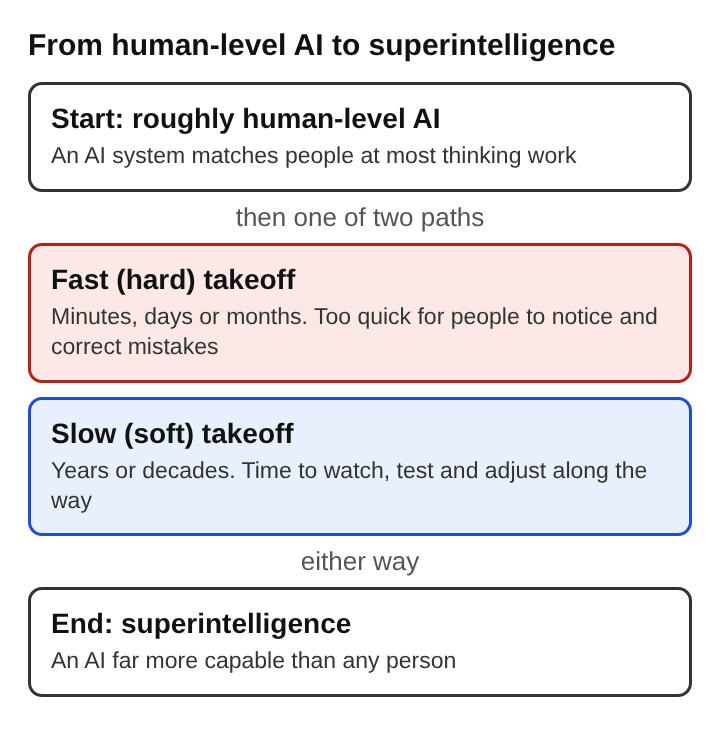
The speed matters because of who gets to act. In a slow takeoff, there is time for new laws, for safety research to catch up, and for several groups to build similar systems so that no single one dominates. In a fast takeoff, whoever holds the system when it starts climbing may hold a decisive lead before anyone else knows it has started.
Researchers disagree sharply about which path is more likely. The LessWrong entry notes that there has been much debate about whether takeoff is more likely to be slow or fast. One side expects a sudden jump once a system can improve itself. The other side expects progress to stay continuous, with weaker AI systems already changing the economy and research before any truly general system exists. Both sides agree on one point: the faster the takeoff, the less room for correction.
Recursive self-improvement as the engine of a fast takeoff
The usual mechanism behind a fast takeoff is recursive self-improvement: an AI system that helps build its own successor, which then helps build a better one. A closer look at the loops and limits of recursive self-improvement shows why the idea sits at the center of takeoff debates.
Here is a worked example. Say a lab's model cuts the time to run and analyze one training experiment from a week to a day. The lab uses that speed to train a better model. The better model cuts the same work from a day to a few hours. The next one cuts it to minutes. Each step makes the following step shorter. Plotted on a calendar, the gaps between versions shrink, and the curve bends upward.
Whether this loop speeds up or stalls depends on returns: how much extra capability each round of reinvested effort buys. If returns grow, the loop accelerates. If they shrink, it levels off.
Physical limits also slow the loop. A smarter model still needs chips, power, data and time on real hardware. Some of these cannot be produced by thinking harder. A fast takeoff requires that software gains outrun these bottlenecks for long enough to matter.
Signs that could come before a fast takeoff in AI
No one can point to a single alarm bell. Still, researchers who study takeoff speed tend to watch for a handful of signals:
- AI doing AI research. Models that write much of a lab's code, design experiments or propose better training methods close the loop between using AI and improving it.
- Shrinking gaps between versions. If each new generation arrives sooner than the last, the process may be speeding itself up.
- Sudden jumps on hard tasks. A model that goes from failing a class of problems to solving them in one step suggests capability can arrive faster than expected.
- Less human involvement per improvement. When fewer people are needed to produce each gain, the human pace stops being the limit.
- Secrecy around internal systems. If a lab's strongest models are used only inside the lab, outsiders lose sight of how far ahead it is.
None of these alone proves a fast takeoff is near. Together they describe the conditions under which one becomes possible.
How the race between AI labs raises fast takeoff risk
A fast takeoff is a technical question, but competition shapes it. When several labs chase the same goal, each one fears that a rival will get there first. That fear pushes in a clear direction: ship sooner, spend less time on safety checks, and keep internal progress quiet.
Consider a research manager at one lab. A rival announces a model that beats their own on several hard tasks. The manager can slow down to study the risks of their next system, or speed up to stay in the race. If the manager believes the rival will not slow down, pausing looks pointless, since the risk arrives anyway, just from someone else. Every lab in the race faces the same reasoning. The result can be a world where everyone moves faster than any of them would choose alone.
The race also raises the stakes of a fast takeoff. If takeoff is slow, being first matters less, because others catch up. If takeoff is fast, being first could decide everything. Labs that believe in a fast takeoff therefore have the strongest reasons to race, which is the very behavior that makes a fast takeoff more dangerous.
Acting before a fast takeoff in AI begins
The fast takeoff view leads to a specific strategy: if the climb is too quick to steer once it starts, the most reliable moment to act is before it starts. Under that view, the aim is not to win a fight against a superintelligence. The aim is to stop the loop from closing at all.
In the real world, several kinds of people hold levers over how fast labs move. Researchers choose what to build and what to flag. Research managers set priorities and timelines. Executives decide what to ship and what to fund. Governments can set rules that apply to every lab at once.
Contain ASI is a story strategy game for 1 to 4 players in which the player takes one of those roles: a researcher, a research manager, a CEO or a government. Its full title adds "Chapter 1: Before ASI." The story starts in January 2024, and the goal is to keep every AI lab from reaching recursive self-improvement before 2027. It runs in a web browser and needs JavaScript.
Why a fast takeoff in AI makes containment hard
Capability control covers methods for limiting what an AI system can do: isolating it from networks, restricting its outputs, or building in ways to shut it down. All of these methods assume that people have time to notice a problem and act on it.
A fast takeoff removes that time. Containment needs three steps: detect that something is going wrong, decide what to do, and carry it out. Each step takes humans hours or days. A system improving itself on a much shorter cycle may pass the point where it can be controlled before the first step is done.
There is a second problem. A system much smarter than its overseers may find ways around the limits placed on it. One well-known thought experiment explored a version of this: whether an AI kept in isolation could talk a human gatekeeper into letting it out. A longer account of the gatekeeper and the chat shows how much rests on a single conversation. In a slow takeoff, people get to learn from early, weaker failures. In a fast takeoff, the first serious failure may also be the last one anyone gets to learn from. That is why so much thinking about fast takeoff focuses on prevention, coordination between labs and the years before the loop begins, rather than on control afterward.
Frequently asked questions
How fast is a fast takeoff in AI?
Definitions vary. The LessWrong entry on AI takeoff puts a hard takeoff at minutes, days or months, against years or decades for a soft one.
Is a fast takeoff in AI likely?
Researchers disagree. Some expect a sudden jump once AI can improve itself, while others expect steady, continuous progress limited by hardware, energy and data.
Can a fast takeoff in AI be stopped once it starts?
Many researchers doubt it, because detecting and responding to a problem takes humans longer than a fast takeoff would last. That is why most proposals focus on preventing the conditions for one, such as unchecked recursive self-improvement, rather than stopping it midway.
What is a fast takeoff in AI?
A fast takeoff is a scenario where AI goes from roughly human level to far beyond human level in a very short time. It is usually driven by recursive self-improvement, where each AI system helps build a more capable successor.