If you want to know what is a trojan horse in computer security, the short answer is this: it is a program that presents itself as something useful and does harm once a person runs it. It does not force its way in. Someone opens it, installs it or clicks it, and that single action gives it the same access as the person who ran it. Tank City Reboot is a browser game, on a computer or a phone, that rebuilds the Family Computer tank classic inside a computer, where an antivirus tank defends the CPU core from malware tanks, and one of those tanks is a Trojan.
What is a trojan horse in computer security, exactly
The name comes from the Greek story of soldiers hidden inside a wooden horse that the city of Troy pulled through its own gates. The computing term) keeps one part of that story: the victim brings the danger in. A trojan horse is any malicious program disguised as a legitimate one.
That disguise is the defining trait. A trojan does not need a software flaw to get in, and it does not copy itself to other machines on its own. It needs a person to trust it. Once it runs, it can do whatever that person's account is allowed to do: read files, change settings, connect to the internet and start other programs.
How a trojan horse gets onto a computer
Because a trojan depends on someone running it, the delivery methods are all about persuasion. Security people call this social engineering): getting a person to act against their own interest. The usual routes are:
- Email attachments that claim to be invoices, shipping labels or job offers.
- Cracked copies of commercial software and games shared on download sites.
- Fake update prompts that say a browser or video player is out of date.
- Apps from unofficial stores that bundle a hidden program with a working one.
- Links in messages that lead to a download page dressed up as a real company.
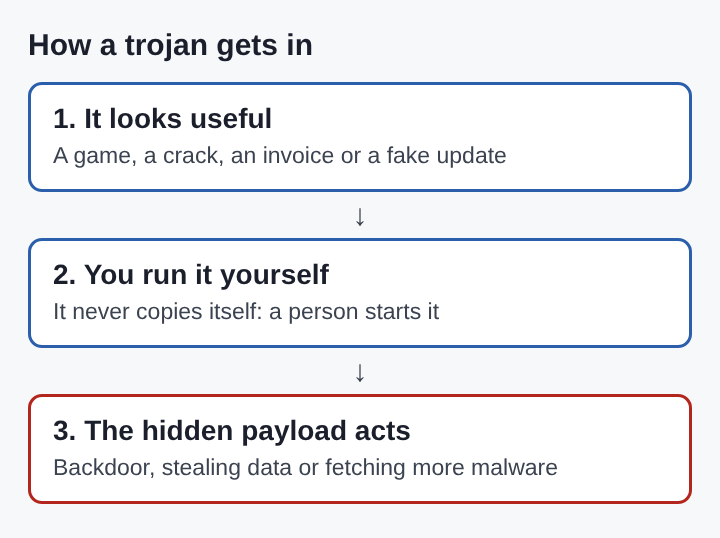
Here is a concrete case. You receive an email saying a parcel could not be delivered, with an attachment named label.pdf.exe. Many systems hide filename extensions by default, so you see only label.pdf and a document icon the sender picked. You double click. The file is a program, not a document. It may even open a real PDF so nothing seems wrong, while it quietly installs itself in the background.
What a trojan horse does once it runs
Many trojans contact one or more command and control servers across the internet and wait for instructions. What happens next depends on why the trojan was written. Common actions include:
- Opening a backdoor), a hidden way for an attacker to reach the computer later without logging in normally.
- Copying saved browser passwords, session cookies and files, then sending them to a remote server.
- Downloading more malware once the first foothold is secure.
- Enlisting the computer in a botnet, a group of infected machines that an attacker controls together.
The trojan often does very little that a person would notice. The less visible it is, the longer it keeps working.
Common types of trojan horse malware
Researchers sort trojans by what they do after they land. The labels overlap, and one program can fit several of them.
- Remote access trojans give an attacker full remote control of the computer: installing software, reading files and watching what the person does.
- Banking trojans steal financial details such as online banking logins, card numbers or the keys to cryptocurrency wallets.
- Downloaders and droppers exist mainly to bring in other malware after they run.
- Information stealers collect browser cookies, saved passwords and documents without the person knowing.
- Rogue security software poses as an antivirus program, shows fake warnings and pushes the person to hand over money or card details.
Many ransomware attacks also start with a trojan. The disguised program gets in first, then the part that locks files arrives later.
How a trojan horse differs from a worm or a virus
The difference is in how each one spreads. A computer virus attaches its code to other programs or files and spreads when those are run or shared. A computer worm copies itself from computer to computer over a network without anyone opening a file. A trojan does neither. It reaches a new computer only when a person carries it there and runs it.
In practice the categories blur. A trojan can install a worm, and a worm can carry a trojan as its payload. The useful question when reading about an attack is: did this spread on its own, or did someone run it? Each family moves between machines in its own way, and the types of malware and how they spread between computers go into that in more depth.
How a tank game models trojan horses and their defences
In the game, the Trojan tank moves twice as fast as the Worm, the basic tank. The site's own one line description of the real thing is that a trojan hides inside a program that looks useful and does its harm once it runs. The other malware tanks follow the same pattern: a Worm for self copying malware, Spyware that fires fast shots, and a Rootkit that is armored and takes four hits.
Several power-ups borrow the names of real defences. Patch gives a shield for ten seconds, and the game ties it to a software update that closes a security hole. Firewall rebuild turns the wall around the CPU core to silicon for fifteen seconds, and the real idea attached is a firewall checking network traffic against rules. Backup gives one extra life, which the game links to a copy of data kept somewhere else so it can be restored after a loss. Every stage also opens with a true fact about how computers work. These are short labels, not a full account, but they map onto three real defensive steps: close the hole, filter the traffic, keep a copy.
Signs a computer is running a trojan horse
Many trojans show no sign at all. When there are signs, they tend to look this way:
- A program you do not recognise appears in the startup list or the task manager.
- Security software has been switched off, and you did not do it.
- The browser has a new home page, search engine or extension.
- Network activity stays high while the computer sits idle.
- An online account reports a login from a place or device you do not know.
- Friends receive messages from your accounts that you never sent.
A trojan that installs a rootkit can hide its files and processes from the very tools you would use to look for it. That is why a rootkit is hard to remove, and why a clean result from a scan is not full proof that a machine is clean.
Defences against trojan horse attacks
Since a trojan needs a person to run it, most defences work before that moment. The rest limit the damage if it happens anyway.
- Get software from its publisher or an official store. Check that installers carry a valid code signature from the company you expect.
- Turn on filename extensions. Seeing
.exeat the end of a "document" stops the parcel trick at once. - Install updates from the system's own update tool. A patch) closes security holes, and real updates never arrive as a pop up on a random website.
- Use an everyday account without administrator rights. The principle of least privilege means a trojan inherits less power when it runs.
- Keep antivirus and a firewall on. Antivirus can spot known trojans by their code and behaviour. A firewall can block a program that tries to call out to a server it should not reach.
- Use multi-factor authentication. A stolen password alone then does not open the account.
- Keep backups somewhere else. If a trojan brings in ransomware or deletes files, a copy stored off the machine lets you restore them.
Encryption helps with some of this but not all. It protects data on a lost laptop or in transit, yet a trojan running under your account sees files the way you do. The details are in how encryption keeps data private from malware.
Frequently asked questions
Can a trojan horse copy itself to other computers?
Not by definition. A pure trojan spreads only when a person shares and runs it, though many trojans download a worm or other self spreading code once they are inside.
Can antivirus software remove a trojan horse?
Often, yes, especially for well known trojans. If the trojan installed a rootkit or the scan cannot be trusted, the safer route is to back up personal files, wipe the device and reinstall the system from a trusted source.
Can a phone get a trojan horse?
Yes. Android trojans often spread through unofficial app stores or phishing messages, and they may ask for extra permissions that reach messages, saved passwords or financial details.
Why do trojan horses often install rootkits or spyware?
A trojan gets an attacker through the door, but it is easy to delete once found. A rootkit buries itself deep in the operating system so the infection is hard to find and remove, and spyware watches what the person does and reports it, which is often the reason the attack happened in the first place.