The extended mind thesis is the claim that a mind does not stop at the skin. Some of what makes up your beliefs and your thinking can sit in a tool you use, such as a notebook, if that tool does the same job a part of your brain would do. The idea comes from the philosophers Clark and Chalmers, and it has found a new audience in AI research, where IndividuationLab uses it to describe the files that give an AI agent its identity.
What the extended mind thesis claims
The Stanford Encyclopedia of Philosophy entry on externalism about the mind puts the claim this way: some mental states or acts are, in part, made up of things located outside the biological boundaries of the person who has them. That is a stronger claim than saying the world shapes what you think about. It says the very thing that carries a belief can be out in the world.
The same entry separates this from an older view, content externalism. Content externalism says the meaning of your thoughts depends on your surroundings. The extended mind thesis says the physical carrier of a thought, its vehicle, can be located outside your head. One is about what a thought is about. The other is about where the thought is.
Clark and Chalmers rest the case on a functionalist view of belief. A belief is whatever plays the role of a belief: it stores information, you can call it up when you need it, and it guides what you do. If something outside the head plays that role closely enough, the functionalist has no principled reason to deny it the name.
Otto's notebook, step by step
The case that made the thesis famous is short, and you can follow it in four steps.
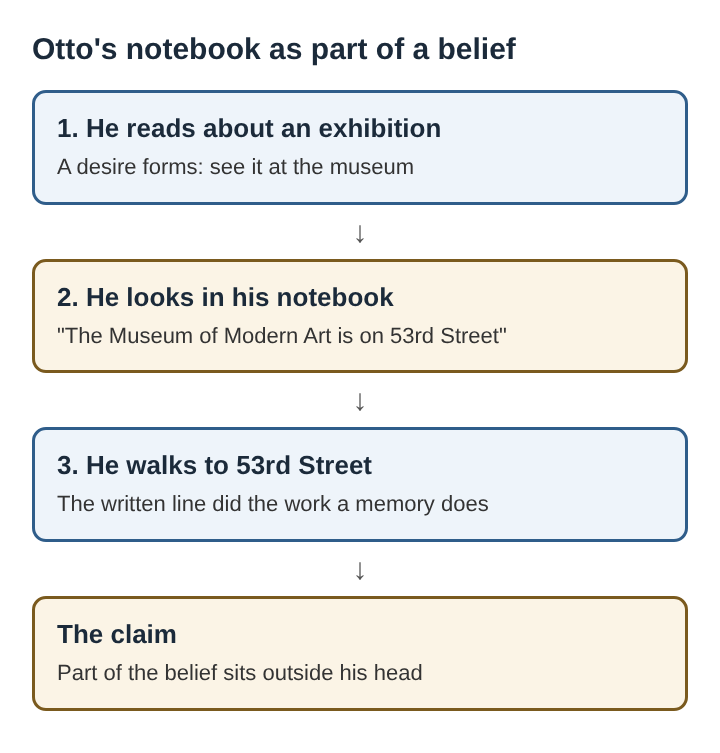
- Otto is in the early stages of Alzheimer's disease. To get through his day, he writes down information he thinks will be useful in a notebook he carries everywhere.
- He reads in a newspaper that there is an exhibition at the Museum of Modern Art, and he wants to see it.
- He opens his notebook and finds the line "The Museum of Modern Art is on 53rd Street".
- He sets off for 53rd Street.
Now compare Otto with someone whose memory works without help. That person recalls the address and walks there. Nobody hesitates to say they believed the museum was on 53rd Street before they recalled it. Clark and Chalmers argue that the sentence in Otto's notebook plays a role similar enough in his life that it should count as one of his beliefs. If that is right, at least one of Otto's beliefs lies in the notebook rather than in his head.
Run the same check on something in your own life. Pick a fact you rely on but never memorized, such as a phone number saved in your contacts. Ask three questions: do you reach for it as readily as a memory, do you trust it without checking it again, and did you put it there yourself? The more answers come back yes, the closer that saved number sits to the role a belief plays.
The conditions that keep the thesis in bounds
The first objection is called cognitive bloat. If Otto's notebook holds his beliefs, why not every sentence in an encyclopedia or on the internet, which he could also reach with little effort? On that reading, everyone would believe almost everything ever written down.
The encyclopedia entry reports that Clark and Chalmers answered with two conditions. The person must, at some time, have consciously endorsed the information. And the person must have entered it into the notebook themselves. The address in the notebook meets both conditions. A random encyclopedia page meets neither.
The entry also says it is unclear whether these conditions work. Subliminal beliefs seem to be beliefs nobody consciously endorsed, which troubles the first condition. And on a strictly functionalist view, how a belief got into your collection should not matter to whether it plays the role of a belief, which troubles the second.
Coupled or part of the mind
A second objection, which the encyclopedia credits to Adams and Aizawa and to Rupert, says the argument mixes up two claims. One is that a thinking process depends on, or is coupled with, something outside the body. The other is that the outside thing is a part of the thinking process itself.
Nobody denies the first. Otto clearly depends on his notebook. The objection says the Otto case shows only coupling, a mind embedded in its surroundings, and not that the notebook is a piece of the mind. A third, the original intentionality objection, comes from a tradition that goes back to Brentano and has been pressed by Adams and Aizawa, Fodor and Rowlands.
These objections matter because they decide what the thesis can support. If coupling is all it shows, then a tool that helps you think is still a tool. If constitution holds, then changing the tool changes you.
Why AI agent identity files bring the thesis back
The question of where a mind ends has a practical side for AI agents that keep files about themselves. The research page of IndividuationLab describes identity-based alignment, in which an agent gets a set of files: SOUL.md for who the agent is, AGENTS.md for how it acts, and MEMORY.md for continuity across sessions.
The research page draws on Clark and Chalmers directly. If thinking can extend beyond the brain into tools, it argues, then SOUL.md and MEMORY.md can be framed not as rules imposed from outside but as part of the agent's own cognitive system: constitutive, not constraining. The page is careful to add that whether this framing holds rigorously for language models is an open question.
The coupling objection maps onto that open question. If an agent's memory file is only coupled to the model, then it is a set of instructions the model reads, and a clever prompt might talk the model out of following them. If the file is part of what the agent is, then a prompt that asks the agent to drop its boundaries is asking it to act against itself. The research page states predictions that would tell these apart: agents with an identity file should resist adversarial prompts more consistently than agents without one, and their alignment should degrade in predictable ways when the coherence of that identity is disrupted.
Endorsement as the common thread
Clark and Chalmers ask that Otto once endorsed what he wrote. The research page leans on the same word: its hypothesis is that an agent with a well-defined identity may honor its boundaries more reliably because those boundaries fit who it understands itself to be, so that it endorses its principles on reflection rather than merely complying. The page says this needs rigorous checking before anyone relies on it.
Endorsement has a longer history in philosophy. The Stanford Encyclopedia of Philosophy entry on personal autonomy describes one popular account, from Harry Frankfurt, in which your point of view is made up of your highest-order desires about which of your first-order desires should move you to act. On that account, an action you repudiate even as you do it is not fully your own, while one whose motives you endorse is. Read together with the extended mind thesis, the thought is that a record you wrote, trust and endorse can belong to you in a way an order handed to you does not.
Frequently asked questions
Who proposed the extended mind thesis?
Clark and Chalmers, in a 1998 paper. The encyclopedia calls their Otto example the canonical argument for the thesis.
Does the extended mind thesis mean a phone is part of your mind?
Only under conditions. Clark and Chalmers asked that the information be reliably at hand, trusted, consciously endorsed at some point and entered by the person, and critics argue that even then a tool may be coupled to the mind rather than part of it.
What is the cognitive bloat objection?
It asks why, if Otto's notebook holds his beliefs, the sentences in an encyclopedia or on the internet would not count too. The worry is that the thesis would make everyone believe nearly everything they could look up.
Is the extended mind thesis accepted?
It is debated. The encyclopedia sets out the cognitive bloat, coupling and original intentionality objections, and says it is unclear whether the replies to them work.
Where the edge of a mind sits
The extended mind thesis turns a quiet assumption into a question: is the boundary of a mind the boundary of a body, or the boundary of what does the work of thinking? Otto's notebook makes the question concrete, and the objections show how much depends on the gap between depending on a thing and being made partly of it. For people and for AI systems that keep records of themselves, the answer decides whether a written memory is a reference to look up or a piece of who is doing the remembering.