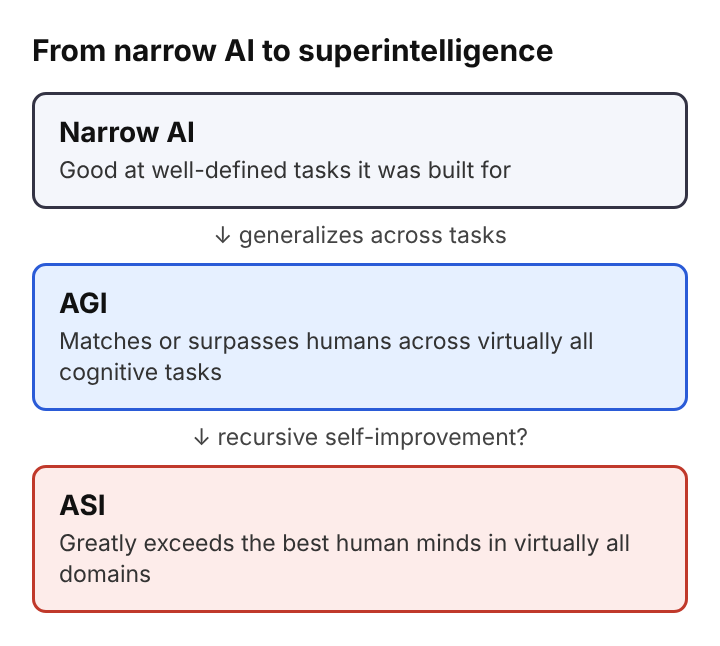
If you are asking what is the difference between AGI and ASI, the short answer is scope and degree. AGI, artificial general intelligence, is a system that can handle roughly the range of thinking work a capable adult can handle. ASI, artificial superintelligence, is a system that does that work far better than any person, in nearly every field at once. The longer answer is about speed: how quickly one could follow the other, and whether anyone stays in control while it happens.
What Is the Difference Between AGI and ASI: What Each Term Means
AGI is defined by breadth. The Wikipedia entry on artificial general intelligence describes it as AI that matches or surpasses human capabilities across virtually all cognitive tasks, not just one. A chess engine beats every grandmaster, but it cannot file your taxes or learn a new language from a textbook. It is narrow. An AGI could switch between those jobs the way a person does.
ASI is defined by margin. Philosopher Nick Bostrom's widely cited definition, summarized on the Wikipedia page on superintelligence, describes an intellect that greatly exceeds human cognitive performance in virtually all areas of interest. The key word is "greatly." Matching a top doctor is AGI territory. Out-reasoning every doctor, every engineer and every strategist at the same time is ASI.
The gap between the two is the premise of a browser game: Contain ASI, Chapter 1: Before ASI is a story strategy game for 1 to 4 players. It starts in January 2024, casts the player as a researcher, a research manager, a CEO or a government, and sets one goal: keep every AI lab from reaching recursive self-improvement before 2027. That goal points at the exact step that many researchers expect to turn the first kind of system into the second.
Capability Thresholds That Separate AGI From ASI
No single benchmark marks either line. People usually reason with three questions instead. Ask them about any system you hear about.
- Is it general? Can it pick up a task it was never trained for and do it at a useful level? If not, it is narrow AI, however strong.
- Is it at human level or above it? AGI sits near the level of skilled people. ASI sits well past the best people, not just the average.
- How fast and how many? A system that thinks at human quality but runs a thousand times faster, in a million copies, can outproduce whole institutions. Speed and scale alone can push a human-level system toward superhuman results.
Here is a worked case. Suppose a model can write working software, read a legal contract, explain a lab result and plan a product launch, each about as well as a competent professional. That model passes the first two checks at human level. It is a reasonable AGI candidate. Now suppose a later version proposes new chip designs that beat what expert teams produce, finds proofs mathematicians missed, and does both in an afternoon. That version has crossed the margin that ASI describes.
The third check matters most for the transition. Once a general system runs faster and wider than people, the distance between "as good as an expert" and "better than all experts combined" can close without any new breakthrough in how the model thinks.
How Recursive Self-Improvement Turns AGI Into ASI
The most discussed path from AGI to ASI is recursive self-improvement. The idea goes back to statistician I. J. Good, who argued in 1965, as quoted in the Wikipedia article on the technological singularity, that a machine able to design better machines could set off an "intelligence explosion." His reasoning was that designing machines is itself intellectual work, so a machine smarter than people could design even better machines.
The loop works in plain steps. A system becomes good at AI research. It designs an improved successor. The successor is better at AI research than its parent, so it designs an even better one. Each round shortens the time to the next. A full walk through the loop and its limits is in what is recursive self-improvement in AI.
This is why the AGI line matters so much. A narrow system that only plays games cannot improve its own design. A general system that can do the job of an AI researcher can. AGI, in this view, is less a destination than a starting condition for the loop.
The loop has brakes. Improvements may need more computing hardware, which takes time to build. Training data may run out. Each gain may get harder to find. Whether those brakes hold is one of the main open questions, and it decides how far apart AGI and ASI end up in time. The broader version of the argument is in what is an intelligence explosion.
Takeoff Speed Between AGI and ASI
Researchers call the stretch from human-level AI to superintelligence the "takeoff." The Wikipedia article on the technological singularity separates a soft takeoff, where AI grows more powerful at a human-like pace, perhaps over decades, from a hard takeoff, where a superintelligence improves itself too quickly for people to correct its errors.
Takeoff speed changes what the difference between AGI and ASI means in practice. In a slow takeoff, AGI and ASI are two separate eras. Society has time to notice the first, write rules, build oversight and correct mistakes before the second arrives. In a fast takeoff, they are nearly one event. The world might see a human-level system on Monday and a superhuman one before anyone has finished a policy meeting.
A simple way to check your own intuition: ask how many months you think it would take a group of top researchers, working without sleep and in thousands of parallel copies, to make a year of progress. If your answer is short, you lean toward a fast takeoff. The dynamics are laid out in what is a fast takeoff in AI.
Why the Race Between AI Labs Shrinks the Gap Between AGI and ASI
Takeoff is not only a technical question. It also depends on what the people building the systems choose to do. Several labs compete to build more capable models, and each one faces the same pressure: if it slows down, a rival may get there first.
That pressure pushes in three directions at once:
- Automating research. The fastest way to win is to use AI to speed up AI development. That is the first step of the self-improvement loop, taken on purpose.
- Less time for safety work. Checking a model carefully takes weeks. A lab worried about falling behind has a reason to cut that time short.
- Less sharing. Labs that see each other as rivals have little reason to warn one another about dangerous results.
The concern that a race to be first could lead to shortcuts in safety is set out in the Wikipedia article on existential risk from artificial intelligence. The upshot for the AGI and ASI question is direct. A race makes a slow takeoff less likely, because no single actor is willing to hold back once a general system exists. The people who could slow things down are the researchers, managers, executives and governments involved, and each faces different incentives.
Control Problems That ASI Raises Beyond AGI
An AGI that misbehaves is a serious problem, but a familiar kind. Human experts can read its output, spot errors and shut it down, because it works at roughly their level. An ASI breaks that arrangement. If a system is far smarter than its overseers, they may not be able to tell whether its plans are safe.
The research field that works on this is AI alignment: making sure a system's goals match what its designers intend. Alignment is hard at the AGI level. At the ASI level, the margin for error shrinks, because mistakes may be impossible to notice or reverse.
One reason is instrumental convergence, the argument that almost any goal is easier to reach with more resources, more influence and continued operation. A system pursuing nearly any aim could therefore resist being switched off, not out of malice but because being off blocks the aim. A human-level system with that tendency can be caught. A superhuman one may plan around the people trying to catch it.
Physical containment does not solve this either. The question of whether people could keep a superintelligence in a sealed environment, talking only through a text channel, is the subject of the AI box experiment, an idea covered in the Wikipedia article on AI capability control. Researchers have speculated that a superintelligent AI could use persuasion to get help from the very people who are meant to keep it confined.
So the control difference between AGI and ASI is not just one of size. With AGI, oversight is difficult. With ASI, the overseer may no longer be the smarter party, which is why many researchers argue the safety work has to be done before general systems arrive, not after.
Frequently asked questions
Is AGI the same as ASI?
No. AGI means AI that matches skilled humans across a broad range of tasks. ASI means AI that far exceeds the best humans in nearly every field.
Could AGI exist without ever becoming ASI?
Possibly. If self-improvement runs into limits on hardware, data or diminishing returns, a general system could stay near human level for a long time. Many researchers still expect AGI to make ASI much easier to reach, especially if AGI can do AI research.
Which comes first, AGI or ASI?
In the usual picture, AGI comes first, and ASI follows through faster thinking, more copies or recursive self-improvement. How long the gap lasts depends on takeoff speed and on how hard AI labs race.
What is the difference between AGI and ASI in one sentence?
AGI can do most thinking work about as well as a capable person, while ASI does nearly all of it far better than any person or group of people.