A reflection question can stop you cold. You read it, your mind goes blank or your chest tightens, and the page stays empty. If you want to know what to do when a reflection question feels too hard, you have more choices than forcing an answer or quitting. You can shrink the question, reword it, answer it in parts, or set it aside on purpose and come back. Some tools build this into their design: one site asks five questions a day about your own life at an hour you pick, ordered from the easiest to step into up to the deepest, and then writes back a plain record of what you said.
Why a reflection question can feel too hard
Most hard questions are hard for one of a few reasons. Knowing which one applies tells you what to change.
- The scope is too wide. "What do you want from your life?" covers decades. Nobody can hold all of that in one sitting.
- It touches something painful. A question about a parent, a breakup, or a job you lost can bring back the feeling along with the memory.
- It asks for a conclusion you have not reached. "Why did you stay so long?" assumes you already know. Often you do not, yet.
- The wording carries judgment. Words such as "fail", "should", and "always" put you on the defensive before you write a word.
- You are tired. A question that is fine on a Sunday morning can feel impossible at 11 at night.
There is also a deeper reason. Looking inward is hard work in itself. Philosophers have argued for a long time about how much direct access people really have to their own thoughts and motives, a debate laid out in the Stanford Encyclopedia of Philosophy entry on introspection. A question that stumps you is not proof that something is wrong with you. Sometimes the answer simply is not easy to see from the inside.
Signs a hard reflection question needs a different approach
Some difficulty is useful. A question that makes you pause for a minute and then write something true is doing its job. Other times the difficulty means the question, as asked, will not get you anywhere. Watch for these signs:
- You have stared at the page for several minutes and written nothing.
- You keep writing the same sentence, deleting it, and writing it again.
- You are going around the same thought without moving. Psychologists call repetitive, stuck thinking about distress rumination), and when it circles the same problem without making progress it is linked with depression.
- You are writing the answer you think you are supposed to give, not the one that is true.
- You start avoiding your journal on days when that question might come back.
The last sign matters most. If one question is keeping you away from reflection altogether, change the question. The habit is worth more than any single answer.
Shrinking a hard reflection question into a smaller one
The fastest fix for a question that is too big is to narrow it by time, place, or event. Pick one day, one room, or one conversation.
Say the question is "What do you want from your career?" That is a real question, but it asks you to sum up years. Shrink it:
- Narrow the time: "What part of work did you enjoy this week?"
- Narrow to one moment: "When did the time pass fastest at work on Tuesday?"
- Narrow to one detail: "What were you doing with your hands in that moment?"
Each step is easier to answer, and each answer is concrete. After a few weeks of small answers, you have material for the big question. You may find the career answer already sitting in your notes. Short, specific questions such as the ones in five daily self-reflection questions to ask yourself work for the same reason: they ask about something you can actually remember.
Rewording a hard reflection question in gentler language
Sometimes the size is fine and the wording is the problem. A few changes make a big difference.
- Swap "why" for "what" or "when". "Why do you keep procrastinating?" pushes you to defend yourself. "What was happening right before you put the task off?" asks you to describe.
- Drop the judgment words. "Why did you fail at the diet?" becomes "What got in the way of eating the way you planned?"
- Remove "always" and "never". "Why are you always late?" becomes "What happened the last time you were late?"
- Ask about noticing, not deciding. "What should you do about your friendship?" becomes "What did you notice the last time you saw your friend?"
A reworded question is not a weaker question. It still points at the same part of your life. It just lets you walk toward it instead of bracing against it.
Answering a hard reflection question in pieces over several days
Some questions are hard because they have layers. You can take one layer at a time.
Take the question "How has your relationship with your sister changed?" Split it across days:
- Day one, facts only. Write what happened. When did you last talk? Where were you? What was said?
- Day two, reactions. What did you feel during and after? Write the feelings you can name, and say plainly where you cannot name one.
- Day three, meaning. Now ask what the change might mean. You have two days of material to look at.
An open question tends to stay with you between sessions. The Zeigarnik effect describes the finding that unfinished tasks are often remembered better than finished ones, though several later attempts to repeat the original experiment found no such difference. Either way, leaving a question partly answered is not a failure. It gives you something to return to. A short weekly pass, the kind described in how to reflect on your week in ten minutes, is a good place to pick up the pieces and see what you have so far.
When to set a reflection question aside for later
Setting a question aside is a decision, not avoidance, as long as you do it on purpose. Put it down when:
- It brings up more distress than you can hold right now.
- You are exhausted, sick, or in the middle of a crisis.
- The event is too recent to see clearly.
- You have tried shrinking and rewording and still have nothing.
Writing about hard experiences can stir things up before it settles them. In the research on writing therapy, including the expressive writing studies started by James Pennebaker, people wrote about difficult events for 15 minutes a day over 4 days in a row rather than all at once. That pacing is a useful model. You do not have to finish a hard question today. The piece on what expressive writing is and how it works goes further into that method.
When you set a question aside, write it down with the date and one line about why. "Too raw, come back in two weeks" is enough. That turns avoidance into a plan. If a question ever brings up thoughts of harming yourself, stop writing and talk to a person you trust or a professional.
Using EnrichAI with a reflection question that feels too hard
The site linked at the start handles several of these problems through how it asks. At the time you choose, Claude, an AI model), asks five questions drawn from what you value, what you are dealing with, and what you are curious about. They run from the easiest to step into up to the deepest. That order gives you a warm start: you answer a question such as "What did you notice on the way out this morning?" before you reach one such as "When did honesty cost you something small this week?"
Each question says what it draws on, such as your place and the season, your stage of life, a value you named, yesterday's thread, or a curiosity. When a question feels hard, that label helps you see why it was asked and which part to start with. None of the questions can be answered yes or no, so even a hard one asks for a few words. One honest sentence counts. Answers can be typed or spoken, and each one saves as it goes.
After the fifth answer, Claude) writes a readout of the day. It catalogs your words, says plainly what was left unanswered, and sets the day beside your week and month. The next day's questions follow what was left open, so a question you could not finish comes back in a new form. Claude does not grade your answers, tell you how you feel, or give advice you did not ask for.
Frequently asked questions
Is it okay to skip a reflection question that feels too hard?
Yes. Skipping a question on purpose, and noting that you skipped it, is a reasonable choice. Over time, the questions you skip can tell you as much as the ones you answer.
Why do some reflection questions bring up strong emotions?
A question that points at a painful memory often brings the feeling back along with it. Questions that ask "why", or that carry judgment words, can also make people feel defensive before they start.
How long should an answer to a hard reflection question be?
As long as it needs to be, and one sentence is often enough. A short, true answer is more useful later than a long one written to fill space.
Do hard reflection questions get easier with regular journaling?
Many people find that small daily answers build up material, so the big questions have something to draw on. The question itself may stay hard, but you come to it with more to say.
What to do when a reflection question feels too hard
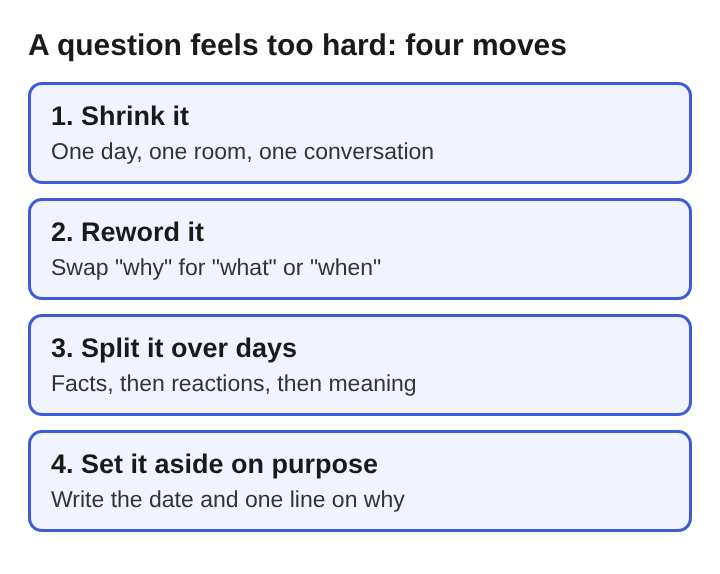
A hard question is information. It tells you the question is too wide, too sharp, too early, or arriving on a tired day. Start by naming which of those it is. Then make one change: narrow it to a single moment, swap "why" for "what", split it across three days, or write it down with a date and put it away.
What you are after is a steady record of your own life, not a perfect answer to any single question. When you look back across weeks of small answers, you may find that the hard question was being answered all along, one detail at a time. Noticing patterns in your own journal entries is how you see it happen.