The snake strategy in 2048 is a way of arranging the board so the biggest tile sits in one corner and every other tile lines up behind it in falling order, along a single path that runs across one row and then turns back along the next. When the tiles keep that order, each new merge happens at the tail of the path and feeds the tile just ahead of it, and the chain can collapse towards the corner one step at a time. The same idea carries over to Evolved 2048, where the board is a cube and the front face is a 3 by 3 grid.
What the snake strategy in 2048 looks like
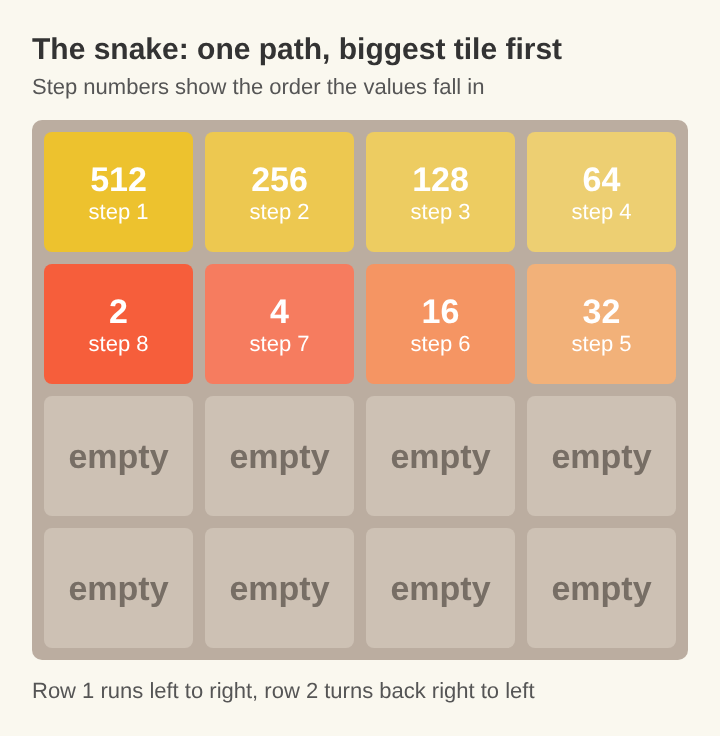
Picture the top row of a 4 by 4 board. The biggest tile goes in the top left corner. The next biggest goes beside it, then the next, until the row ends. At the end of the row the path drops down one square and runs back the other way, so the fifth biggest tile sits under the fourth, and the values keep falling as the path heads back towards the left edge.
The result is a path that winds across the board, row by row, with the values falling the whole way. The line of tiles bends back on itself at each wall, which is where the name snake comes from.
The bending path has an older name outside games. Boustrophedon is a style of writing in which alternate lines are reversed, and the word comes from Greek words for ox and turn. A 2048 snake follows the same back and forth order, with tile values in place of letters.
Why a falling order keeps merges in reach
A merge in 2048 needs two equal tiles side by side. On a random board, a big tile can end up boxed in by small ones, and then it has no partner for a long time. The snake avoids that by keeping every tile next to the tile that is one step bigger, or close to it.
When a new 2 merges with a 2 at the tail, the result is a 4. If the next square on the path already holds a 4, the two can merge on the following slide, making an 8, which meets the 8 further along, and so on. One small merge can set off a run of merges that travels up the path to the corner.
The Wikipedia page on 2048) describes the plain version of this idea: keep the largest tile in a specific corner with other large tiles filling the row. It adds a general rule that matches the snake: no small tiles should be separated from other small tiles by a large tile. A big tile in the wrong place cuts the path in two.
The same page notes that programs written to play 2048 judge positions by things such as empty squares, the number of possible merges, larger tiles at the edge, and monotonicity, which means tile sizes that rise or fall steadily in one direction, especially among the larger tiles. The snake is a hand-played version of that monotonic order, stretched across more than one row.
Building the snake one move at a time
The snake is not set up in one go. It grows as the game goes on, and most of the work is in which directions you avoid.
- Pick a corner and stay with it. Choose the top left, for example, and make every early merge happen there.
- Use two main directions. With the corner at the top left, up and left keep tiles pressed towards it. Right is the third direction, used to shuffle tiles along the rows.
- Keep the top row full. The Wikipedia page points out that with the row filled, the player can move in three directions and the largest tile stays in its corner. A full row cannot slide sideways, so the corner tile cannot be pushed out of place by a left or right move.
- Feed the tail. New merges should happen at the end of the path, where the smallest tiles live, so the chain can roll forward.
- Avoid the fourth direction. Down is the move that pulls the corner tile away from its wall. Use it only when nothing else moves.
A worked example on a 4 by 4 board
Take the board in the diagram. The top row holds 512, 256, 128 and 64 from left to right. The second row runs back from the right: 32 under the 64, then 16, then 4, then 2 at the far left. The bottom two rows are empty.
Suppose a new 2 appears in the third row, under the 2 at the end of the path. You slide up. The two 2s meet and become a 4, which sits at the tail next to the existing 4. The order is still falling along the path, so nothing is broken.
Now slide right. The full top row has no equal neighbours, so it stays where it is. On the second row the two 4s merge into an 8, and the row slides towards the right wall: an empty square at the far left, then 8, 16 and 32, with the 32 still under the 64. The path is shorter by one tile, and the values still fall the whole way along it.
Two more 8s fed in the same way would make 16 next to the 16 already there, then 32 next to the 32, then 64 under the 64 in the top row. One slide up merges those, and the top row climbs one value. Every step of that chain happened because the tiles were already in falling order along one path.
The move to watch for is the one that lets a 2 land in the top row while it has a gap. Once a small tile sits between two big ones, the rule from the Wikipedia page is broken and the chain stops there.
Where the snake breaks down
The snake is a habit, not a guarantee. A new tile appears after every slide, and its place is out of your hands. Sometimes the only legal move is the one that pulls the corner tile out. When that happens, the best repair is usually to slide straight back so the corner is filled again before the next tile drops.
A second weak spot is a jammed second row. If the second row fills with tiles that do not match their neighbours, the tail has nowhere to grow, and the bottom rows fill with small tiles that cannot reach the path. Keeping the bottom rows as open as possible gives the tail room to merge.
A third is greed at the corner. Merging two big tiles in the middle of the board can feel like progress, but if the result ends up away from the corner, the path now has a large tile in the wrong place, and the falling order is gone.
The snake on a 3 by 3 face
A cube changes the size of the board but not the idea. In Evolved 2048 the puzzle is a cube of six faces of nine squares, 54 squares in all, and in the main mode a slide moves only the front face. You swipe the front face, or press the arrow keys or W A S D, and tiles slide as in 2048, with two equal tiles merging into their sum.
A 3 by 3 front face gives a shorter snake: three tiles across the top, three back along the middle, three along the bottom. There is less room to be wrong, so a corner and a falling top row matter even more.
The cube also offers a way to feed the tail that a flat board does not. A twist turns a row on the right face, or a column on the top face, a quarter turn and carries its tiles to the next face. The game's own tip is that a tile you need is often on a side face, so you twist its row or column round to land it next to its match on the front. Every slide or twist adds a 2 or a 4, so a twist is a move with a cost, not a free look. Turning the whole cube to check the other faces adds no tile.
In the main mode the game ends when all 54 squares are full and no face has two equal tiles side by side. A snake on the front face keeps that moment further away, because the front stays ordered while the other faces hold spare tiles for later twists.
Frequently asked questions
Is the snake strategy the same as the corner strategy?
The corner strategy keeps the biggest tile in one corner with large tiles along its row. The snake extends that order past the first row, turning back along the second so the whole path falls in value.
Which corner should the biggest tile go in?
Any corner works. What matters is choosing one at the start and keeping every early merge pointed at it.
Why should the top row stay full?
A full row cannot slide sideways, so left and right moves leave the corner tile where it is. That leaves three safe directions instead of two.
What should you do when the corner tile moves out?
Slide it straight back as soon as you can, before a new tile fills the empty corner. A small tile in that corner splits the path.
Does the snake work on a cube?
Yes, on a smaller scale. A 3 by 3 front face holds a nine-tile snake, and twists can bring a matching tile from a side face to the end of the path.
Why the snake strategy holds a 2048 board together
The snake turns a grid of loose numbers into a single ordered line. Each tile has a neighbour it can grow into, each merge at the tail moves the chain one step towards the corner, and the biggest tile stays where no slide can push a small one in beside it. Programs that play 2048 reward the same falling order among the larger tiles, and the Wikipedia page's rule against cutting off small tiles with a big one is the snake's rule stated in one line. On a flat board or on the front of a cube, the snake works for the same reason: it keeps the next merge always within one square of the last.