Why does a 2048 game end? Not when you reach 2048, and not the moment the last square fills. A game of 2048 ends only when two things are true at once: every square holds a tile, and no two equal tiles sit side by side. Either part alone leaves you a move. That rule holds on a flat grid and on Evolved 2048, where the board is a cube of 54 squares and the same rule runs across six faces.
Knowing exactly what ends a game changes how you play the last stretch of it. A crowded board is not a lost board. A board is lost when nothing on it can move, and you can learn to see that coming several moves early.
Why does a 2048 game end only when nothing can move
2048) is a single-player sliding tile puzzle written by Gabriele Cirulli and released on 9 March 2014. You play on a 4x4 grid. Each move slides every tile as far as it can go in one direction, until it hits another tile or the edge. When two tiles with the same number collide, they merge into one tile with their total. After each turn a new tile, a 2 or a 4, appears in a random empty square.
Put those rules together and the end condition follows. A move does something only if at least one tile can travel or at least one pair can merge. A tile can travel only into an empty square. A pair can merge only if its two tiles are equal and touching along a row or column. So when there is no empty square and no equal pair touching, every direction leaves the board exactly as it was. No move works, and the game is over.
Reaching 2048 does not end anything. The game counts as won when a 2048 tile appears, but you can keep playing past it to build bigger tiles. The only true end is a locked board.
Two conditions, and why you need both
Players often say the game ends "when the board fills up". That is half the rule, and the missing half is where most rescues come from.
- A full board with a touching pair is still alive. Slide towards the pair and it merges, which frees a square. The new tile lands there, and you are back in the game.
- A board with one empty square is always alive. At least one tile next to that gap can slide into it, so at least one direction moves something.
- Only the two together end it. No gaps and no equal neighbours means every slide is refused.
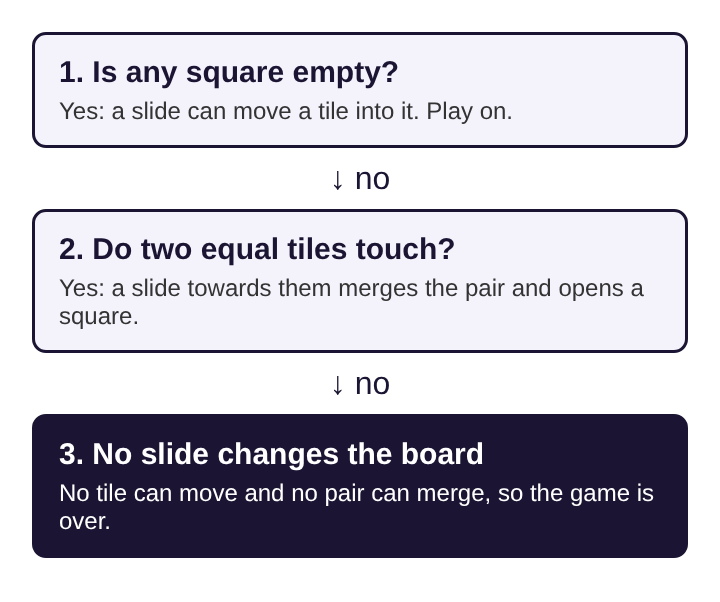
This is why a board can look hopeless and still turn around. Sixteen tiles with a single pair of 8s touching is a live position. One merge opens a square, and the next tile may land somewhere that sets up another pair.
How the random new tile pushes you towards the end
The pressure in 2048 comes from the tile that appears after every move. A 2 appears 90% of the time and a 4 the other 10%, always in an empty square chosen at random. Each move that merges nothing still adds a tile, so a run of moves without merges fills the board one square at a time.
Merges are the only thing that win squares back (the rules for how tiles merge in 2048 decide which pair combines first). Every merge turns two tiles into one, so it gives you exactly one square, and the new tile takes one away. A move with one merge breaks even. A move with two merges gains a square. A move with none loses one. Counting this way tells you whether you are gaining room or slowly giving it up.
Reading a crowded board before it locks
When the board has three or four empty squares left, look for pairs before you look for big tiles. Scan each row, then each column, and count the equal neighbours. If the count is zero and the gaps are few, you are close to the end even if the board looks open.
The common advice is built around keeping pairs available. One well known approach keeps the largest tile in one corner with other large tiles filling its row, and avoids cutting a small tile off from the other small tiles with a large one between them. Small tiles near each other are pairs waiting to happen. A small tile stuck between two large ones may never find a partner.
Programs that play 2048 point the same way. They search ahead with expectiminimax, a variation of minimax made for games that mix skill with chance, where chance nodes take the expected value of a random event such as where the next tile lands. The positions those programs rate highly favour empty squares, many possible merges, and large tiles kept at the edge. Those are the two halves of the end condition, read in reverse: room to move and pairs to merge.
A worked example on a 4x4 grid
Take an invented position. The grid is full. The top row reads 64, 32, 16, 8. The second row reads 4, 8, 16, 2. The third row reads 2, 4, 8, 4. The bottom row reads 4, 2, 4, 2.
- Check for gaps. There are none, so the game survives only if a pair is touching.
- Check rows. In the top row 64, 32, 16 and 8 are all different. The second row is 4, 8, 16, 2, all different. The third row is 2, 4, 8, 4, no equal neighbours. The bottom row is 4, 2, 4, 2, no equal neighbours.
- Check columns. The third column reads 16, 16, 8, 4 from the top. The two 16s touch. That is your move.
- Make it. Slide up. The two 16s merge into a 32 in the top row, which now sits beside the 32 already there. The column shifts up and leaves one empty square at the bottom, where the new tile appears.
- Look again. The top row now reads 64, 32, 32, 8, so a slide left merges the two 32s into a 64, which then sits beside the 64 in the corner.
A full board that looked finished gave two merges in a row, because one pair was hiding in a column. Checking columns as carefully as rows is the habit that finds them.
How the end condition grows on a cube
On the cube version the board is six faces of nine squares, 54 squares in all. Every slide or twist adds a 2 or a 4, on the front face when it has room. Turning the whole cube to look at it adds nothing. In the main mode the game ends when all 54 squares are full and no face has two equal tiles side by side.
The same two questions apply, with more places to look. A full front face is not the end if a side face still has a gap or a touching pair. A twist turns a row on the right face or a column on the top face a quarter, carrying its tiles to the next face, so a tile from a side can land next to its match on the front. Before you decide a position is lost, turn the cube and check every face for an equal pair.
Frequently asked questions
Does 2048 end when you make the 2048 tile?
No. Making a 2048 tile counts as a win, but you can keep playing to build larger tiles. The game ends only when the board is full and no move can change it.
Can a 2048 game end with empty squares left?
No. If any square is empty, at least one tile next to it can slide in, so some move always works.
Why did a move do nothing?
A move in a direction where no tile can travel and no pair can merge leaves the board unchanged. Try another direction, since a gap or a pair may be reachable from a different side.
How do you avoid a locked board?
Keep small tiles together so they can pair up, keep large tiles along one edge, and count your empty squares. A run of moves with no merges is the warning sign.
A locked board is a lack of pairs
A 2048 board ends when it runs out of room and out of partners at the same time. Room comes back only through merges, and merges need equal tiles that touch. Watching the number of empty squares and the number of touching pairs, together, shows how far a position is from the end, long before the last square fills.