Most weeks blur by Friday. Meetings, meals, errands and small worries run together, and by Sunday you can name maybe three things that happened. If you want to know how to reflect on your week in ten minutes, the answer is a fixed order: spend three minutes recalling, four minutes asking a few honest questions, and three minutes choosing one thing to do differently. Some people make the week easier to recall by answering a few questions each day. One example is a daily reflection site that asks five questions about your own life at an hour you pick, then gives a plain readout of what you said, set beside your week and month. You can also do all of it with a pen, a page and a timer.
How to reflect on your week in ten minutes, and why it works
A week is long enough to show a shape. One day can be an accident. Seven days show what repeats: the same tired afternoon, the same skipped walk, the same conversation you keep avoiding.
Ten minutes is short enough that you will actually do it. A long session feels like homework, and people drop homework. A short one with a clear order gets done on a bad week too, and the bad weeks often have the most to show you.
The idea of stepping back from your own actions to learn from them has a name in education and work research: reflective practice. The core move is simple. You look at what happened, ask why, and decide what to try next. A weekly reflection applies that move to your ordinary life.
What to prepare before reflecting on your week
Preparation takes under a minute if you keep it small. Have these within reach:
- Your calendar. It holds the skeleton of the week, even if it misses the parts that mattered.
- Your phone's photos from the last seven days. Photos often catch moments the calendar does not.
- Any daily notes you kept. A few lines per day are enough to jog memory.
- One sheet of paper or one note. Not a notebook. One page keeps you brief.
- A timer set to ten minutes. The limit is part of the method.
Sit somewhere you will not be interrupted. Silence notifications. Then start the timer.
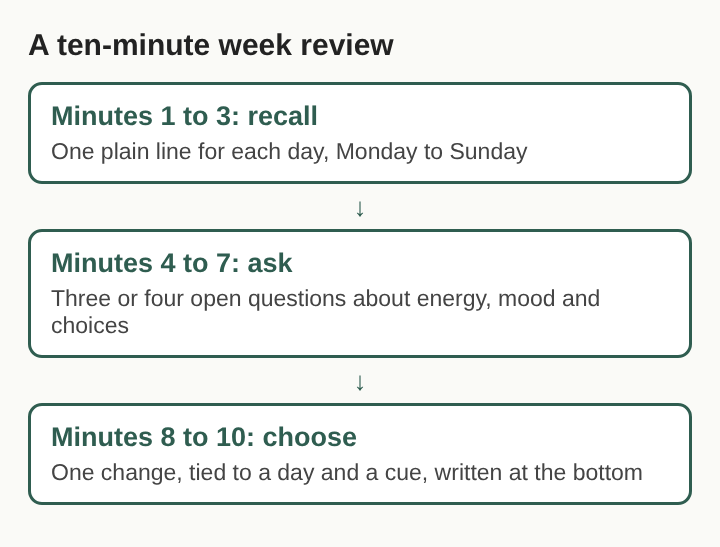
Minutes one to three: recalling what happened this week
Go day by day. Write one line per day, Monday to Sunday. Stick to facts: what you did, who you saw, what took most of the time. Leave judgment for later.
Say it is Sunday evening. Your page might read:
- Monday: long planning meeting, cooked at home.
- Tuesday: stayed late to fix a report.
- Wednesday: phone call with a sister, short run.
- Thursday: tired, ordered food, scrolled until midnight.
- Friday: lunch with a coworker, left early.
- Saturday: cleaned, went to the market.
- Sunday: slow morning, this reflection.
Go in order on purpose. Memory favors the start and end of a sequence and loses the middle, a pattern known as the serial position effect. Without a calendar, Saturday and Sunday crowd out Wednesday. Walking through each day gives the middle of the week a fair hearing.
If a day is blank, write "blank" and move on. A blank day is information too.
Minutes four to seven: questions about energy, mood and choices
Now read your seven lines and ask a few questions. Pick three or four from this set, not all of them:
- When did you have the most energy this week, and what were you doing?
- When did your energy drop, and what came just before it?
- What did you spend time on that you would not choose again?
- What did you put off, and what made it easy to put off?
- Who did you feel most like yourself around?
- What surprised you?
Notice that none of these can be answered with yes or no. "Was it a good week?" ends in one word. "When did your energy drop, and what came just before it?" makes you go back to Thursday and look at what happened before the late night of scrolling. Open questions do the work of pulling detail out of memory. There is more on choosing questions like these in five daily self-reflection questions to ask yourself.
Write answers in concrete terms. "Thursday: tired" is weaker than "Thursday: skipped lunch, back to back calls until five." The concrete version gives you something you can change. Philosophers have argued for a long time about how far self-knowledge of your own inner states can be trusted. Writing down what you did, and when, gives you firmer ground than writing down only how you felt.
Mood still belongs on the page. Just tie it to an event. "Low after the planning meeting" tells you more than "low all week."
Minutes eight to ten: choosing one change for next week
Look at what you wrote in the last four minutes and choose one change. One. A list of five changes is a list of five things you will forget by Tuesday.
Make the change specific and attach it to a time or a cue. Psychologists call this an implementation intention: an if-then plan that names the when, where and how of an action, and that can lead to better goal attainment than a general aim.
From the example week, a vague change would be "rest more." A specific one would be: "On Thursday, when the last call ends, the phone goes in the other room before dinner." It names the day, the cue and the action. Next Sunday you can check whether it happened.
Write the change at the bottom of your page. If you keep the pages, the bottom lines become a record of what you tried.
Daily answers that make the weekly recall easier
The hardest part of the method is the first three minutes, when you try to recall seven days from scratch. A daily habit of answering questions makes that part easier, because the week is already written down.
That is the approach behind the site linked at the start. At a time each person chooses, Claude) asks five questions drawn from what they value, what they are dealing with and what they are curious about, ordered from the easiest to step into to the deepest. Each question says what it draws on, such as the season, a stage of life, a value the person named, or a thread from yesterday. None can be answered yes or no. Questions from its home page include "What did you notice on the way out this morning?" and "When did honesty cost you something small this week?"
Answers can be typed or spoken, and each saves as it goes. After the fifth, the site writes a readout of the day that catalogs the person's own words, says plainly what was left unanswered, and sets the day beside the week and the month. The next day's questions follow what was left open.
For a weekly reflection, those readouts can replace the calendar in minutes one to three. The questions in minutes four to seven then start from what you actually said. The site also holds to a few limits that suit this kind of work: it will not tell a person how they feel, flatter them, grade their answers, give advice they did not ask for, or invent progress their answers do not show. It keeps a plain record of what was said.
Frequently asked questions
What is the best day to reflect on your week?
Pick the day when the week feels finished to you, which for many people is Sunday evening or Friday afternoon. The day matters less than keeping it the same each week, so the habit attaches to a fixed point.
Should a weekly reflection be written or done in your head?
Written works better for most people. Thoughts in your head drift and repeat, while a page forces you to finish a sentence and lets you compare this week with last week.
What if nothing important happened this week?
Do the ten minutes anyway. Quiet weeks show your defaults: what you do when nothing pushes you, which is often where the most useful change is hiding.
How is reflecting on your week in ten minutes different from daily journaling?
Daily journaling records each day while it is fresh. A weekly reflection steps back to see what repeated across days and ends with one decision for the next week. The two work well together, since daily notes make the weekly recall faster.
Keeping a ten minute weekly reflection going week after week
The method only pays off over time. One reflection tells you about one week. Eight of them tell you how you live.
A few habits keep it going:
- Same time, same place. Tie it to something you already do, such as the first coffee on Sunday.
- Keep the page short. If a reflection runs to two pages, the next one will feel heavier and you will skip it.
- Start by reading last week's change. Did it happen? Write one line about it before you begin the new recall.
- Once a month, read the last four pages together. Look for words and situations that keep coming back.
That monthly read is where reflection turns into understanding. The same tired Thursday, the same person you feel at ease with, the same task you keep pushing off: these only show up when you lay weeks side by side. For ways to spot them, see how to notice patterns in your own journal entries.
Some weeks bring something heavy that ten minutes cannot hold. On those weeks, longer writing about the hard thing itself may help more than a quick structured pass. That kind of open, emotional writing has its own method, covered in what expressive writing is and how it works. Then, the following Sunday, come back to the ten minutes: recall, ask, choose one change.