Knowing how to merge tiles in 2048 sounds trivial: push two equal numbers together and they become one. Yet most lost games come from merges that happened in the wrong order, or did not happen when you expected them to. The rule has three small details, and once you see them you can predict every slide before you make it. The same rules carry over to Evolved 2048, which puts the puzzle on a Rubik's cube and adds new ways to bring two tiles side by side.
How to merge tiles in 2048: the basic rule
2048) is a sliding tile puzzle written by Gabriele Cirulli and released on 9 March 2014. It is played on a 4 by 4 grid. Each move slides every tile in one direction, as far as it can go, until it hits another tile or the edge of the grid.
When two tiles of the same number collide during a slide, they merge into one tile holding their total. Two 2s make a 4, two 4s make an 8, and so on up the powers of two. Tiles of different numbers never merge; they simply stop next to each other.
After every move that changes the board, a new tile appears in a random empty square. That tile is a 2 nine times in ten and a 4 one time in ten. So each move you make adds one tile, and only merges take tiles away. That balance is the whole game: you need at least one merge for every new tile, on average, or the board fills.
Which pair merges first
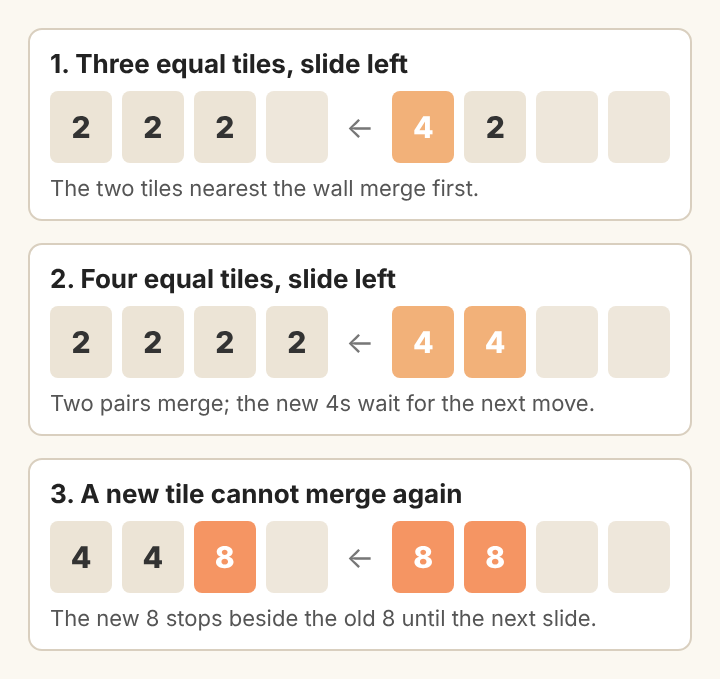
The first detail is order. A slide works from the wall it moves towards. When three equal tiles slide together, only the two farthest along the direction of motion combine. Slide a row of 2, 2, 2 to the left and you get 4, 2, not 2, 4.
That matters more than it looks. The 4 lands against the wall, and the leftover 2 sits beside it. If your big tiles live on the left side, the new 4 lands beside them and the spare 2 waits one square further out, where it can still meet the next 2.
The second detail covers a full row. When all four squares in a row hold the same number, a slide along that row combines the first two and the last two. A row of 2, 2, 2, 2 slid left becomes 4, 4 and two empty squares.
Why a new tile waits for the next move
The third detail stops chain reactions. A tile created by a merge cannot merge again in the same move. Slide 4, 4, 8 to the left and the two 4s become an 8, but that new 8 stops beside the old 8. You get 8, 8, not 16.
The same rule explains the full row above: the two new 4s sit side by side and wait. One more slide in the same direction turns them into an 8. Read this way, the rule hands you a short plan. Any time a slide leaves two new equal tiles touching, the next slide in that direction is a sure merge.
It also tells you what not to expect. A row of 2, 2, 4, 8 slid left becomes 4, 4, 8. The 4s do not keep rolling into the 8. It takes two more moves to turn that row into a 16, and the new tiles that appear in between can block it.
A worked example: one row, four moves
Take a bottom row that reads 8, 4, 4, 2, with your largest tile kept in the bottom left corner. The rest of the board is mostly empty. Follow it slide by slide.
- Slide left. The two 4s meet and become an 8. The row now reads 8, 8, 2 and one empty square. The new 8 cannot merge with the old 8 in this move.
- Slide left again. The two 8s merge into a 16 against the wall. The row reads 16, 2 and two empty squares. A new tile appears somewhere on the board.
- Bring a 2 down. If the new tile landed above the spare 2, slide down. The two 2s meet in the bottom row and become a 4. The row reads 16, 4.
- Keep feeding the row. Each tile you merge into the bottom row from now on should be the next size down from its neighbour on the left. That keeps one long line of merges open towards the corner.
Two habits do the work here. You slide towards the wall that holds your biggest tile, so every merge lands next to it. And you count the leftovers: a spare 2 after a merge is not waste, it is the start of the next pair.
How to keep merges coming
Programs written to play 2048 well judge a board by a few signs. According to the game's Wikipedia page), their measure of a good board favours empty squares, a large number of possible merges, larger tiles at the edge, and tile sizes that rise steadily in one direction. Each of those turns into a plain habit you can use.
- Keep squares empty. Each empty square is room for the next new tile. A merge now is often worth more than a bigger tile later.
- Count merges before you move. Look at each of the four directions and count how many pairs would combine. A move with no merge only adds a tile.
- Keep big tiles on an edge. A large tile in the middle splits the board into small pockets where pairs cannot meet.
- Line tiles up in order. A row such as 64, 32, 16, 8 can collapse into one tile with a run of slides. A row such as 8, 64, 16, 32 cannot.
The game ends when there are no empty squares and no two equal tiles side by side. Every one of these habits pushes that moment further away.
Merging tiles on a cube
On a cube, the same merge rule meets more space. The puzzle has six faces of nine squares, 54 squares in all. A slide moves the front face, by swipe or with the arrow keys or W A S D, and two equal tiles merge into their sum, just as on a flat grid.
The difference is how tiles meet. A twist turns a row on the right face or a column on the top face a quarter turn and carries its tiles to the next face. So the tile you need is often on a side face, and a twist can land it next to its match on the front. Turning the whole cube to look costs nothing; only a slide or a twist adds a new tile, a 2 or a 4, on the front face when it has room.
The cube also changes the end of the game. In the main mode it ends when all 54 squares are full and no face has two equal tiles side by side. In Edge mode, a slide towards an edge also merges the tile at that edge with an equal tile just over it on the next face, so a merge can cross from one face to another.
Frequently asked questions
Can a tile merge twice in one move in 2048?
No. A tile made by a merge cannot merge again in the same move. It waits beside any equal tile until the next slide.
What happens when three equal tiles slide together?
Only the two tiles farthest along the direction of the slide combine. The third tile stays behind them, ready to pair with the next equal tile.
Do tiles of different numbers ever merge?
No. Only two tiles of the same number merge, into one tile holding their total. A 4 and an 8 just stop next to each other.
Why does a new tile appear after every move?
The game adds a 2 or a 4 to a random empty square after each move that changes the board. Merges are the only way to take tiles away, so you need them to keep pace.
What is the best direction to slide?
Usually the one that makes the most merges while keeping your largest tile against its wall. A slide with no merge only fills the board.
Merging tiles is about order, not luck
A sliding tile puzzle, as the entry on sliding puzzles puts it, asks you to move pieces along fixed routes towards an end position. In 2048 that end position is a single large tile, and every step towards it is a merge. The three rules decide which merges happen: the pair nearest the wall combines first, a full row combines in two pairs, and a new tile waits a move. Once you can read those rules on the board, each slide stops being a gamble and becomes a choice you can count in advance.