How to play 3D 2048 comes down to one change from the flat game: some of the tiles you need are on a face you cannot see. Evolved 2048 is a version played on a cube in a web browser, on a computer or a phone, and this is what a first game looks like in it, from the mode you pick to the move that brings a tile round to its match.
The rule of the original stays. Two equal tiles merge into their sum. What the cube adds is a place to look and a new kind of move.
Where 3D 2048 comes from
The flat game, 2048, was made by the Italian developer Gabriele Cirulli and released on the web on 9 March 2014, according to the Wikipedia page on 2048). A 3D version takes that rule and puts it on a body with more sides.
The body here is a Rubik's Cube, a 3D combination puzzle invented in 1974 by the Hungarian sculptor and professor of architecture Ernő Rubik. Each of its six faces is covered by nine stickers, and an internal pivot mechanism lets every layer turn on its own. The Wikipedia page on the Rubik's Cube has the history.
The game keeps the cube's layout: six faces of nine squares, 54 squares in all. The aim is the biggest tile you can make. 2048 is the first milestone, and the cube plays on past it.
Pick a mode before the first move
When the game opens it asks for a mode, and each choice comes with one line of description. There are three.
- The main mode. Classic 2048 on the front face. You twist and turn the cube to bring tiles together. Slides move only the front face.
- Edge mode. The same, and a slide also merges across the front face's edges, with the next face.
- Fun mode. Each row and column of the front runs all the way round the cube, so tiles travel round it and pile up on the front.
For a first game the main mode is the plainest: only the front face slides, so what you see is what a slide acts on. The game also opens with a short introduction in three steps, and it can be skipped.
The three moves in the order you will use them
There are three moves, and a first game uses them in a fixed order of need.
- Slide. Swipe the front face, or press the arrow keys or W A S D. The tiles slide as in 2048, and two equal tiles merge into their sum.
- Turn. Drag the space around the cube, or press Shift and an arrow key, and the whole cube turns to show another face. Turning costs nothing, so look as often as you like.
- Twist. Drag a row on the right face sideways, or a column on the top face. On a keyboard, press 1 to 6, and add Shift for the other way. That layer turns a quarter and carries its tiles to the next face.
Slide and twist are the two that change the board, and each adds a new tile, a 2 or a 4, on the front face when it has room. Turning adds nothing. That gives you a habit worth forming from the first move: turn to read the cube before you commit to a slide or a twist.
How to play 3D 2048: a worked first game
Here is an invented opening, to follow the moves. It is a made-up position, not a record of a real game.
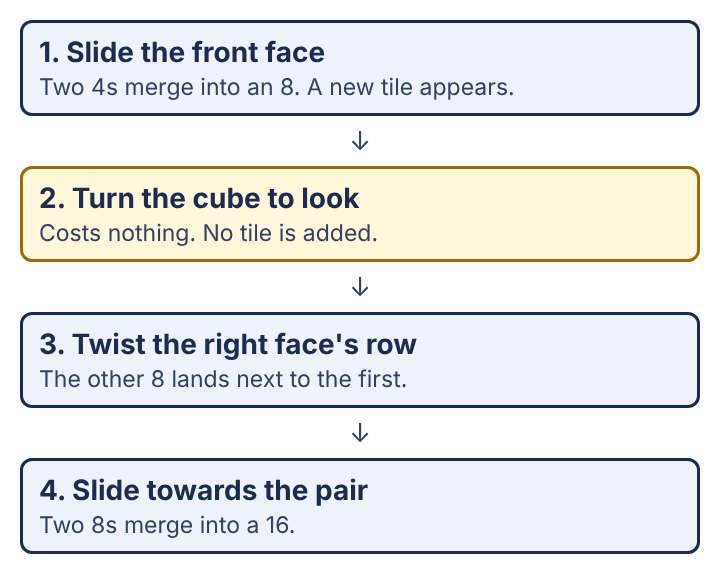
You start in the main mode. The front face holds a 2, a 4 and another 4 in different squares, and the rest are empty.
- Slide. You swipe towards the corner where the two 4s can meet. They merge into an 8, and a new 2 appears on the front.
- Turn. You drag the cube round to look at the right face. No tile is added. There is an 8 in the row that lines up with your front row.
- Check room. The front has empty squares, so a twist is possible, because a twist needs one empty square for its new tile.
- Twist. You drag that row on the right face sideways. The layer turns a quarter and carries the 8 to the next face, which lands it next to the 8 on the front.
- Slide. You swipe towards the pair. The two 8s merge into a 16.
Five steps, two of them moves that changed the board, and one tile that was never on your face at the start. The game's own tip says the same: a tile that is needed is often on a side face, so twist its row or column round to land it next to its match on the front.
Keep room on the front face
Every slide or twist adds a 2 or a 4 on the front face when it has room, and a twist cannot be made without one empty square. A front face packed with tiles takes away the twist, which is the move that makes the cube worth playing.
So the first habit after turning to look is a count: how many empty squares does the front have? With none, only a slide that merges something will free a square. With two or three, you can afford a twist and still leave space.
The game ends when all 54 squares are full and no face has two equal tiles side by side. That is the 2048 rule applied to every face at once, so a side face that fills up is a warning even if you cannot see it from the front.
Using Edge mode and Fun mode
Once the main mode feels familiar, the other two change what a slide does.
In Edge mode, a slide towards an edge also merges the tile at that edge with an equal tile just over it, on the next face. The game's tip for this mode is to look just round the edge before you slide, and to turn the cube to check the far sides. A pair that straddles an edge can merge without a twist.
In Fun mode, each row and column of the front runs all the way round the cube. A tile that would be stuck on a side face comes round by itself, and tiles pile up on the front. Turning the cube still shows you where they are heading.
Frequently asked questions
What is 3D 2048?
It is the 2048 puzzle played on a cube of six faces with nine squares each, instead of a flat grid. Two equal tiles still merge into their sum, and the cube plays on past 2048.
Does turning the cube use up a move?
No. Turning costs nothing. Only a slide or a twist adds a new tile.
Which mode should a first game use?
The main mode is the plainest, because slides move only the front face. Edge mode and Fun mode change what a slide does.
What do the number keys do?
Keys 1 to 6 twist a layer, and Shift with them twists it the other way. Slide with the arrow keys or W A S D, and turn the whole cube with Shift and an arrow key.
Does the game end when a 2048 tile is made?
No. 2048 is the first milestone. The game ends when all 54 squares are full and no face has two equal tiles side by side.
Why a cube changes how 2048 is planned
On a flat grid, a tile you need is either on the board in front of you or it is not. On a cube, it is often one face away, and the question stops being where a tile will end up and becomes which layer to turn to bring it here. That is a planning question, and the free turn lets you ask it as often as you want before you spend a move.
The cost is the space each slide or twist takes on the front face. Reading the cube, counting empty squares and then choosing between a slide and a twist is the whole rhythm of the game, and it is the part of 2048 that a flat board never asked for.