2048 on a Rubik's cube keeps the rule everyone knows, two equal tiles merge into their sum, and moves the tiles onto a cube. Evolved 2048 plays this way in a web browser, on a computer or a phone, and its line is "the 2048 puzzle on a Rubik's cube, and past 2048". The change sounds small. It is not: a tile you need is no longer always on the grid you are looking at.
This is a plain account of how 2048 on a Rubik's cube works: what is kept from the original, what the cube adds, and what a move looks like when a tile has to travel.
What the original 2048 asks of you
2048 was made by the Italian web developer Gabriele Cirulli and released on 9 March 2014. It is played on a 4 by 4 grid with the arrow keys. All tiles slide in the chosen direction until something stops them, and two equal tiles that collide combine into one tile with their sum. After each move a new tile appears in a random empty space, a 2 about nine times in ten and a 4 about one time in ten. Making a 2048 tile wins, but play can go on, and the game ends when no space is empty and no two neighbours match. The details are on the Wikipedia page on 2048), which also notes that spinoffs include a 3D version.
Everything in that paragraph is a rule about one flat grid. The cube keeps the merging and the new tiles, and changes where the tiles can be.
2048 on a Rubik's cube: six faces and 54 squares
A Rubik's Cube was invented in 1974 by Ernő Rubik, a Hungarian sculptor and professor of architecture. It has six faces, each covered by nine stickers in a 3 by 3 pattern, and an internal pivot mechanism lets each layer turn on its own, in quarter turns. The details are on the Wikipedia page on the Rubik's Cube.
The game takes that shape. The puzzle is a cube of six faces with nine squares each, 54 squares in all. The aim is the biggest tile you can make: 2048 is the first milestone, and the cube plays on past it. A 3 by 3 face holds nine tiles, a 4 by 4 grid holds sixteen, so each face is tighter than the original board. The other five faces are where the extra room is, and the moves are how you reach it.
Slide, twist and turn
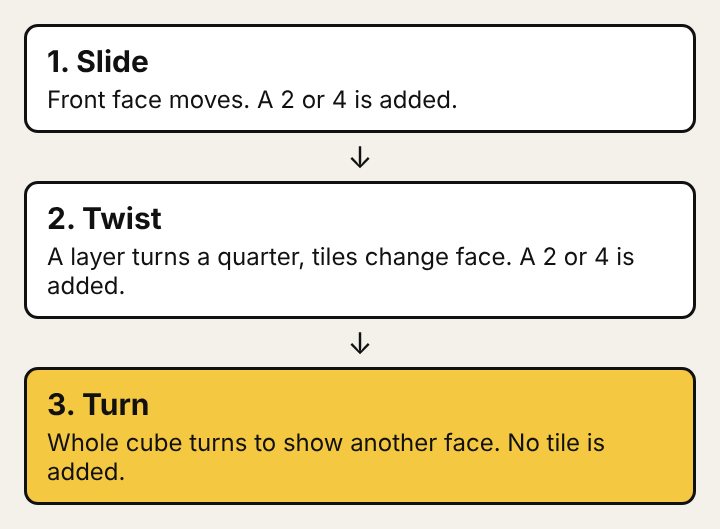
There are three moves, and they do different jobs.
- Slide. Swipe the front face, or press the arrow keys or W A S D. The tiles slide as in 2048, and two equal tiles merge into their sum.
- Twist. Drag a row on the right face sideways, or a column on the top face. On a keyboard, press 1 to 6, and add Shift for the other way. That layer turns a quarter and carries its tiles to the next face, so a tile from a side face can land next to its match on the front.
- Turn. Drag the space around the cube, or press Shift and an arrow key, and the whole cube turns to show you another face. Turning costs nothing.
The last line matters for how you plan. Only a slide or a twist adds a new tile. Every slide or twist adds a 2 or a 4, on the front face when it has room, and a twist needs one empty square for that new tile. So you can turn the cube as often as you like to read the position, and nothing changes until you commit to a move.
A worked example: bringing a tile round to its match
Here is an invented position, to follow the moves. You have an 8 on the front face, in the top row. You can see no other 8 on the front, so sliding will not merge it. You turn the cube, which costs nothing, and find an 8 on the right face, in the row that lines up with your front row.
- Turn the cube to check where the 8 sits. No tile is added.
- Check that the front has an empty square, because the twist will add a 2 or a 4 and needs room.
- Twist that row on the right face. The layer turns a quarter and carries the 8 to the next face, which puts it next to the 8 on the front.
- Slide the front face towards the pair. The two 8s merge into a 16.
Two moves, one merge, and the 8 never had to be on your face to begin with. The game's own tip says the same thing: a tile that is needed is often on a side face, so twist its row or column round to land it next to its match on the front.
The three modes of the cube
The game has three modes, and they change what a slide does.
In the main mode, slides move only the front face. The game ends when all 54 squares are full and no face has two equal tiles side by side. That last condition is the 2048 rule again, applied to every face at once.
Edge mode opens the edges. A slide towards an edge also merges the tile at that edge with an equal tile just over it, on the next face. The tip for this mode is to look just round the edge before you slide, and to turn the cube to check the far sides, since a pair that straddles an edge can merge without a twist.
Fun mode runs each row and column of the front all the way round the cube. Tiles travel round it and pile up on the front, so a tile that would be stuck on a side face comes round on its own.
Frequently asked questions
Is 2048 on a Rubik's cube the same as the original 2048?
The merging rule and the new 2 or 4 after a move are kept. The board is different: six faces of nine squares instead of one 4 by 4 grid, and a twist move that carries tiles between faces.
Does turning the cube add a tile?
No. Turning costs nothing. Only a slide or a twist adds a new tile.
Can the game be played on a phone?
Yes. The game runs in a web browser on a computer or a phone. You swipe the front face to slide, and drag a row or a column to twist.
Which keys do the moves use?
Slide with the arrow keys or W A S D. Twist with 1 to 6, and add Shift for the other way. Turn the whole cube with Shift and an arrow key.
Does the game end at 2048?
No. 2048 is the first milestone, and the cube plays on past it. The game ends when all 54 squares are full and no face has two equal tiles side by side.
What a third dimension does to a tile puzzle
On a flat grid, a lost tile is a lost tile: if the match you need is in the far corner, you wait for slides to bring it near. On a cube, the match is often one face away, and the question changes from where a tile will end up to which layer to turn to bring it here. That is a planning question, and the turn that costs nothing lets a player ask it as often as needed before spending a move.
The cost is the new tile each slide or twist adds. A twist needs an empty square on the front, so a crowded front face limits the moves open to you even when the match is a quarter turn away. Keeping room on the front is part of the puzzle in a way it never was on the flat board, where an empty square was only a place for the next tile to land.