Knowing how to deal with flying enemies in tower defense comes down to one shift in thinking. Ground units walk the route you shape. Flying units cross over it. A defense that depends on a long, winding road can lose most of its firing time the moment a wave takes to the air, because fliers often head almost straight for the goal. The fix is not more towers everywhere. It is putting the right towers where every route meets.
How to deal with flying enemies in tower defense: why they break plans
Most tower defense plans assume enemies follow a set path. The genre, as described on Wikipedia's tower defense page, centers on stopping waves before they reach a point you protect, and much of the craft is about stretching the route so each tower gets more shots. Flying enemies cancel that work. They do not care how long the road is.
The same planning problem shows up in any game built around one fixed goal. In Two Towers, a castle defense game you can play in a browser or on Android, you pick a pair of towers, add two more with gold, and hold the city gate against knights, monks, kings and rams, stage after stage. What carries over is the general tower defense habit: how to cover a threat that does not follow your main line when you only have a few towers to place.
How flying enemies move past paths and mazes
On the ground, players build long routes through mazing, where path length decides how long enemies stay under fire. A maze that doubles the walking distance roughly doubles the time each tower can shoot at a unit.
The same tower defense page describes the usual pattern: occasional air units that ignore the layout of the board, its maze paths and its obstructions, and travel directly to the end. In Desktop Tower Defense, where the towers themselves form the maze, some waves fly over the towers instead of following it.
For a flying wave, the maze adds nothing. What matters is the length of the flight line that passes through each tower's range circle. That length depends on where the line crosses the circle. A line that passes through the center spends the most time in range. A line that clips the edge spends very little. A tower placed at a far bend of a long maze may only see fliers for a moment, or not at all.
Here is a worked case. Say your ground maze snakes across the whole map, and your towers sit along its outer bends to get many passes at walking units. A flying wave appears and crosses the center of the map toward the goal. Of your towers, only the ones near that center line ever fire. The rest are idle. Nothing about the towers is weak. They are simply in the wrong place for this kind of enemy.
Where to place towers that reach flying enemies
Start with one fact: every route ends at the goal. Ground units arrive there after the maze. Fliers arrive there after their straight line. A tower close to the goal sees both, every time. That makes the area just in front of the gate the most reliable spot for anything that can hit air.
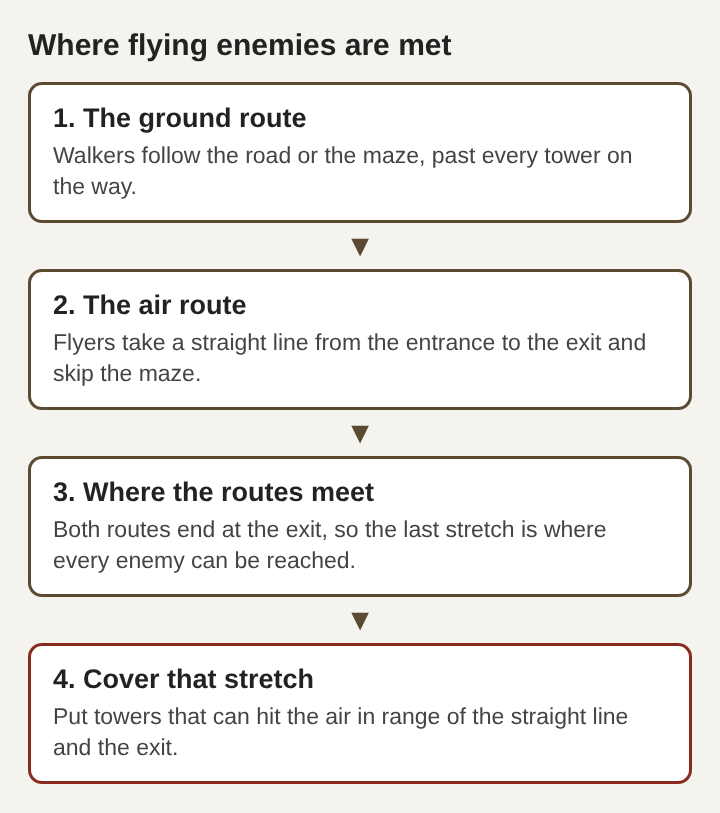
The second strong spot is on the flight line itself. If fliers cross the map in a straight line, a tower centered on that line gets the longest possible stretch of firing time. Put it where the flight line and the ground route come close, and it serves both jobs.
This follows the general rules covered in where to place towers in a tower defense game: look for spots where a tower's range overlaps the most enemy movement. With fliers, you are adding a second movement pattern to the map, and the best spots are the ones where both patterns overlap.
Military planners call layered protection defence in depth: several layers that keep meeting an attacker, rather than one strong line that must hold alone, and successive layers can use different means against different targets. Against fliers, that means one air tower near the start of the flight line and one near the goal, so a unit that survives the first gets a second round before it arrives.
Spending gold on air defense without weakening the ground line
When tower slots are few, every slot has to earn its place. A common trap is to see one flying wave, panic, and pull gold away from the ground line to build pure air defense. Then the next ground wave walks through.
A better order of thinking:
- Prefer towers that hit both. If a tower can reach ground and air, it rarely sits idle. A pure air tower does nothing during ground waves.
- Place before you add. Before spending gold, check whether moving a planned tower closer to the goal would already cover the flight line.
- Add air coverage when the threat is real. If the game warns you that fliers are coming, or you have seen them, that is the time to spend. Gold spent early on a threat that has not appeared is gold missing from the ground line now.
- Keep the ground line whole. Air defense should be added to a working ground plan, not built by taking pieces out of it.
Worked example: in a game where fliers appear, say a pair of towers holds the ground route and you have gold for two more. A flying wave arrives. Put the first new tower at the gate, where it covers the end of both routes. Watch one wave. If fliers still reach the goal, put the second new tower on the flight line, farther out. If the gate tower handles them, the second slot can go back to the ground line, where pressure usually grows.
Holding the gate when flying and ground waves arrive together
Mixed waves are where plans fail. The good news is that a maze helps you here too. Ground units take the long road. Fliers take the short one. If both leave at the same moment, the fliers arrive first and the walkers arrive later. Your gate towers can deal with the air units, then turn to the ground units as they come out of the maze.
The danger is when both reach the gate together. That happens when ground units are fast, the maze is short, or fliers start later than the ground wave. In that case your gate towers split their fire, and the strongest unit on either side may get through.
Heavy ground threats make this worse. Siege weapons that strike the gate itself, such as the ram described in what a battering ram is and how it was stopped, need focused fire before they arrive. Real castle builders layered the entrance, a pattern laid out in how medieval castles defended their gates. Wikipedia's page on the gatehouse notes that it was often the most heavily defended part of a fortification, because the gate was the easiest point to attack. The idea holds in a game: the gate area is where threats from every direction meet, so it deserves coverage that can switch targets.
In practice, keep at least one tower near the gate that you can count on for any kind of enemy, and let the towers farther out do the specialized work.
Common mistakes against flying enemies in tower defense
- Trusting the maze. A long route does nothing to fliers. Check flight lines, not just the road.
- Placing air towers on far bends. They look good next to the maze but miss the straight line fliers take.
- Selling the ground line for air. One flying wave does not mean every wave is air.
- Building only one air tower far from the goal. If it misses, nothing else gets a shot. Keep a second chance near the gate.
- Ignoring timing. When fliers and walkers arrive together, gate towers split their fire. Shape the route so arrivals stay spread out.
- Spending too early. Air towers placed before any fliers appear can leave the ground line short.
Frequently asked questions
Why do flying enemies ignore the path in tower defense?
In many games, air units ignore the board's layout and travel straight to the end, so they are a different threat from ground units. That forces you to cover more than one route instead of relying on a single long maze.
How much gold should go to air defense in a tower defense game?
Enough to stop the fliers you are actually facing, and no more. Start with one tower near the goal, watch a wave, and add more only if fliers still get through.
Should air defense towers sit near the gate or along the route?
Near the gate first, because every route ends there and the tower always sees enemies. A second tower on the flight line, farther out, adds depth if one is not enough.
What is the main way to deal with flying enemies?
Cover the point where all routes meet, usually the goal, with towers that can hit both air and ground. Then add towers on the flight line itself if fliers still reach the gate.
Dealing with flying enemies at the gate
Flying enemies change one question in tower defense. On the ground, you ask how long the route is. In the air, you ask where the routes meet. The answer is almost always the goal, so that is where your most flexible towers belong. Place for overlap, spend gold only on threats you have seen, keep the ground line whole, and use the maze to spread out when each kind of enemy reaches the gate. A defense built that way holds whether the next wave walks, rides or flies.