If you have wondered what is mazing in tower defense, the short answer is this. Mazing means placing towers or walls so that enemies have to walk a longer, winding route to their goal, and that keeps them inside your towers' range for more time. The idea applies to any game where you defend one point against waves of attackers. Two Towers is one such game: a castle defense game in the browser where you hold the city gate against knights, monks, kings and rams, stage after stage. To understand why mazing matters, you need a little math about time, range and gold.
What is mazing in tower defense
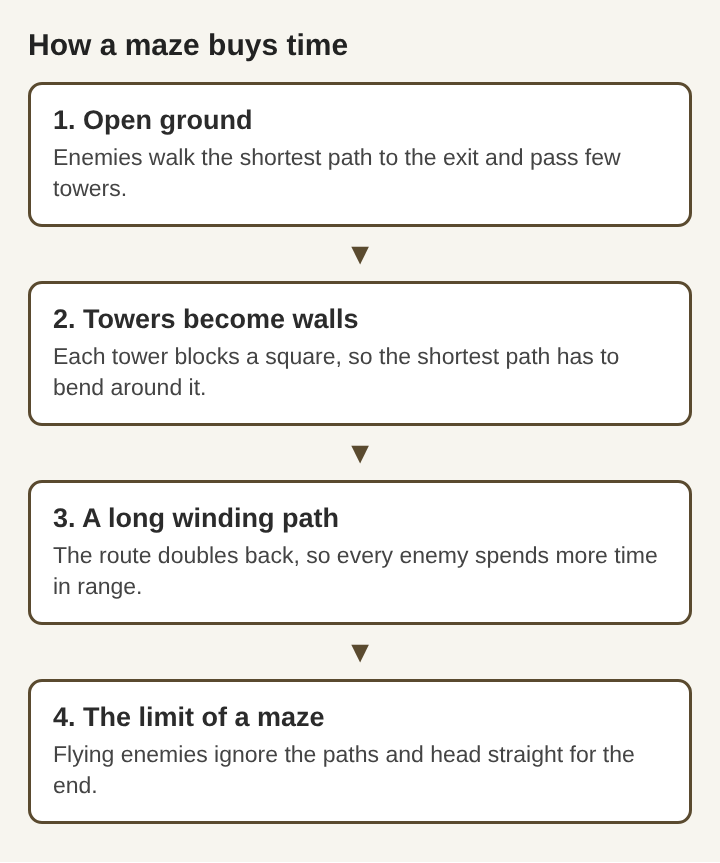
Tower defense is a strategy genre. Enemies move along a route toward a goal, and you place structures that attack them as they pass. The Wikipedia entry on tower defense describes two broad kinds of map. In some games the route is drawn for you. In others the map is open, and the towers you build become the walls of the path. The same entry calls mazing an essential strategy: building a long, winding path of towers to lengthen the distance enemies must walk to get past the defense.
Mazing belongs mostly to the second kind. You do not just place towers where they shoot well. You place them so that the enemy's shortest route to the goal becomes long and twisted. Every extra step an enemy takes is another moment your towers can hit it.
The word covers two jobs at once. The first job is building the route. The second job is putting damage along that route. A good maze does both. A maze that only does the first job delays enemies and kills nothing.
How mazing lengthens the enemy path and multiplies damage
Take a made-up map to see the math. An enemy walks one tile per second. A straight road runs 20 tiles from the entrance to the gate. You have one tower that deals 10 damage per second and covers 4 tiles of road.
On the straight road, the enemy spends 4 seconds in range. It takes 40 damage. Now build walls so the route bends back and forth past that same tower. If the new route passes through its range three times, the enemy spends 12 seconds in range and takes 120 damage. The tower did not change. Its output tripled because the enemy stayed longer.
That is the core rule. Total damage on an enemy equals damage per second multiplied by time in range. You can raise the first number by spending gold on stronger towers. You can raise the second number by mazing. The second option is often the cheaper one.
Mazing works because enemies on open maps usually follow the shortest available route. Games compute that route with pathfinding methods that find the cheapest way from start to goal. You cannot make enemies wander. You can only make the shortest route a long one. Each wall you add changes what "shortest" means.
Open maps versus fixed paths for mazing
On an open map, you shape the route directly. Walls and towers block tiles, and the enemy recalculates its way around them. The skill is building long switchbacks with as few pieces as possible, and keeping your damage towers at the center of the turns.
On a fixed path, you cannot move the road. The mazing idea still applies, but it turns into a question of coverage. You look for spots where the road passes your tower more than once. A tower set on the inside of a U-bend can reach both sides of the bend. A tower near a spiral can hit the same enemy three or four times as it circles. The road length is fixed, so you raise the share of it that sits inside your range.
Both styles ask the same question: how many seconds does each enemy spend in range? Placement on a set route has its own set of habits, covered in detail at where to place towers in a tower defense game.
Spending gold on a maze in Two Towers
The game's loop is short to describe. You pick a pair of towers to start, then add two more with gold, and you hold the gate. Its home page does not describe walls or a buildable maze, so the part of mazing that carries over here is the exposure math, not wall building.
With a small number of towers, each placement carries more weight. A single tower that covers twice as much of the enemy route is worth almost a second tower. So before you spend gold, ask two questions:
- Where does the enemy route pass close to this spot more than once?
- Do the towers overlap on the same stretch, so an enemy faces more than one at a time?
Timing matters too. Gold spent early raises your damage for every enemy that follows. Gold held back lets you respond to what the next stage brings. A common middle path is to add the tower that covers the most route time first, then save for the one that fixes your weakest spot.
Holding the gate with a maze and choke points
A gate is the end of every route. All enemies must reach it, so it is the one spot you know they will pass. In military strategy, a choke point is a narrow place, such as a valley or a bridge, that a force must pass through to reach its objective, and it lets a smaller defending force hold off a larger one. In tower defense, the ground just before the gate often acts as one.
Mazing and choke points work together. The maze adds time. The choke point packs enemies close together, so towers that hit an area strike several at once. A strong layout often has a long route that ends in a tight funnel near the goal, with the heaviest damage aimed at that funnel.
Castle builders faced the same question at a real gate, and the history of how medieval castles defended their gates shows the same concern with time under fire. The threat aimed straight at the gate itself is the subject of what a battering ram is and how it was stopped.
Common mazing mistakes in tower defense
Most failed mazes fail for a small number of reasons.
- Length with no damage. A long maze with weak towers only delays the loss. The route must pass through range, not around it.
- Spread-out towers. Towers placed far apart each cover a short stretch alone. Clustering them at bends lets each enemy face several at once.
- Ignoring enemies that skip the maze. Many games send occasional air units that ignore the maze paths and travel straight to the end. A maze built only for walkers leaves no defense against them.
- Trusting one trick. Some games allow juggling: closing one exit, then the other, so enemies walk back and forth. Where the rules allow it, it is a bonus, never a plan for every wave.
- Spending everything at once. Gold put into walls you do not yet need cannot add damage when a hard wave arrives.
- Weak goal defense. The final stretch before the gate is where leaks happen. Keep strong coverage there even if the rest of the maze is long.
Frequently asked questions
Is mazing the same as blocking in tower defense?
No. Mazing lengthens the route while leaving it open. Blocking closes an exit, and in some games switching the block from one exit to the other makes enemies walk back and forth, a trick called juggling.
Which towers work well inside a maze?
Towers with long range and towers that hit an area tend to gain the most, since they cover many tiles of route or many enemies at once. Towers that slow enemies also help, because slower enemies spend more time in range of everything else.
Does mazing still matter on maps with a fixed path?
Yes, in a changed form. You cannot lengthen the road, but you can place towers where the road bends past them more than once, which raises the time each enemy spends in range.
How much gold should go into walls versus damage?
Spend on walls only up to the point where your damage can use the extra time. If enemies leak, add damage before you add length, since a longer route with weak towers still loses.
Mazing as the core of tower defense strategy
Every decision in tower defense comes back to one number: how much damage each enemy takes before it reaches the goal. That number has two parts, damage per second and time in range. New players often chase the first part by putting gold into stronger towers. Experienced players watch the second part just as closely.
Mazing is the study of that second part. On an open map, it means shaping the route. On a fixed map, it means finding the bends and narrow places where one tower sees the enemy again and again. In both cases, the habit is the same. Before each purchase, trace the enemy's route, count the seconds it spends in range, and put your gold where those seconds grow the most. The gate holds when the route feeds every attacker through your fire for as long as possible.