Where to place towers in a tower defense game is the choice that matters most, and it is made before the first enemy walks in. A pair of well placed towers can hold a gate that four badly placed ones lose. Two Towers is a castle defense game in the browser: you pick a pair of towers, add two more with gold, and hold the city gate against knights, monks, kings and rams, stage after stage. In any game of that kind, the position of each tower decides how much of the enemies' walk it can punish.
What a tower defense game asks of you
Tower defense is a subgenre of strategy games in which you defend a territory by obstructing attackers or stopping them from reaching the exits, usually by placing defensive structures on or along their path. The same source lists the basic pieces: a base to defend, waves of enemies, and towers or obstructions placed along the path. It calls the strategic choice and positioning of defensive elements an essential strategy of the genre.
That gives you a clear job. The enemies will walk a route. Your towers cannot choose the route in most games, but they can choose where along it they stand. The rest of the work is that one choice.
Where to place towers in a tower defense game: find the choke point first
A choke point is a feature, such as a valley, a bridge or a narrow pass, that an armed force has to go through to reach its objective, often on a much narrower front. Because the attacker cannot bring its full numbers to bear there, a smaller defending force can use the terrain to stop a much larger one. The history of war has many cases; the Battle of Stirling Bridge, where William Wallace faced an English army at a narrow wooden bridge, is one of the examples the same page names.
A map in a game has the same shape. Look for the place where the path narrows, where two lanes meet, or where the path turns sharply. Enemies bunch up there. A tower that reaches that spot hits a crowd instead of a line, and it keeps hitting for as long as the crowd takes to clear the spot.
Count how long enemies stay in range
A tower only does harm to an enemy while that enemy is inside its reach. So the useful question is not "how strong is this tower" but "how many steps of the path can this tower see". Put the same tower beside a straight stretch and it sees the enemy for a short walk. Put it on the inside of a bend and the path curls around it, so the enemy stays in range for far longer.
The inside of a bend is often the strongest seat on the board for that reason. A tower there covers the approach, the turn and the exit from the turn, all from one position.
One tower on a stretch of path is a risk. If it is the only one that can hit a fast or sturdy enemy, that enemy gets through, and then there is nothing between it and the base. A pair of towers that reach the same stretch share the work, and when an enemy ignores one or outlasts it, the other is still firing.
Overlap is also where upgrades pay off. The same source describes modern tower defense as having currency, often earned by defeating attacking units, to spend on upgrades and repairs. Gold spent on a tower that sits at a choke point, where it fires most often, returns more than gold spent on a tower at a quiet corner.
Lengthen the path where the game lets you
Some games let you shape the route. The tactic is called mazing: you build a long, winding path of towers so that enemies must walk further to get past. In Desktop Tower Defense, the page notes, the player builds the maze out of their own towers, while in Flash Element Tower Defense enemies cross a maze and the player places towers beside it.
Whether or not a game allows mazing, the principle holds. More path inside your range means more time under fire. A fixed map gives you the path; your job is to stand where the most of it can be seen.
Plan for enemies that ignore the path
The same page points out a common theme: occasional air units that ignore the layout of the board and travel straight to the end, and enemies that go for different targets than their main destination. Every placement plan that depends on the path fails against them.
The answer is to keep at least one tower close to what you are defending, not only along the route. A tower beside the gate or the base covers the last stretch whichever way the enemy arrives. Spread everything out along the path and a unit that skips the path meets nothing.
A worked example on an invented map
This map is made up, and no game shows it. A road runs from the left edge to a gate on the right. Halfway along, the road narrows to a single lane for a short stretch, then bends sharply to the right before the final straight run to the gate. You can place four towers: two to start, two more once you have earned gold.
- Mark the choke point. The single lane is the choke point. Enemies arrive spread out and leave it in a line.
- Place the first tower on the inside of the bend. From there it sees the end of the lane, the turn and the start of the final run: three parts of the walk from one spot.
- Place the second tower to overlap the first. Put it so that it reaches the lane too, from the other side of the road. The lane is now covered twice.
- Spend the first gold on the gate. A third tower beside the gate covers the last straight run, and covers it against any unit that leaves the road.
- Spend the second gold where the fighting is. After one wave, look at which tower fired most. Upgrade or reinforce that position, not the idle one.
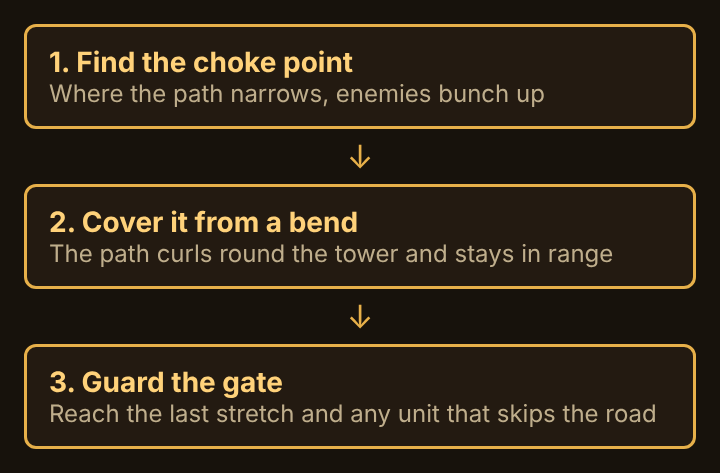
Find the narrow place, stand where the path stays longest in range, then guard the end.
Mistakes that waste a good position
- Placing by the look of the map. The spot nearest the entrance feels natural, but enemies pass it quickly. Place by how long the path stays in range.
- Putting every tower in one place. A cluster at the choke point is strong against ground units and empty against a unit that skips the road.
- Spending all the currency at once. Early waves are small. Keep some back until you have seen where the pressure falls.
- Ignoring the last stretch. If everything fires early, one enemy that survives walks the final run alone.
Frequently asked questions
Where is the strongest place for a tower?
Usually where the path narrows or bends, because enemies bunch up there and stay in range longest. The inside of a bend is often the strongest single position.
Should towers be near the start or near the base?
A mix works best. Towers along the route thin out the wave, and at least one near the base covers the final run and any unit that skips the route.
What is mazing in tower defense?
Mazing is building a long, winding path of towers so enemies must walk further to get past, which keeps them in range for longer.
Is it better to upgrade a tower or build a new one?
If a tower already sits at a choke point and fires most often, an upgrade there returns the most. If a stretch of path is covered by only one tower, a second tower there is the safer choice.
Do the same rules apply on a map with several paths?
Yes, but find where the paths meet first. A spot that every path reaches serves all of them at once.
What tower placement shows about tower defense
Tower defense is a game of position more than of speed. The enemies follow a known route, the waves are of set sizes and types, and the one decision left to you is where to stand. That is why the genre has kept its shape from Rampart in 1990, which the page calls the game that established the prototype with its phases of build, defend and repair, to the games played in a browser today. A reader who looks at a new map and asks where the path narrows, where it stays longest in range and what could skip it has already done most of the planning.