A battering ram is a heavy beam driven again and again into a gate or wall until the wood splits, the bar snaps or the stones work loose. If you want to know what is a battering ram and how was it stopped, the short answer is that defenders kept it away from the gate for as long as they could, then attacked the crew, the ram and its shelter from above. That contest between one heavy machine and one narrow entrance also sits at the center of Two Towers, a browser castle defense game where you pick a pair of towers, add two more with gold, and hold a city gate against knights, monks, kings and rams, stage after stage.
What is a battering ram and how was it stopped
The battering ram is one of the oldest siege weapons. At its simplest it was a log carried by a group of people who ran it into a door. Larger versions were whole tree trunks, often capped with an iron head, hung from a frame by ropes or chains so the crew could swing it instead of carrying it.
Its weakness was plain. A ram only worked when it touched the target. Every method of stopping one came from that fact: keep it from reaching the gate, make the gate harder to hit, or hurt the people and machine while they stood at the wall.
How a battering ram broke a gate
A gate is a set of timber leaves held shut by a bar across the back and by hinges set into stone. When a ram strikes, the force passes through the boards into the bar and the hinge posts. One blow rarely does much. Hundreds of blows loosen nails, crack the bar and grind the hinge sockets wider.
The suspended ram made this steady. The crew pulled the beam back on its ropes and let it swing forward, so the same point took the same blow at a regular pace. Against a wall, the ram did not need to break a whole stone. It only needed to shake the mortar loose until a few stones shifted and the face of the wall began to fall in.
Here is the situation a defender faced. The gate is barred and the enemy has reached it. Each swing is weaker than the gate, but the crew can keep swinging for hours. Time is on the side of the ram unless something interrupts it.
The covered shed that protected the battering ram crew
The crew had to stand right at the base of the wall, which is the most dangerous place in a siege. So attackers built a roofed shed on wheels, hung the ram inside it, and pushed the whole thing up to the gate. Roman writers called this kind of shelter a tortoise, because the crew worked under a hard shell.
The roof was thick timber, and builders often covered it with wet or fresh animal hides. The hides made it harder for burning material thrown from the walls to set the shed alight. With the crew under cover, the attackers could keep the ram swinging while arrows and stones bounced off the roof.
This changed the defender's problem. Shooting at the crew no longer worked well. The defenders had to destroy the shed, burn it, or deal with the ram itself.
How defenders stopped a battering ram from the walls
The most detailed early account comes from the historian Josephus, who described the Roman siege of Jotapata in The Wars of the Jews. He reports that the defenders lowered sacks filled with chaff on ropes so the ram struck the soft sacks instead of the wall. The Romans answered with long poles fitted with blades to cut the ropes. He also tells of a defender who dropped a huge stone that broke the head off the ram, and of scalding oil poured onto the attackers below.
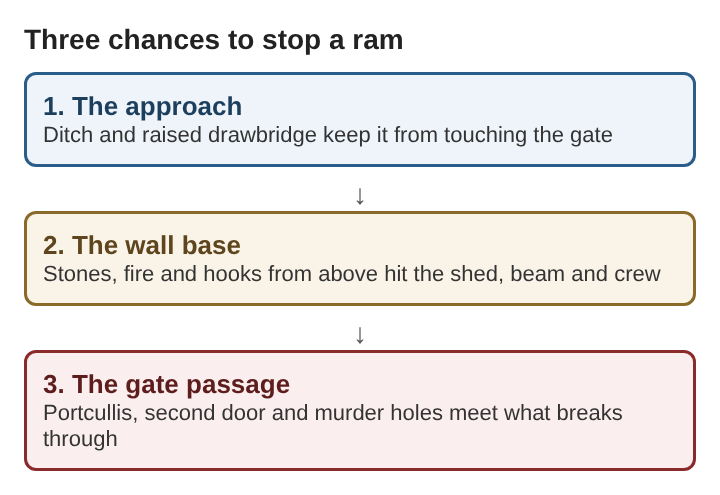
Those methods fall into a few groups:
- Soften the blow. Padded sacks, mattresses or bundles hung in front of the point of impact absorbed the force.
- Break or catch the ram. Heavy stones dropped on the beam could snap it. Defenders also used hooks, nooses or forked poles to grab the ram head and pull it up or sideways.
- Burn the shed. Fire, pitch and hot material thrown onto the roof could destroy the shelter if the hides failed.
- Strike the crew. Stones and hot liquids fell through gaps in the shelter or onto anyone who stepped outside it.
Later castles built these attacks into their stone. Machicolations were projecting galleries at the top of a wall with openings in the floor, so defenders could drop things straight down onto the base of the wall and gate. Inside a gate passage, murder holes in the ceiling did the same job for anyone who got through the first door.
Ditches, drawbridges and gatehouses that kept the battering ram away
The best way to beat a ram was never to let it touch the gate. A wide moat or dry ditch did this well. A wheeled shed cannot cross a ditch, so attackers had to fill a stretch of it with earth, rubble and bundles of brush first. That work was slow and done under fire.
A drawbridge over the ditch could be raised during a siege. Once it was up, the gate sat behind empty space, and the bridge itself became one more barrier.
The gatehouse turned the entrance into a sequence of obstacles. A typical design had a drawbridge, then a portcullis, then wooden doors, then a second portcullis, all inside a passage with openings overhead. A ram that broke the first door found another one behind it, while its crew stood in a narrow space with defenders above them. For more on how these layers worked together, see how medieval castles defended their gates.
Stopping a battering ram at the gate in Two Towers: tower placement and gold
Tower defense games turn this same question into decisions you make on a map. In this game you start with a pair of towers, can add two more with gold, and hold a single city gate while enemies come at it stage after stage. It runs in a web browser on a computer or a phone, and there is also an Android app.
The historical record gives you a useful way to think about placement. Real defenders had three chances against a ram: on the approach, at the ditch, and at the gate itself. In general tower defense strategy, the same three zones exist. Towers that reach the long approach get the most time to act. Towers close to the gate cover the last stretch, where any threat that gets through must pass.
Here is a worked example of the reasoning. Say foot soldiers and a ram come down the same path. Ask two questions before you place anything. First, which enemy does the most harm if it reaches the gate? Second, where on the path will every enemy have to pass, no matter what? A tower that covers that shared point works on every wave. A tower placed far out on one side may only touch part of the path.
Gold is a limited budget, and castle builders worked under a limit too. A castle could not put machicolations on every wall, so builders put them over gates. With only two extra towers to add, you face the same choice: spread coverage thin, or stack strength where the threat must arrive. A common habit in tower defense is to hold some gold until you see which part of your line is struggling, then add a tower there. For a longer look at this trade, read where to place towers in a tower defense game.
Frequently asked questions
How heavy was a battering ram?
There was no single weight. A hand ram was light enough for a few people to carry and run, while a large suspended ram was a full tree trunk with an iron head that needed a frame and a crew to swing it.
Did hot oil really stop a battering ram?
Ancient sources do report it: Josephus describes scalding oil poured on the Romans at Jotapata in The Wars of the Jews. It hurt the crew rather than the ram, so it worked alongside stones, fire and padded sacks.
Why did defenders lower padded sacks in front of the ram?
A soft sack absorbed the force of each blow, so far less of it reached the wall or gate. The attackers then had to spend time cutting the ropes or clearing the sacks before the ram did real damage again.
Where should towers go to stop a ram in a tower defense game?
Cover the stretch of path that every enemy must cross before the gate, so each tower works on every wave. If you have gold for extra towers, add them where the line is weakest once you see the threat arrive.
Why the battering ram shaped how gates were held
The ram forced a basic fact on castle builders. A wall is only as strong as its door, and the door is the one place an attacker can always find. Because the ram needed contact and time, every answer to it aimed to deny one or the other. Ditches and drawbridges denied contact. Padded sacks, hooks and dropped stones denied time. Gatehouses denied both, turning one door into several and filling the space between them with danger from above.
That is why the gate became the most heavily built part of many castles. Builders stopped treating it as a hole in the wall and started treating it as a fortress of its own. The lesson carries to any defense with a single entrance: know the path the threat must take, meet it as early as you can, and keep your strongest resources where it must finally arrive.