How did medieval castles defend their gates? With layers. A gate is the one part of a wall made to open, so an attacker aims at it first, and the builders of castles answered by turning the entrance into the most heavily armed building they owned. Two Towers is a browser game built on the same situation: you hold a city gate, stage after stage, against knights, monks, kings and rams. The history shows why that is a hard thing to hold, and why it takes more than one defense.
Why the gate was the weak point
A gatehouse is a building that contains the entrance to a castle, a walled town or a monastery, so that the entrance can be controlled or defended by the people inside. The source on gatehouses states the reason plainly: the gate was the easiest point for an enemy to attack. A wall of stone is thick and hard to break. A wooden door set in that wall is thinner, and it has to open for friends, so it can never be made as solid as the stone around it.
That is why gatehouses were often the most heavily defended section of a fortification. Builders did not try to make the door strong and leave it there. They put the strength around the door, so that an attacker who reached it had already been under fire for some time and still had more to get through.
How did medieval castles defend their gates in layers
A strongly fortified medieval gatehouse could include a drawbridge, one or more portcullises, machicolations, arrow loops and murder holes. Each of these does one job, and no one of them is the defense. The drawbridge keeps the approach narrow. The portcullis closes the passage. The machicolations and murder holes let defenders strike from above. The arrow loops let them shoot from cover.
In some castles the gatehouse was so strong that it took on the function of a keep, a last place to hold when the rest had fallen. Late in the Middle Ages, some arrow loops were converted into gun loops, so the same openings served a new weapon. The layers were not fixed; they changed as the weapons that attacked them changed.
The portcullis: a gate that drops at once
A portcullis is a heavy gate that closes vertically. It is a latticed grille of wood, metal or both, and it slides down grooves cut into each side of the gateway. Chains or ropes attached to a winch inside raised and lowered it. The advantage over an ordinary door was speed: a single guard could close it immediately when trouble came, with no time spent swinging doors shut and dropping a bar.
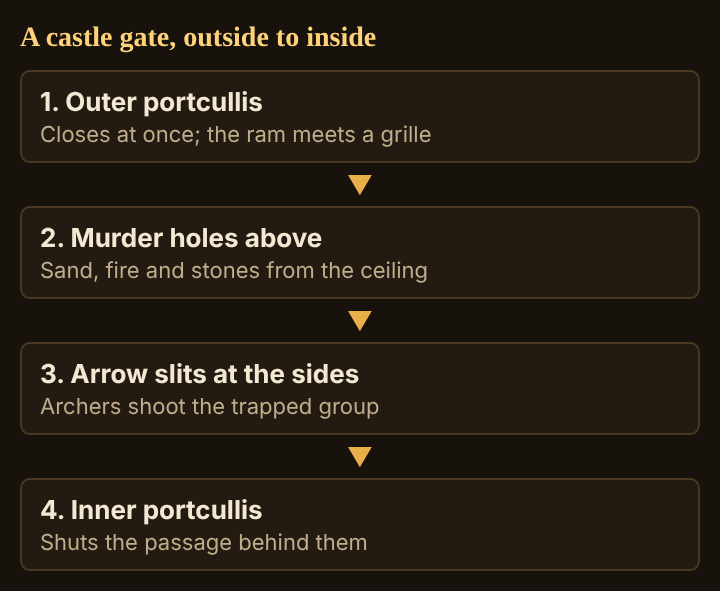
Two portcullises were often used at the main entrance. The inner one was closed first, then the outer one, and anyone between them was trapped in a short passage with stone on both sides and a ceiling above. That passage is the center of the whole design, and the next layer is what made it dangerous.
Murder holes and machicolations: striking from above
A murder hole is a hole in the ceiling of a gateway or passage. Defenders on the floor above could shoot through it, or throw or pour things down: rocks, arrows, scalding water, hot sand, quicklime. Hot oil is on the same list, but the sources say it was rarely used, because oil cost too much. The popular picture of boiling oil poured over every attacker is mostly a legend.
Machicolations do a similar job on the outside. They are holes in the curtain walls, where the parapet is built out over the face of the wall, so defenders can drop things on attackers at the foot of the wall. The difference is place: murder holes sit inside, at the entrance, and machicolations sit on the outer face. One caution from the source on murder holes: some may also have been used for something plainer, such as passing messages between floors. Not every hole in a ceiling was a weapon.
What a battering ram did to a gate
The attacker's answer to a gate was the battering ram, a siege engine made to break open masonry walls or splinter wooden gates. In its simplest form it is a heavy log carried by several people and driven against the target. Later rams were slung from a wheeled frame by ropes or chains, so the log could be heavier and swing with more force, and the tip was often capped in metal.
The operators needed cover, and many rams had a curved or slanted wooden roof and side screens covered in fresh wet hides. The roof kept off arrows and javelins, and the wet hides made fire harder to set. So the people on the wall had two problems at once: the ram itself, and a shelter that protected the crew pushing it.
Defenders tried several answers. One was to drop an obstacle, such as a large sack of sawdust, in front of the ram just before its head struck. Another was grappling hooks, to hold the log still. They also tried to set the ram ablaze, to douse it in fire-heated sand, or to drop boulders on it from the battlements. The source adds that rams had an important effect on how defensive walls developed: walls were built more cleverly to cancel what siege engines could do.
A worked example: one attack on one gate
Follow a single attack on a gatehouse with two portcullises, a murder hole in the passage ceiling and arrow slits in the passage walls. Each piece comes from the sources named earlier; the order is a simple case, not a record of a real siege.
- A ram under a hide-covered roof is pushed up to the outer gate. Defenders on the wall try the obstacle first, a sack dropped in front of the head. If the log swings anyway, they try the grappling hooks.
- The outer door starts to splinter. The guard at the winch has already lowered the outer portcullis, so the ram now faces a latticed grille in its grooves instead of a door.
- Some attackers get past the outer grille. The guard drops the inner portcullis behind them. They are in the passage, and both ends are shut.
- From the floor above, defenders pour fire-heated sand or drop burning wood through the murder hole. Archers and crossbowmen at the arrow slits shoot the trapped group.
- Outside, the ram is still under fire from the battlements, with boulders and fire-heated sand aimed at its roof.
Notice how few of these steps depend on strength. They depend on time and position: the ram is slowed before it matters, and the people who get through are held where every defender has a clear shot. A gate defended this way does not need to stop the first rush. It needs to make the second step cost more than the first.
What carries over to a game about a gate
In Two Towers you pick a pair of towers, add two more with gold, and hold the gate against knights, monks, kings and rams. What matters is the shape of the problem, and it is the same one a gatehouse builder had: a limited set of defenses, a fixed gate, and attackers that come back stronger.
The history gives a useful way to think about any defense of a gate. Ask what each piece does, not how strong it is. A defense that slows an attacker buys time for the others. A defense that works only at the gate itself fails if the enemy never reaches the gate. And as the sources show, each new attack, the ram, the fire, the gun, changed what a good gate looked like.
Frequently asked questions
Why was the gate the weakest part of a castle?
It had to open, so it could not be a solid wall. The source on gatehouses says the gate was the easiest point for an enemy to attack, which is why builders defended it more heavily than any other section.
What is a portcullis?
It is a heavy, vertically closing gate, a latticed grille of wood, metal or both that slides down grooves in the sides of the gateway. A winch and chains or ropes raised and lowered it, and one guard could close it at once.
Did defenders really pour boiling oil on attackers?
Rarely. The sources say hot oil was expensive, so defenders more often used rocks, scalding water, hot sand or burning wood.
What is the difference between a murder hole and a machicolation?
A murder hole is a hole in the ceiling of a gateway or passage, inside the entrance. A machicolation is a hole where the parapet projects over the outer face of a wall.
How did defenders stop a battering ram?
They dropped obstacles such as a sack of sawdust in front of it, held the log with grappling hooks, set it on fire, doused it in fire-heated sand or dropped boulders from the battlements.
What a fortified gate shows about defense
The lesson of a medieval gatehouse is that a single strong point is never enough. The builders did not ask how to make a door that could not be broken; they asked how to make breaking it cost more than it was worth. Each layer was cheap beside the whole, and each one covered a gap in the last. The drawbridge slowed the approach, the portcullis shut the passage, the holes above and the slits at the sides turned the passage into a trap.
That pattern of slowing, shutting and striking from cover is why a gate was held for so long against rams and fire, and why later gatehouses added gun loops and kept the rest. A defense is the sum of what each part covers, and the weak point of one layer is the strong point of the next.