When the same trouble keeps showing up in different clothes, fixing each problem on its own rarely holds. Learning how to link related problems to find a pattern means writing each problem down, drawing a connection between the ones that share something, and reading what the connections say. A single problem tells you very little. Five problems with lines between them often point at one cause you can actually change.
What it means to link related problems
Linking is a written claim: "these two problems are connected, and here is why." It is more than a hunch. You put the link on paper or on a map so you can go back to it, check it, and drop it if it turns out to be wrong.
One way to keep these links is a journal that draws itself as a graph. Problem Graph is a journal of problems and the solutions tried on them, where each problem is a node, each fix hangs off it, and links between problems appear as lines. The graph can stay private, go to people you choose, or go public. A list keeps problems in rows. A graph shows which ones touch each other, which is where a pattern lives. If you have ever wondered why the same problems keep coming back, unlinked problems are often the reason: each one gets its own fix, and the shared cause stays untouched.
Signs that separate problems share a hidden pattern
You do not need a method to spot the first hints. Watch for these:
- The same person, place, tool or time of week shows up in more than one problem.
- A fix that worked on one problem made another one worse.
- You keep writing a similar sentence in different notes, such as "I said yes too fast."
- Two problems start within days of each other.
- A problem in one part of life, such as poor sleep, rises and falls with a problem in another part, such as a heavy work week.
Any one of these is weak on its own. Two or three together are worth a link.
How to write each problem down so it can be linked
Problems written vaguely cannot be linked well. "Work is stressful" connects to everything, so it connects to nothing. Write each problem in one line that names something you could observe.
Compare these:
- Vague: "Money is tight."
- Specific: "Clients settle invoices 30 or more days late."
- Vague: "Always behind."
- Specific: "Two of the last three projects ran past the agreed deadline."
Under each line, keep a short record of what you tried and what happened. That record is what makes links useful later, because the fixes often reveal the connection more clearly than the problems do. A guide on how to track what you tried to solve a problem covers that record in more depth.
What connects two problems: causes, triggers and attempted fixes
A link needs a reason. Most reasons fall into three kinds.
A shared cause
Two problems grow from the same root. Asking "why?" a few times in a row, the idea behind the five whys technique, often lands two separate problems on the same answer. Late invoices and missed deadlines can both trace back to "no written scope or payment terms at the start of a project."
A shared trigger
The problems have different roots but start from the same event. A Monday client call that adds new work might set off both a missed deadline and a bad night of sleep. The trigger is the link, even if the deeper causes differ.
A shared fix
The same solution was tried on both problems. If it worked on one and failed on the other, that difference tells you the problems are less alike than they looked. If it failed on both, the fix may be aimed at a symptom. Sorting possible causes into groups, as an Ishikawa diagram does with people, process, tools and so on, helps you name which kind of link you are drawing. For a fuller walk through finding roots, see how to do a root cause analysis on a personal problem.
A worked example of how to link related problems to find a pattern
Here is a worked example. A self-employed designer has three problems that feel unrelated.
- Write each problem in one line. "Late invoices." "Projects run past the deadline." "Short sleep on Sunday nights."
- Put each in a lane. Every problem goes in one of four lanes: personal, work, expert or scientific. The first two problems go in work. The sleep problem goes in personal.
- Attach the solutions tried. Each solution is added as an idea, marked when it is being tried, and given an outcome: worked, partly or failed. The journal's own home page uses a "Late invoices" example with three solutions on it: automatic reminders, marked as settling invoices 9 days sooner, a deposit upfront, and late fees.
- Keep the failures. A solution that failed stays on the map as a failed solution. If "late fees" failed on the invoice problem, and longer hours only partly helped the deadline problem, both outcomes stay on the record, and they matter later.
- Link the problems. Problems that belong together can be linked, even across lanes. The designer links "Late invoices" to "Projects run past the deadline" because both trace back to vague terms at kickoff. Then "Short sleep on Sunday nights" goes onto the work problems, because Sunday is when overdue admin gets done.
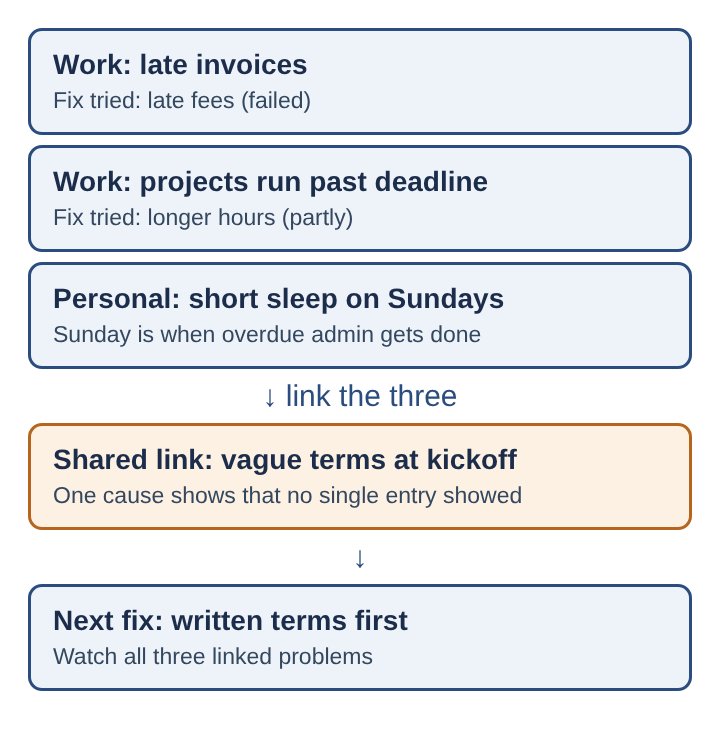
Now the map shows something no list would: one personal problem hangs off two work problems, and all three point at the same missing step at the start of each project.
Sharing is optional. The default is private, seen only by the owner. You can also share with a private network of people who have an invite code, or make a problem public. Only a main node can be shared, and it carries its solutions, their outcomes and the requirements they need.
Reading the pattern once related problems are linked
Once links are drawn, look for three things.
- Hubs. A problem with many links is either a root cause or a place where many causes meet. Either way, it is where effort pays off most.
- Repeated failures. The same failed fix sitting on several linked problems usually means that fix treats a symptom. Kept failures are some of the most useful entries on the map, a point made in how to learn from failed solutions.
- Cross-lane links. A link between personal and work problems is easy to miss in separate notebooks and often explains why a personal fix, such as an earlier bedtime, does not stick.
Be careful. People tend to see connections in noise, a habit called apophenia, and once a pattern feels right, they notice only what supports it, which is confirmation bias. Two checks help. First, write the reason for every link in a few words. If you cannot, delete the link. Second, look for a problem that should fit the pattern but does not. If the designer has one client who always settles on time despite vague terms, the pattern is weaker than it looked, and that client is worth a closer look.
Using solutions other people tried to confirm a pattern
Your own map is a small sample. Other people's records can show whether your pattern holds elsewhere. The same journal shows similar problems other people shared and which of their solutions worked. If several people with late invoices and deadline trouble recorded that clearer terms at the start helped both, that supports the link you drew. If their records show something else, that is worth knowing too.
A solution from someone else can be borrowed into your own graph with a link back to where it came from, so you always know its origin. An AI also proposes new solutions grounded in what worked for others on similar problems. The public network can be browsed without an account, and it works on a phone.
A borrowed solution is a record of what happened for someone else, not a promise. Treat it as one more idea to try, mark it when you start, and give it your own outcome.
Frequently asked questions
How many problems are needed before a pattern shows up?
Two linked problems can hint at a pattern, but three or more give a better check. The quality of each written problem matters more than the count.
What if two problems look related but need different fixes?
Keep the link and write down that the fixes differ. That usually means the problems share a trigger rather than a root cause, which is still useful to know.
How often should linked problems be revisited?
Go back after each fix gets an outcome, and at least once a month for problems still open. Links that no longer make sense should be removed.
How does linking related problems help find a pattern faster?
Links put the shared cause in one view instead of across scattered notes. Repeated failed fixes and hub problems stand out at a glance.
How linking related problems turns a pattern into a lasting fix
A pattern only helps if it changes what you do. Once a hub problem is clear, aim one fix at it and watch the linked problems. In the designer's case, a single change, written scope and payment terms before work begins, is a fix aimed at the root. If late invoices drop, deadlines hold, and Sunday nights get quieter, the links were real. If only one problem improves, the links need another look.
Either result teaches you something. Write the outcome next to the fix, keep any failure on the record, and redraw the links that the evidence no longer supports. Over months, the map stops being a list of complaints and becomes a record of which causes you found, which fixes held, and which problems were never as separate as they first seemed.