A domestic shorthair cat is a cat of mixed ancestry with a short coat. It is not a breed with a written description. It is the plain name that shelters, clinics and registries give to an ordinary short-haired cat whose parents were never chosen to produce a look. The question of what is a domestic shorthair cat comes up the first time someone tries to name the breed of a cat on the street and finds that no breed fits.
The game Cat Go, a walking game played with real cats, gives the label a place of its own in a list of cat breeds, and the answer starts with where that label comes from.
What is a domestic shorthair cat, in registry terms
The Wikipedia page on domestic short-haired cats starts from the word moggy: any cat that has not been intentionally bred. Moggies lack a consistent appearance, unlike purebred cats that are bred to match a written breed description. Where cats must be recorded, in a veterinary practice or a shelter, a moggy is entered as domestic short-haired (DSH) or domestic long-haired (DLH), depending on the length of its coat.
So the label answers two small questions and nothing more. Is this cat of a known breed? No. Is its coat short or long? Short. The page calls this kind of label a pseudo-breed, a category used for registry and for shelter and rescue records.
Why most pet cats carry the label
Purebred cats are the exception. The same page reports that fewer than 2% of cats in the United States are purebred and raised by breeders, and it gives the American Humane Association figure of 95% for domestic short-haired cats in that country. Those are figures for one country, and they come from the page's own sources, so treat them as the scale of the thing and not as a count for your street.
The result is that the cat you meet on a walk, on a wall or in a window is far more likely to be a domestic shorthair than anything on a breed poster.
Coat length is the only thing the label sorts
Domestic shorthair and domestic longhair are the same kind of cat with different fur. A domestic longhair is a cat of mixed ancestry with a semi-long to long coat. It should not be confused with the British Longhair or American Longhair, which are formally defined breeds that only share a word with the label.
The same warning works the other way. A short coat on a mixed cat does not make it a British Shorthair or an American Shorthair, which are breeds with registered parents. If the parents are unknown, and the cat has a short coat, the honest entry is domestic shorthair.
One coat pattern turns up again and again
Domestic shorthairs come in a wide range of colours, and the Wikipedia page says they typically revert to type after a few generations. That means the coat settles into a natural tabby pattern, in any colour or mix of colours.
The tabby cat page describes the pattern: an M-shaped marking on the forehead and stripes by the eyes, cheeks, along the back and around the legs and tail. It also settles a common mix-up. Tabby is not a breed, it is a coat pattern, and it is common among non-pedigree cats around the world. Four patterns are known: mackerel, classic (also called blotched), ticked and spotted. A fifth is a patched tabby, where tabby markings sit alongside calico or tortoiseshell patches.
Bodies differ from one country to the next
A domestic shorthair has no fixed build. The Wikipedia page notes that domestic short-haired cats in different countries tend to look different in body shape and size, because they developed from different gene pools. A slim cat from one region and a stocky cat from another can both be correctly entered as domestic shorthairs.
This is also why registries are wary of describing the label by looks. One rule of the Fédération Internationale Féline for its household pet entries, as the page quotes it, permits any eye colour, all coat colours and patterns, any coat length or texture and any length of tail. In other words, almost any cat.
A worked example: the cat on the garden wall
Take an invented cat, seen from a distance on a garden wall. Work through four plain checks.
- Coat length. Short, flat to the body. That points to a shorthair and not a longhair.
- Pattern. Grey-brown stripes along the back and an M on the forehead. That is a mackerel tabby pattern, a coat pattern and not a breed.
- Face and body. Ordinary, with no flat face, no folded ears, no hairless skin, no very long legs. Nothing points to a breed with a distinct shape.
- Parents. Unknown. Without a pedigree, no breed name can be certain.
The conclusion is domestic shorthair, mackerel tabby. That is a complete and correct description. A cat that does show a distinct shape, such as folded ears or a hairless body, is worth a second look against a list of breeds, but a pedigree is the only thing that proves a breed.
Where the label sits in a list of 34 breeds
Cat Go keeps a Catdex of 34 breeds in four groups, and the two labels for cats of mixed ancestry lead the first.
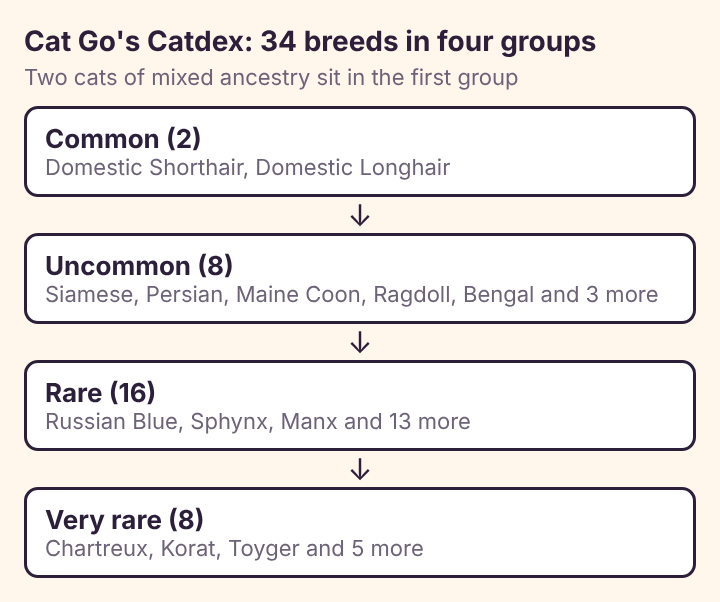
Common holds Domestic Shorthair and Domestic Longhair. Uncommon holds eight breeds, among them Siamese, Persian, Maine Coon, Ragdoll and Bengal. Rare holds sixteen, from Russian Blue and Sphynx to Manx, and Very rare holds eight, such as Chartreux, Korat and Toyger.
When a cat has been spotted, the game asks, "Which breed is it?" and says that most cats you meet are mixed breed and that rarer breeds are warier. The player picks the breed from the list, and when nothing fits, the game says, "Mixed breed is always a safe pick." Every catch is then kept with its breed and the place it was met.
Frequently asked questions
Is a domestic shorthair a breed?
No. It is a label for a cat of mixed ancestry with a short coat, used by shelters, clinics and registries, which is why the Wikipedia page calls it a pseudo-breed.
What is the difference between a domestic shorthair and a British Shorthair?
A British Shorthair is a formally defined breed with registered parents. A domestic shorthair has no breed description and usually unknown parents.
Are all tabby cats domestic shorthairs?
No. Tabby is a coat pattern that also appears in some breeds, and it does not tell you the ancestry. A tabby can be a domestic shorthair, a domestic longhair or a member of a breed.
Can a domestic shorthair have a pedigree?
Some do. The Wikipedia page notes that some domestic short-haired cats have a recorded genealogy and are entered in household pet divisions of cat shows.
Why do domestic shorthairs look so different from each other?
Nothing in the label fixes a look, and cats in different countries developed from different gene pools, so size, build and colour vary widely.
Why the domestic shorthair cat is the cat you meet most
The domestic shorthair is the default cat of most places, the one that fills shelters, windowsills and garden walls. It earns its place in a list of breeds because it is what most people find when they look for a cat. It has no written description, no registry rules to meet and no required look, and its short coat, its tabby markings and its mix of builds are what ordinary cats look like.